"No One Can Stand Up to a Beating": Hormuz Oil Shipments Halve in a Week
- Input
- 2026-11-22 06:22:21
- Updated
- 2026-11-22 06:22:21
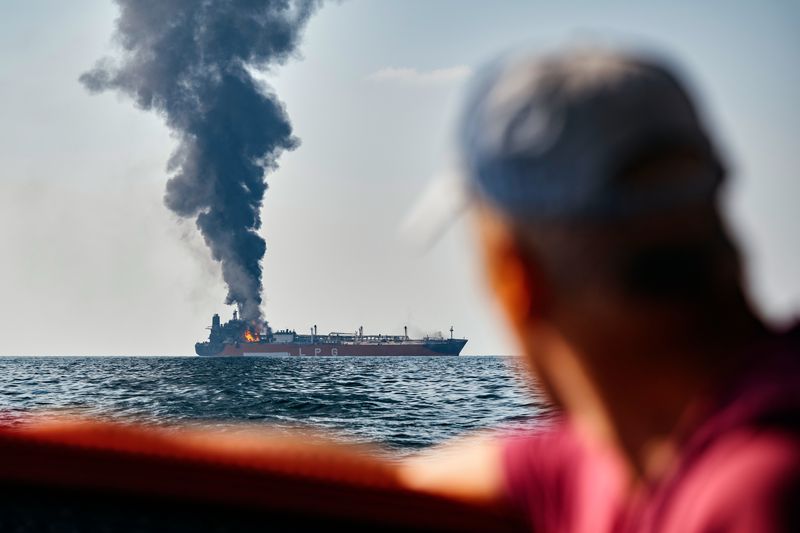
The number of vessels passing through the Strait of Hormuz has finally begun to decline amid Iran's continued attacks on ships. Crude oil shipments are estimated to have halved in a week.
The Financial Times (FT) reported this on the 21st (local time), citing an announcement by the United Kingdom Maritime Trade Operations (UKMTO), a maritime security organization under the British Navy. While the oversupplied oil market may prevent a major impact on prices for now, concerns are growing that the situation could become a serious problem in a few months.
Vessel traffic through the strait turns downward
According to the UKMTO, 263 vessels passed through the vital waterway in the week through the 18th, down 15% from the previous week and 20% from two weeks earlier. The pattern shifted as Iran attacked ships almost daily.
The decline in tankers passing through the strait was particularly pronounced. A total of 37 tankers passed through over the past week, a drop of nearly 29% from 52 two weeks earlier.
According to maritime data provider Kpler, the volume of crude oil passing through the Strait of Hormuz in the second week of this month shrank to about half the level recorded in the first week.
The actual volume may be higher when accounting for “dark transits,” in which ships switch off their tracking devices while passing through the strait to avoid Iranian attacks, but the overall decline appears clear. This means Iran's renewed attacks on merchant ships are having a tangible impact on Gulf countries' crude oil exports.
"Vulnerability of Middle Eastern crude exports exposed"
Before the Iran war broke out on February 28, about 135 vessels a day passed through the Strait of Hormuz. This narrow strait handled about 20% of the world's oil and natural gas supply.
When crude oil shipments increased last month, some analysts interpreted this as a sign that Gulf countries had finally found a way to transport oil safely while avoiding threats from Iran. But the trend reversed in just a month.
UBS market strategist Giovanni Staunovo noted in an analysis note on the 20th that "the recovery in Middle Eastern crude exports is proving increasingly fragile."
Iran began stepping up its attacks on ships again last month after a period of relative calm. At the same time as it entered negotiations with the United States to end the war, it intensified attacks on ships in the Strait of Hormuz to put pressure on the global oil market. At least seven tankers were attacked over the past week. Since the war broke out, at least three ships have also sunk.
List of “non-compliant vessels” grows more than fivefold
Iran continues to expand its list of so-called “non-compliant vessels,” which are targeted for attack. Ships are added to the list if they fail to follow the procedures Iran has set for passing through the Strait of Hormuz.
When Iran began compiling the list last August, it contained 46 vessels. It now has 240—more than five times as many.
As Iran's attacks on tankers continue, Gulf countries are expected eventually to face disruptions to crude oil exports due to a shortage of vessels.
Jorge León, head of geopolitical analysis at Rystad Energy, warned that "Iran is attacking an average of 1 to 1.5 ships a day, and the number reported is far lower than the actual figure." He added, "If Iran continues attacking at this pace, a real problem will emerge when it comes to deploying vessels." He went on to say, "It may not be a problem right now, but in two to three months, this will be a really big issue."
Insurance premiums surge more than 1,000-fold
The sharp rise in ship insurance costs due to Iran's intensified offensive is another problem. More vessels could be forced to stop operating because they cannot afford the insurance.
John Walker, a security consultant at EOS Risk Group, which advises vessels transiting the Strait of Hormuz, said insurance premiums had remained relatively stable for a while, but that things are different now.
Hung Cao, the U.S. secretary of the Navy, said on the 17th that insurance for tankers transiting the Strait of Hormuz had cost $54,000 (about 72 million won) a year ago, but had now surged to $64 million (about 86.1 billion won).
Walker said that Iran's Islamic Revolutionary Guard Corps (IRGC) has increasingly been striking ships twice, explaining that this "shows the shipping industry that Iran still has ample ability to identify vessels at sea and strike precise targets." He also said that attacks on vessels not listed as “non-compliant” reflect "a deliberate intent to maximize uncertainty."
[email protected] Song Kyung-jae Reporter