[Exclusive] Former Acting U.S. Ambassador to South Korea Mark Knapper Warns Against Turning the Alliance Into a Transaction... Coupang and OPCON Issues Must Be Resolved Through Working-Level Channels
- Input
- 2026-11-24 07:30:00
- Updated
- 2026-11-24 07:30:02
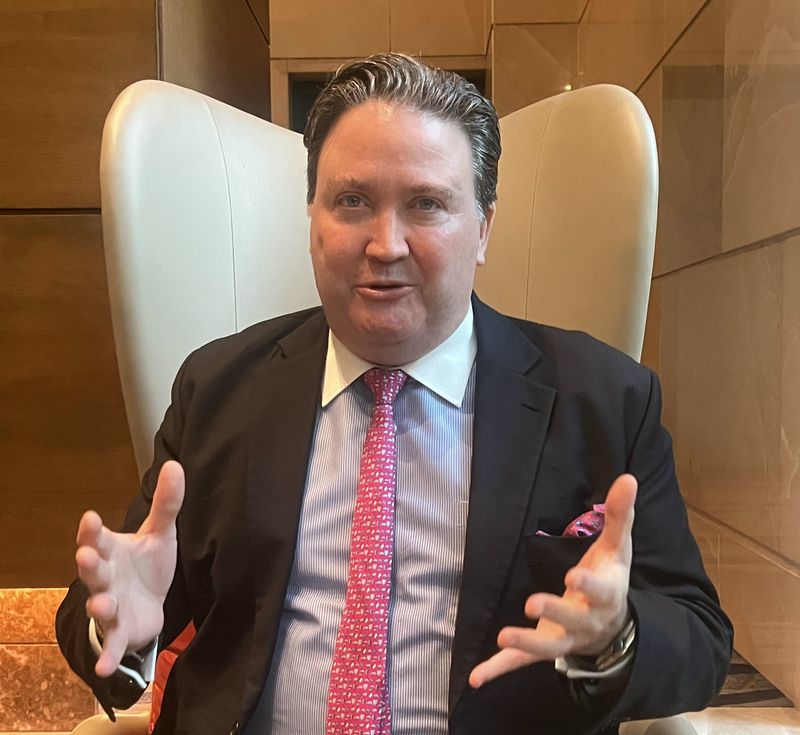
Knapper also said that while the possibility of dialogue between the United States and North Korea remains open, South Korea should be wary of discussions on North Korea’s nuclear issue that exclude it, as well as summit diplomacy pursued without adequate preparation.
He also advised that, following the U.S. midterm elections held on the 3rd of this month, South Korea should broaden its points of contact beyond the White House to include Congress and local political leaders. Although the Democrats control both chambers, foreign policy is still led by the White House, he explained, making it important to strengthen ties with governors and lawmakers in areas where Korean companies have factories. The following is the full transcript of the interview with Knapper.
“Even after the Democrats’ landslide, foreign policy is led by the White House ... When the U.S.-South Korea alliance hits turbulence, just buckle up and keep flying.”
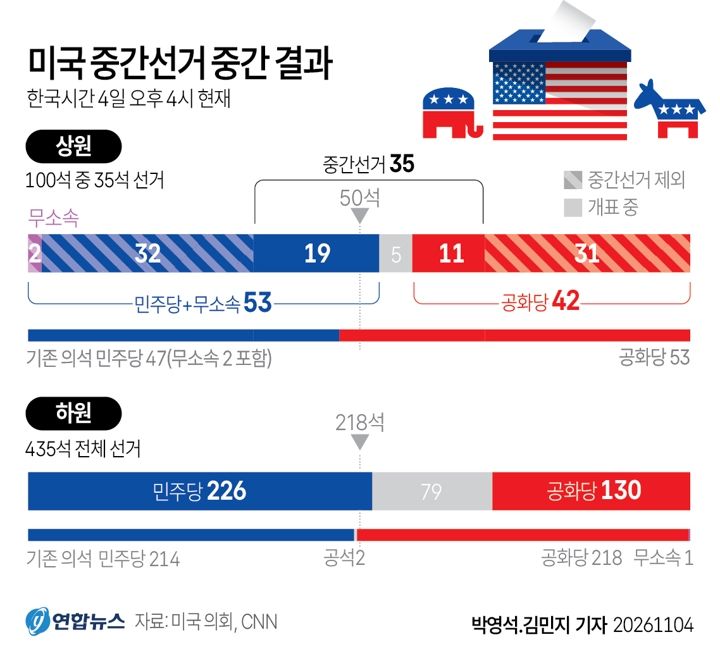
▲ On the 3rd, the American people sent a clear message. The Democrats now control both chambers, and even Vice President JD Vance cited the Iran war as one of the reasons for the Republican defeat. This means voters felt uneasy about a foreign policy that has demanded a great deal from them without sufficient explanation.
Foreign policy is still led by the White House, so we should not expect a sudden change in direction. What will change is accountability. Congress now has subpoena and budgetary powers, and its oversight of foreign policy will grow. After the U.S. Supreme Court struck down tariffs imposed under the International Emergency Economic Powers Act (IEEPA) earlier this year, tariffs now require a legal basis. As a result, Congress has more say over trade issues than at any point since the current administration took office. Hearings will follow on the Iran war, tariffs, and the treatment of allies.
We will also see a lame-duck effect. It was already evident just two weeks after the election. President Trump visited Manila and Shenzhen, held the first-ever trilateral summit with Chinese President Xi Jinping and Russian President Vladimir Putin, and publicly reached out to North Korean leader Kim Jong Un. A president facing a hostile Congress looks for achievements abroad—summits, agreements, and various commemorative events. South Korea should prepare for both the opportunities and the unexpected developments that may result.
My advice to South Korea is to keep broadening its relationships beyond one building on Pennsylvania Avenue in Washington, D.C.—the White House. Support for the U.S.-South Korea alliance in Congress is bipartisan and very strong. Korean companies operating across the United States bring prosperity to local communities and are warmly welcomed. Governors and lawmakers in areas with Korean factories are the alliance’s staunchest supporters. South Korea is right to invest in its relationships with them.
However, a change in the party holding the congressional majority does not mean that all sources of friction have disappeared. Concern that U.S. companies should receive fair treatment abroad is bipartisan. The way that concern is expressed, and its tone, may change.
—You were serving as acting U.S. ambassador to South Korea when the “Korea passing” controversy arose. As then, concern about U.S.-South Korea relations has recently grown to the point that people are describing them as facing “turbulence.” How do you assess the relationship now?
▲ I remember “Korea passing” vividly. When I served as acting U.S. ambassador to South Korea in 2017–2018, there were concerns that Washington and Pyongyang would speak directly, bypassing Seoul. It was a real concern for many South Koreans, and I took it seriously, too. But South Korea was actually at the center of the discussions, and its diplomacy helped open the door to the Singapore summit. Much of the problem at the time was perception.
The problem now is different and, in some ways, more serious. The issue is not that South Korea is being excluded. It is that the alliance is increasingly being managed not as a partnership but as a series of transactions—as if it were a ledger. Ambassador Michelle Steel’s description of “turbulence” was candid, and Foreign Minister Cho Hyun’s response was wise. When you hit turbulence, buckle up tightly and keep flying.
The foundations of the U.S.-South Korea alliance are strong. South Korea increased its 2026 defense budget by 7.5% and expanded its support for U.S. Forces Korea. Korean companies have pledged massive investments in the United States. The leaders of both countries also agreed on cooperation on nuclear-powered submarines and shipbuilding. No U.S. ally has such a combination of capital, manufacturing capacity, and military strength.
The problem is with the working-level channels that support the alliance. Washington left the U.S. ambassador to South Korea post vacant for about 18 months. When an alliance is managed through social media posts and tariff letters instead of steady, quiet channels, even minor problems turn into public disputes. This is a problem that can certainly be fixed. Ambassador Steel’s arrival in Seoul came at a very important time. The two sides now need to rebuild a system of routine working-level consultations so they can resolve disagreements before they become media headlines.
—There are concerns that the Coupang personal data breach could lead to a trade dispute between South Korea and the United States. What would be a wise way to resolve the issue?
▲ I fully understand why many South Koreans are angry about the data breach. It should never have happened. South Korea has every right to enforce its laws and protect consumers. Those laws, however, must be applied fairly and consistently to all companies, whether Korean or foreign.
As a former diplomat, I would not want this issue to damage trust between the two countries or the alliance itself. South Korea and the United States have so much to do together. This includes deterrence on the Korean Peninsula, as well as shipbuilding, energy, artificial intelligence (AI), semiconductor supply chains, and reciprocal investment by companies in both countries. We cannot afford to let this issue hold us back.
South Korea should not assume that the new Democratic majority in the U.S. Congress will simply let this issue pass. The Democrats care just as much about fair treatment for U.S. companies and will be watching the matter closely.
The wisest solution has three parts. First, procedure. Regulators, including the Korea Fair Trade Commission, must treat all companies fairly and be seen to do so. Law enforcement must be nondiscriminatory, proportionate, and transparent, and disputes should be resolved through South Korea’s legal process, not through the media. As in any market, investors around the world will be watching how this matter is handled.
Second, mutual trust. Both governments need to recognize that regulatory or trade disputes should not escalate into issues that really matter. Third, lowering the temperature. Put down the megaphone and move to quiet working-level channels. The highest levels of both governments should also send a clear signal that they intend to resolve the issue.
South Koreans have experienced this from the other side. Last year, when South Korean workers were detained at the Hyundai Motor Company-LG battery plant in Georgia, it was natural for South Koreans to be angry about how their workers were treated in the United States. Both sides understand that feeling. That shared experience should make it easier, not harder, to find a solution both sides can accept.
“A U.S.-North Korea summit is possible ... A bad deal is a bigger problem than no deal.”
▲ The U.S.-South Korea alliance is 73 years old and one of the most successful alliances in modern history. It matured a long time ago. What we are seeing now is friction as a mature alliance adapts to a new era and to a more transaction-oriented Washington. This friction will not resolve itself. It needs to be actively managed.
On the visa issue, I understand that many South Koreans and Americans are concerned about the past actions of some of these lawmakers. But this is a matter of legal procedure rather than a political signal. U.S. law is clear. Applicants with certain criminal histories are ineligible for a visa and must obtain a waiver. There is an established process for this, and it works properly.
When I served as acting U.S. ambassador to South Korea and later as deputy assistant secretary of state for Korea and Japan, I handled such cases through the proper procedures without condoning past actions. However, because both the State Department and the Department of Homeland Security review each case individually, the process usually takes several weeks to several months. It is important to apply early and follow the established procedures. Washington, too, should act promptly once the process begins.
Elected leaders from allied countries should be able to visit U.S. Indo-Pacific Command and meet members of Congress. Secretary of State Rubio said the issue would be resolved through official channels. That is how it should be.
Both sides have a point on the issue of wartime operational control. Since 2014, the two countries have agreed to pursue the transfer of OPCON based on conditions, and those conditions should reflect actual threats. North Korea’s capabilities and geopolitical position have changed. But any adjustment to the conditions should be made within alliance mechanisms such as the Security Consultative Meeting (SCM), rather than being raised publicly first. South Korea’s concern that the goalposts are being moved is understandable.
South Korea taking the lead in inter-Korean relations is not anti-American. South Korea’s initiative made U.S.-North Korea diplomacy possible in 2018. The key is coordination, not who speaks first. Washington should welcome a confident South Korea that leads its own defense and diplomacy. That is what burden-sharing means.
The solution is tedious but essential. The two sides should use existing institutions and agree on a joint roadmap for the transfer of OPCON with clear criteria. They should coordinate disagreements privately before they become public.
—Expectations for U.S.-North Korea dialogue rose around the APEC meetings, but it ultimately did not materialize. Do you think the possibility of a meeting between President Donald Trump and North Korean leader Kim Jong Un remains open? If dialogue resumes, what should we be wary of?
▲ President Trump clearly wants a meeting. He said so again as he set out on his trip to Asia. But he left Shenzhen on the 19th without meeting Kim. Kim did not simply refuse. While leaders from around the world were gathered for APEC, North Korean state media released photos of him on a ski trip with his family.
Kim’s position is stronger than it was in 2018–2019. He has established a cooperative relationship with Russia, his weapons have become more advanced, and he has money from cybercrime. The FBI recently said it believes North Korean hackers were behind the Binance hack involving more than $6 billion.
A meeting could take place during President Trump’s term. The president wants one, and the door to dialogue is open. But I am skeptical that there will be a breakthrough on denuclearization.
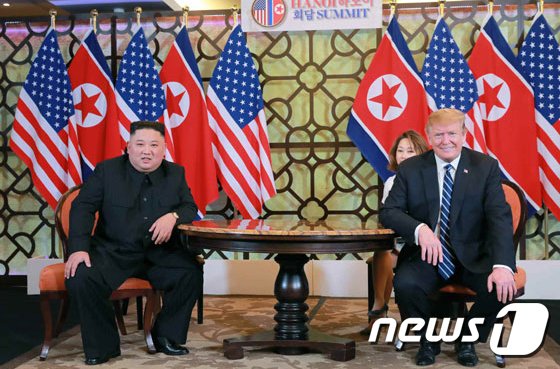
I was working at the State Department during the Hanoi summit. The lesson I learned then is that when summit diplomacy gets ahead of preparation, the photographs remain but the policy does not. The greater risk is not failing to reach an agreement but reaching a bad one. A freeze agreement could quietly recognize North Korea as a de facto nuclear power while South Korea and Japan are excluded from the negotiating table.
The Shenzhen summit was a warning. The leaders of the United States, China, and Russia issued a joint statement on reducing nuclear risks, but made no mention at all of the Korean Peninsula. Seoul and Tokyo took note.
My advice to the South Korean government is to support dialogue but insist on full participation at every stage. There should be no decisions about South Korea without South Korea. North Korea’s cryptocurrency theft should also be treated as a national security issue, not merely a financial crime. South Korean exchanges and fintech companies are on the front line, and that money funds missile development.
“As U.S. attention shifts and China’s influence grows, Southeast Asia is stepping up its hedging ... South Korea, the United States, and Japan need to coordinate.”
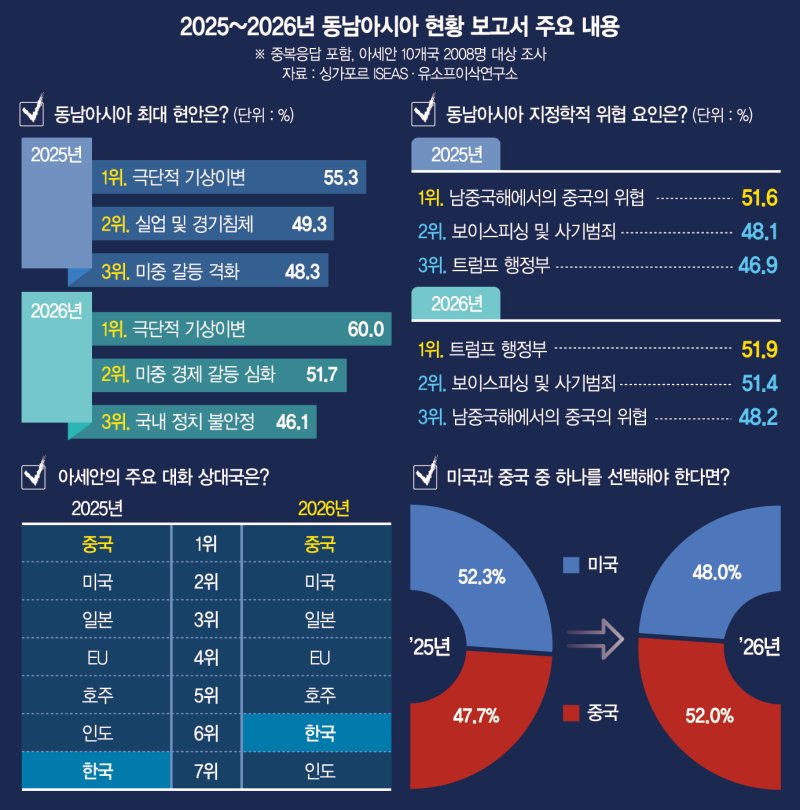
▲ Southeast Asia’s importance to the United States has not changed. What has changed is Washington’s attention. Attention is a limited resource, and right now it is focused on Ukraine and Iran. The Iran war is also driving up energy prices across Southeast Asia. The region is paying the price for a conflict it did not choose.
Southeast Asia’s strategic importance is immense. It has a population of nearly 700 million and some of the world’s fastest-growing economies. The region also has sea lanes through which a substantial share of global trade passes, including energy supplies for South Korea and Japan. It is also a hub for supply chain diversification. According to Fortune’s latest rankings, Vietnam alone accounted for about a quarter of the growth among Southeast Asia’s largest companies.
What frankly concerns me is the message the United States is sending. President Trump’s visit to Manila to attend the ASEAN summit was meaningful. He also held a Quad summit. But he stayed for just over a day and did not attend the East Asia Summit (EAS). The most consistent message the region has heard from Washington this year has been about tariffs.
In Asia, showing up in person is most of diplomacy. Leaders remember who attended a summit, who invested, and who helped train their engineers.
This is a moment of opportunity for Korean companies. ASEAN is already South Korea’s second-largest trading partner. As U.S. attention becomes more divided, the importance of trusted partners such as South Korea and Japan grows even greater in the region. South Korean investment that raises standards, transfers technology, and builds transparent supply chains is valuable both strategically and commercially.
—China’s influence is growing in some Southeast Asian countries, including Laos and Cambodia. Do you think China has effectively taken control of the region?
▲ China’s influence is real. In some areas, it has expanded beyond the economy into the security sphere. At Cambodia’s Ream Naval Base, 30 km from Vietnamese territory, China has supported major expansion work, and Chinese warships have stayed there for extended periods. There is also a nearby airport with a long runway built by China.
At the end of September, China and Laos opened a joint air base at Ban Keun, about 50 km from the capital, Vientiane. China calls it a training center, but it is China’s first overseas air facility. It is also worth noting that the facility is in a country already saddled with massive debt from infrastructure built with Chinese capital. Considered alongside China’s outposts in the South China Sea, it is clear why neighboring countries are watching closely. Their concerns are justified.
But saying that China “dominates” Southeast Asia is an exaggeration. Southeast Asian countries do not want to be dominated by anyone, whether China or the United States. Cambodia has also welcomed Japanese and U.S. warships at Ream. In January this year, the U.S. Navy’s USS Cincinnati called at the port. Hedging to spread risk is the region’s basic strategy.
Lecturing cannot counter influence. We need to offer better alternatives: infrastructure financing with transparent terms, quality investment, scholarships, and health programs. The Trump administration’s dismantling of the U.S. Agency for International Development (USAID) last year was a gift to China. Many projects that made the U.S. presence tangible in places such as Laos and Cambodia were halted. It was a strategic own goal.
Fortunately, the United States does not have to do this alone. South Korea and Japan are among the most trusted investors in the region. If South Korea, the United States, and Japan coordinate financing for ports, power grids, and digital infrastructure, they can offer Southeast Asian countries a practical alternative. That is where I would focus my efforts.
Three postings in South Korea, two visits to North Korea ... Who is former Ambassador Mark Knapper?

He is currently president of Knapper Global Advisors (KGA), advising Korean, U.S., Japanese, and Vietnamese companies on Asian strategy and government relations.
[email protected] Kim Jun-seok Reporter