‘KOSDAQ Revitalization’ Amid KOSPI Plunge? ... Taiwan Tightens Rules—Will South Korea Again Sit on Its Hands on ‘Black Monday’? [Why the Stock Market?]
- Input
- 2026-11-22 06:00:00
- Updated
- 2026-11-22 06:00:13
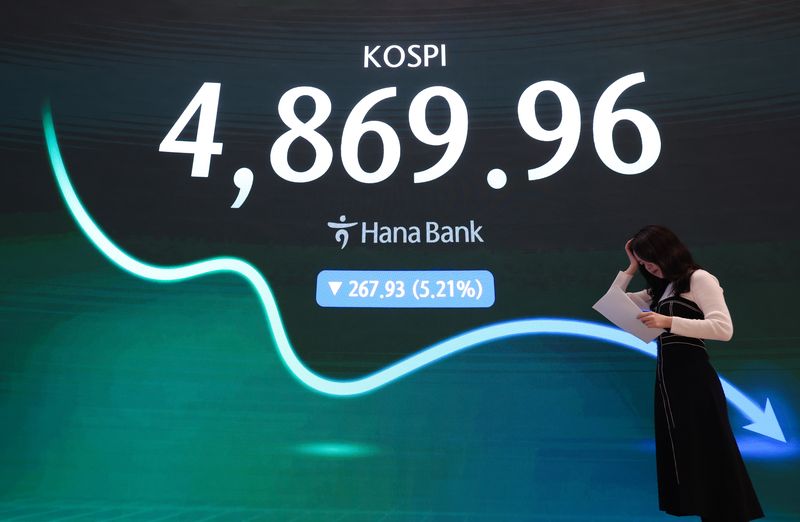
[Financial News] Before the shock of ‘Black Friday’—when the KOSPI fell below 4,900 and even the 4-quadrillion-won market capitalization barrier was breached—could subside, fears of a U.S.-led tech-stock rout are engulfing South Korea’s stock market.
On the 20th (local time), the Nasdaq Composite plunged 5.28% in the New York stock market, giving back much of its gains for the year. AI bellwether Nvidia sank 14.01% in a single day despite strong earnings, hitting a 52-week low.
With the market set to open on the 23rd, concerns are mounting about further declines. Foreign investors’ short-selling transactions in the domestic stock market totaled 16.2123 trillion won from the 2nd to the 19th of this month. As market jitters intensified, the timing of the government and financial authorities’ response—and the absence of clear policy messaging—emerged as a key issue.
Taiwan has stepped up its response, but South Korean authorities have yet to announce a policy.
According to the financial investment industry on the 22nd, Taiwan’s Financial Supervisory Commission (FSC) will restrict short selling from the 23rd in stocks whose prices fell on the previous trading day. Previously, the restriction applied to stocks that fell by 3.5% or more, but it has now been expanded to cover all decliners. The minimum margin requirement for short selling will also rise from 130% to 150%. After the TAIEX closed down 6.23% at 36,033.29 on the 20th, the FSC announced additional measures the following day.On the 6th, Taiwan’s National Financial Stabilization Fund Management Committee approved the use of fund resources depending on market conditions. The FSC then progressively tightened short-selling rules. After the TAIEX fell below 39,000 on the 19th, it announced that short selling would be restricted on the next trading day for stocks that had closed down 3.5% or more. On the 21st, it expanded the restriction to all stocks that had fallen on the previous trading day.
Like South Korea, Taiwan is an export-driven economy with market capitalization heavily concentrated in semiconductors (TSMC and MediaTek) and an overwhelming reliance on AI exports to the United States.
Criticism is mounting that the authorities should benchmark measures taken by neighboring countries that have already been implemented and proven effective. Rather than resorting to an extreme measure such as a blanket ban on short selling, which could hinder inclusion in the MSCI World Index, even Taiwan-style ‘targeted restrictions’ could curb indiscriminate downward attacks by short sellers.
A securities industry official warned, “If Taiwan sharply raises barriers to short selling while South Korea alone, with an almost identical industrial structure, leaves its market wide open and defenseless, it could bring about a ‘balloon effect’ by drawing global short sellers to Korea.”
The mismatch between a criteria-free ‘ghost’ securities market stabilization fund and easing collateral requirements that fueled the decline
At a capital markets policy meeting held at the Korea Exchange in Yeouido, Seoul, on the 13th and chaired by President Lee Jae Myung, Kim Jin-wook, chief economist at Citibank Korea, said, “Extreme volatility is why foreign long-term investors hesitate to enter the undervalued Korean stock market,” and called for a signal that the Securities Market Stabilization Fund (the stabilization fund) would be activated to curb short sellers.Park Se-ik, CEO of Chesley Investment Advisory, also proposed clarifying the criteria for activating the stabilization fund. He pointed out that the fund, established in 2020 with 10 trillion won, was not deployed when the COVID-19 shock pushed the price-to-book ratio (PBR) below 0.6, nor during the sharp market decline in 2022 or last year’s tariff shock. Citing a PBR of 0.9 or lower or a 40% fall in the KOSDAQ Index from its peak as examples of activation thresholds, he stressed that criteria should be established so funds can actually be deployed during sharp market declines.
The effectiveness of the financial authorities’ market-stabilization measure announced on the 9th—a temporary, three-month exemption from securities firms’ obligation to maintain a 140% collateral ratio for margin loans—is also being questioned. As of the 5th, before the measure was announced, the outstanding balance of margin loans stood at 28.7715 trillion won, 2.9 times the 9.8628 trillion won recorded in March 2020, when the same measure was implemented.
A securities firm official said, “With no separate measures targeting foreign short selling, easing the requirement to maintain collateral ratios alone has limited ability to reduce selling pressure. Delaying forced liquidations may reduce immediate forced selling, but margin-loan positions will remain as potential supply and could weigh on a stock-price rebound.” There are also concerns that if prices fall further, more accounts will have insufficient collateral, triggering forced liquidations all at once. Sales by investors fearing a chain of forced liquidations could add to the pressure and deepen the decline.
KOSDAQ Revitalization Even as the KOSPI Crumbles? Investors’ Patience Is Wearing Thin
With the benchmark KOSPI sliding to 4,869.96 (-5.21%) on the 20th, back to levels last seen in January this year, and 3.4 quadrillion won in market capitalization wiped out from its peak (with sidecars triggered 59 times over the year), the government’s call to ‘revitalize KOSDAQ’ is also being met with market cynicism.On the same day, the KOSDAQ Index sank 5.71% to 645.68. At the meeting on the 13th, participants also observed that “when the KOSPI rose 100%, the KOSDAQ gained just 4%,” while voices from the industry warned that tighter market-capitalization delisting criteria were drying up trading in small- and mid-cap stocks. Critics say discussing KOSDAQ revitalization while a supply-demand collapse is engulfing the KOSPI is absurd.
The government’s push to secure inclusion in the MSCI World Index, a national policy priority, also remains a challenge. In the annual market classification review last June, South Korea’s stock market failed to make the watch list and retained its emerging market (EM) status. Critics say the authorities should clarify what measures they will take and under what criteria when market volatility increases, making policy more predictable.
An investment industry official said, “We need tools to respond to sharp volatility while maintaining the market’s price-discovery function. With concerns about further declines mounting ahead of the market opening on the 23rd, the financial authorities need to explain to the market what measures they are considering and the criteria for applying them.”
[email protected] Choi Doo-seon Reporter