Do Urban Parks Do More Than Absorb Carbon? Heat-Wave and Fine-Dust Effects Assessed Together
- Input
- 2026-11-21 12:03:35
- Updated
- 2026-11-21 12:03:35
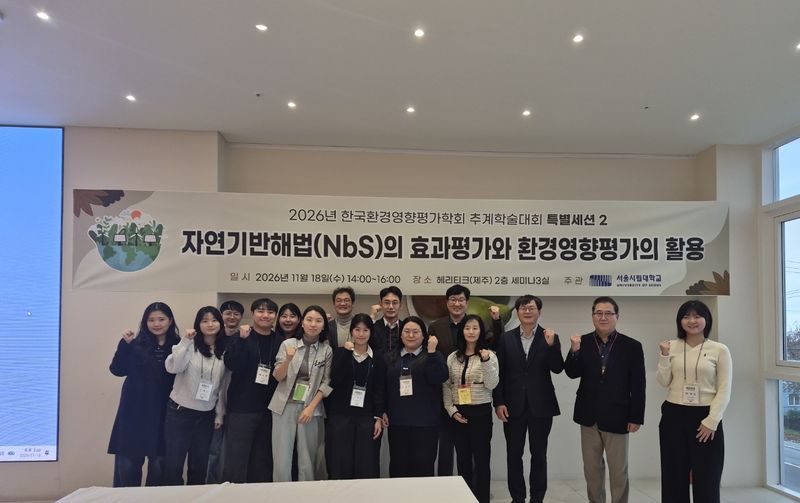
[Financial News] A new assessment technology calculates not only how much carbon urban forests and parks absorb, but also their effects in cooling heat waves and reducing fine dust, so the results can be incorporated into development projects. The University of Seoul said on the 21st that a research team led by Professor Park Chan of its Department of Landscape Architecture, together with researchers from Korea University and Dankook University, had unveiled findings on “Integrated Management Technology for Carbon Sinks Considering Ecosystem Services.”
The findings of the study, supported by the Ministry of Climate, Energy and Environment (MCEE), were presented at a special session of the 2026 Fall Conference of the Korean Society of Environmental Impact Assessment, held in Jeju on the 18th.
Until now, efforts to create forests or green spaces in cities have focused mainly on how much carbon they absorb. But for “Nature-Based Solutions,” which use nature such as trees and grass to address environmental problems, to fulfill their role, their various effects on the surrounding environment must also be taken into account. In particular, applying this technology to the “environmental impact assessments” conducted before large-scale construction or development projects could make it possible to verify the effects of creating green spaces much more scientifically.
At the conference, the joint research team presented specific assessment methods for each field. First, the Korea University team introduced a technique that combines seasonal air-quality forecasting models with regional site characteristics to assess in advance where green spaces should be created to maximize air-purification effects, including the reduction of fine dust.
The University of Seoul team, the lead institution, proposed a way to calculate appropriate carbon-absorption targets for creating green spaces in inhabited urban areas without harming existing ecosystem functions such as rainwater circulation, soil protection, lowering urban temperatures and improving air quality. The Dankook University team demonstrated the potential to assess the biodiversity of grasslands using satellite imagery, without people having to visit sites in person.
Professor Park Chan of the University of Seoul, who led the study, said, “Nature-based solutions absorb carbon while also affecting the urban thermal environment, air quality and biodiversity.” He added, “I hope these findings will be used as a scientific basis for environmental impact assessments and policies for managing carbon sinks.”
[email protected] Kim Man-gi Reporter