“What’s AI, and Why Is Everyone Making Such a Fuss?” ... Older People Left Further Behind in the Digital World [Recorder of the Low Places]
- Input
- 2026-11-22 06:00:00
- Updated
- 2026-11-22 06:00:09

Artificial intelligence (AI) is changing the convenience of everyday life by handling everything from restaurant bookings and phone calls to shopping and government services. But for older adults who struggle even to order at kiosks or use smartphone apps, these changes remain unfamiliar. We looked at the digital habits of older people we met around Tapgol Park in Seoul and at younger generations’ experiences using AI to examine the generational gap emerging amid technological advances.
[Financial News]“I can barely figure out the machines for ordering at restaurants, and now someone is supposed to make phone calls for me, too? I don’t know what you’re talking about.”A man in his 70s, identified as A, whom we met near Tapgol Park in Jongno District, Seoul, on the afternoon of the 19th, said this after hearing that an artificial intelligence (AI) assistant could handle restaurant bookings and shopping orders as well as phone calls. He said he already found kiosks difficult to use, and the idea that AI could take care of such tasks was completely unfamiliar to him.
He said that even using a kiosk, or self-service information terminal, at a restaurant was difficult. The process of choosing items on the screen and paying was complicated, so he often had to ask a staff member for help, he said.
Most of the older people we met at the park that day were unfamiliar even with the term “AI agent.” Those who had tried using kiosks said they had struggled with the process. By contrast, people in their 20s and 30s said they used AI in their daily lives and even entrusted it with bookings and shopping.
“AI? I’ve heard of it on the news...” Older people unfamiliar with the digital world

A man in his 80s, identified as B, asked what kind of machine a kiosk was when he heard the term. When it was explained that it was a machine for ordering food by tapping a screen at a restaurant, he recalled having encountered one. “Oh, you mean that? You know, the thing at restaurants where they tell you to tap the screen. I’m not good at that,” he said, adding, “It’d be easier to order from a person, but they keep telling us to use a machine.”
He said he could make calls and check text messages on his phone, but found it difficult to install apps or sign up for accounts. When several instructions appear on the screen, he gets confused about what to tap, he explained.
Another man in his 70s, identified as C, also admitted, “I’ve tried ordering from a machine, but there’s just so much on it. If you tap the wrong thing, you have to start all over, so you feel even more rushed when people are waiting behind you.”
The explanation of AI assistants drew even more unfamiliar reactions. When told that AI could call a restaurant and make a booking without the user having to call directly, some asked whether an actual person would be making the call. A man in his 70s, identified as D, asked the reporter, “I’ve heard the term AI on the news, but I don’t really know what it does. You mean if I say something, the machine makes the call on its own? Is there really such a thing?”
A man in his 60s, identified as E, said he watched YouTube videos on his smartphone but hardly ever used new apps. “I can’t even use all the features I already have, so it’s hard when they keep telling me to learn new things,” he said, adding, “I ask my children when I don’t know something, but I feel bad asking them every time.”
“Call the Restaurant for Me” ... AI Assistants Even Make Reservations
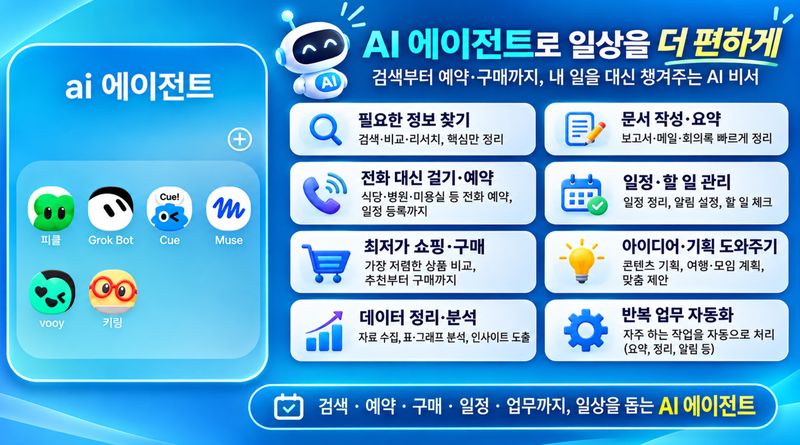
The AI used by younger generations has moved beyond simply answering questions. “AI agents,” which have emerged recently, are services that understand users’ requests and carry out tasks on websites.
Pickle, a personal AI assistant app, supports restaurant and hospital bookings, calls to customer service centers, and online shopping. Users tell it which restaurant they want and what date, and the AI finds a place to book and, if needed, calls directly to make the reservation.
It can also help search for products on shopping sites, compare items that meet specific criteria, or place orders. However, the range of support varies by service, and users may need to confirm major actions such as payments and bookings.
Meta Platforms’ AI assistant Muse has also added a feature for making calls on users’ behalf. The service calls stores and other businesses for users and coordinates schedules. However, availability and supported features in South Korea differ from those of services overseas.
People in their 20s and 30s said they used these features in their everyday lives.
An office worker in his 20s, identified as F, said, “I used to start by searching whenever I had a question, but now I ask GPT first,” adding, “I often use it to organize work materials or plan trips, too. It’s gotten to the point where I’d find it inconvenient without it.”
An office worker in his 30s, identified as G, said he had recently installed an AI agent app. “It’s convenient to have it take care of annoying tasks like booking restaurants or calling customer service,” he said. “I tried it at first because it was novel, but it turns out there are more things I can delegate than I expected.”
An office worker in his 20s, identified as H, uses AI to compare products for shopping. “If I tell it what I’m looking for, it organizes the products for me,” he said. “I just have to check the price and payment details at the end, so it saves time.” A man in his 30s, identified as I, explained, “I think the biggest difference is that AI doesn’t just give answers—it actually gets things done.”
Accessing Government24 with AI ... Government services are changing
The reporter also tried related services to see what AI agents could do. The approach was to use AI to access services the reporter already used, such as Government24 and online shopping sites.
Previously, to obtain a resident registration certificate, users had to access Government24, search for the relevant service, verify their identity, and complete an application process. If users explain what they want to do, an AI assistant can find the relevant service or help them navigate the website.
Meanwhile, the government is also expanding conversational services for government requests. Last May, the Ministry of the Interior and Safety introduced voice recognition to the KakaoTalk-based AI National Secretary. When a user says, “Issue my resident registration certificate,” the AI understands the request and either guides the user to the relevant service or carries out steps that are supported.
The AI National Secretary supports a range of services, including issuing electronic certificates and searching for and booking public facilities. On Government24, users can also search for government services in everyday language and get information about benefits they may need.
However, even when AI takes care of complicated procedures, users still need to be comfortable operating a smartphone and verifying their identity to access the service. For some older adults, even installing a new app or granting it permissions can be a burden.
AI Use Among Older Adults at 30.2% ... Gap Wider Among Those 70 and Older
These difficulties are also reflected in surveys on digital access and literacy.
According to the Ministry of Science and ICT and the National Information Society Agency’s (NIA) 2025 Digital Divide Survey, the level of digital access and literacy among older adults stood at 71.8% when the general population was set at 100. Their competency level—their ability to actually use digital devices—was just 56.2%.
The differences were even greater by age. Digital competency among people in their 60s stood at 63.1% of the general population’s level, while the figure for those aged 70 and older was 29.4%. This means that even among people who own smartphones, there are differences in their ability to use a range of services.
A gap was also evident in experience using AI services. Among older adults, 30.2% had used an AI service, while 69.8% said they had no such experience.
Kiosks are also unfamiliar devices for many older adults. According to a 2022 survey of kiosk use published by the Korea Consumer Agency, 53.6% of respondents aged 60 and older who had experienced inconvenience while using kiosks reported difficulty operating them. Another 23.2% said the small text on ordering screens was inconvenient.
The government is expanding easy-to-use screen layouts and voice-based AI services to improve older adults’ access to digital technology. Letting users request tasks by speaking, rather than having to navigate complicated screens themselves, could help reduce the burden on older adults.
However, it is difficult to try new features if people do not know where to access the services or already struggle with installing apps and verifying their identity.
When the man in his 70s, identified as A, whom we met at Tapgol Park heard another explanation of how AI could call and make reservations on his behalf, he pointed to his own phone.
“Something like that would be convenient, sure. But you’d have to know where and how to use it, wouldn’t you?” he said, adding, “People like us can’t even get started unless someone shows us how.”
We put engaging stories of life into print. However rough the words may be, we capture what we hear on the ground just as it is. From alleyways and markets to someone’s workplace, accounts of the ordinary days we have passed by find their way to you, our readers.[Recorder of the Low Places]To receive it conveniently, please subscribe to the reporter’s page.
[email protected] Han Seung-gon Reporter