“A Year’s Worth of Gains Wiped Out in Just One Week”... NVIDIA Plunges 14%, Wall Street Rocked by ‘AI Mega-Panic’ [Money Signal]
- Input
- 2026-11-21 10:00:00
- Updated
- 2026-11-21 10:00:04
[Financial News] Thirty million won, saved by setting aside and carefully eking out a salary. For some, it represents savings steeped in years of hard work; for others, it is their children's education fund and the family's last safeguard for retirement. If that money were invested in U.S. tech stocks and lost 10% in a week, the mark-to-market loss would be 3 million won. That is how much an employee saving 500,000 won a month would have to save for six full months to accumulate.
Overnight, that punishing figure became reality on the New York stock market. The tech-heavy Nasdaq plunged 10% in just one week, giving back all the gains it had built up this year. NVIDIA, the heart of the global AI semiconductor industry, plunged more than 14% in a single day. Even more unsettling is that the plunge did not come after corporate earnings collapsed. NVIDIA tumbled despite posting results that beat market expectations. A firm belief in the growth of the AI industry and rising share prices for AI companies has begun to crack.
According to financial investment industry sources and foreign media on the 21st, the Nasdaq Composite plunged 1,261.47 points (5.28%) from the previous trading day to close at 22,617.73 on the New York stock market on the 20th (local time). The S&P 500 fell 3.70% to 6,910.39, while the Dow Jones Industrial Average fell 1.93% to close at 48,147.33.
The Nasdaq's plunge is particularly shocking. It fell 10% for the week, turning its year-to-date return negative, at minus 2.7%. Investors who bought into the Nasdaq index at the start of this year and patiently held on have, nearly a year later, ended up with losses on their principal instead of gains. According to The Wall Street Journal (WSJ), more than $4 trillion in market capitalization has vanished from the Nasdaq alone this week.

The epicenter of the crash was NVIDIA, the “AI emperor.” Its shares plunged 14.01% in a single day to $125.53, setting a new 52-week low. Its loss for the week was about 23%, its worst weekly performance since the global financial crisis. A 30 million won investment would have lost 6.9 million won in just one week—the equivalent of 14 months of savings for someone putting away 500,000 won a month. The sell-off spread across the semiconductor and cloud infrastructure sectors, including the Philadelphia Semiconductor Index (down at least 10%), AMD, Broadcom and Micron.
What individual investors find hardest to accept is a “crash despite strong earnings.” NVIDIA recently reported quarterly results that beat market expectations. There was also the high-profile listing of Anthropic, the developer of the Claude chatbot, at an offering price of $83 on the 19th (local time); its shares surged 17.1% on the first day. But that did not thaw the market's chill: Anthropic shares plunged 8.50% the following day, sliding to around the offering price.
The fundamental reason Wall Street turned its back was deep skepticism about whether investments could be recouped. Global big tech companies are pouring astronomical sums into data centers, semiconductors and power infrastructure, but fear has gripped the market that there is no way to know when—or how much cash flow—those investments will generate. That was compounded by the U.S. Federal Reserve's (Fed) tightening stance as it guards against inflationary pressures, and the burden of high interest rates. Growth stocks that had been trading at high valuations based on future earnings took a direct hit.
The fear is spreading beyond tech stocks to the market as a whole. The S&P 500 fell for a seventh consecutive trading day through that day, its longest losing streak since 2020. Having dropped more than 10% from its record high set on October 6, it entered an official “correction” alongside the Dow.
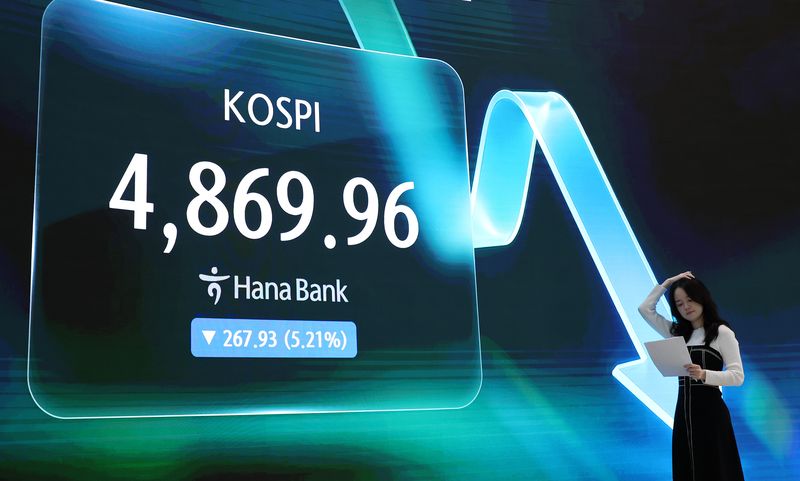
The chill from the United States is casting a deep shadow over the South Korean stock market as well. The KOSPI had already plunged 5.21% to 4,869.96 on the 20th, with Samsung Electronics (-7.01%) and SK hynix (-5.92%) falling in tandem; now, the further plunge in U.S. semiconductor stocks has added to the bad news. Increased volatility in the South Korean market on the next trading day, the 23rd, is unavoidable. The market's direction could of course vary depending on exchange rates, foreign investor flows and the fundamentals of individual domestic companies, but South Korea's two leading semiconductor companies will not be immune if global AI investment slows.
What is most frightening in the market now is not the blue lights on the stock boards, but the “collapse of confidence.” The market is now asking, coldly, not “Is AI growing?” but “How much of that growth can actually be returned to shareholders?”
At times like this, it is extremely risky to rush into averaging down in an attempt to recoup losses. The math of the stock market is brutal. If a stock falls 20%, it must rise 25% to recover its original value; if it falls 30%, it needs to rise 42.9%; and if it is cut in half, down 50%, it must rise a full 100% to break even.
If a company's technological capabilities and ability to generate cash remain intact, today's fear will pass someday. But the money that can withstand the wait until recovery and the money needed to protect a family's daily life right now carry entirely different weight. A company growing again and my account recovering its principal are two separate things. That is the most painful lesson Wall Street's massive crash left ordinary investors with in the early hours of November 21.
[email protected] Jeon Sang-il Reporter