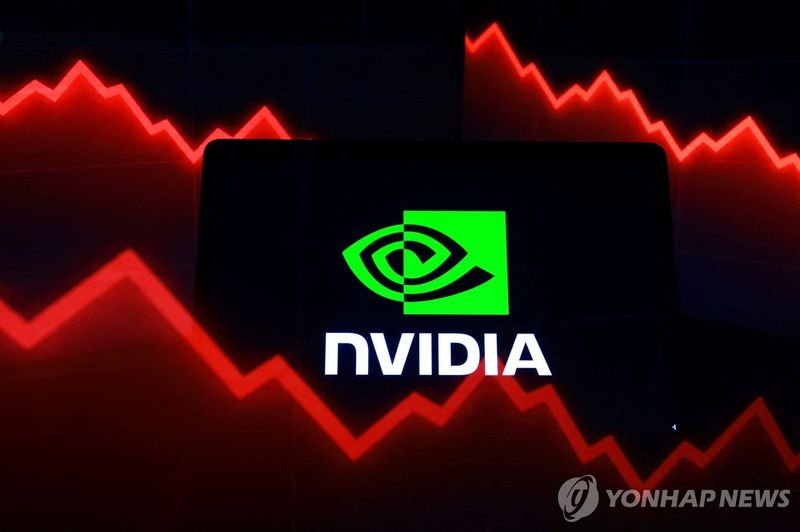
NVIDIA Corporation Plunges 46% in Seven Weeks... Longest Losing Streak Since 2008 Financial Crisis
- Input
- 2026-11-21 07:15:35
- Updated
- 2026-11-21 07:15:35
Seven consecutive weeks of declines... longest since the financial crisis
NVIDIA Corporation's stock plunged 14% on the 20th (local time), marking its seventh consecutive trading-day decline. It also fell for seven consecutive weeks, setting its longest weekly losing streak since 2008. This was the first time NVIDIA Corporation's stock had fallen for such an extended period since the 2008 global financial crisis. At the time, NVIDIA Corporation's main product was GeForce, a graphics processing unit (GPU) for high-end PC gaming.
The sharp decline in the stock price also significantly reduced the company's value. NVIDIA Corporation's market capitalization fell to about $3 trillion, pushing it to fourth place globally behind Apple Inc., Microsoft (MS), and Alphabet Inc. NVIDIA Corporation's standing was badly shaken after it had once ranked first in the world by market capitalization.
The company's valuation also fell sharply. NVIDIA Corporation's forward price-to-earnings (P/E) ratio, based on projected future net income, dropped to about 8.4. This contrasts with competitor Advanced Micro Devices, Inc.'s (AMD) forward P/E ratio of 29.
Accounting issues have also surfaced. Some foreign media reported that the U.S. Securities and Exchange Commission (SEC) was reviewing potential accounting problems at NVIDIA Corporation. The news sent the stock lower still.
Jensen Huang's resignation and concerns over AI investment
One of the direct causes of NVIDIA Corporation's sharp stock decline was former CEO Huang's sudden resignation. Huang stepped down as CEO on the 12th after allegations surfaced that he had extramarital relationships with several women, including a Chinese businesswoman suspected of having ties to Chinese intelligence.
Harvey Jones, the new chair of NVIDIA Corporation's board, explained Huang's resignation earlier this week, saying, “It was because personal conduct that did not conform to the company's code of conduct and standards, and cultural norms, had come to light.”
However, NVIDIA Corporation's stock decline began before Huang's resignation. Investors have been questioning whether investment in AI infrastructure can continue after the U.S. midterm elections. Concerns have also grown that NVIDIA Corporation's dominant position could be shaken, particularly as Google and AMD accelerate development of their own AI chips and expand their presence in the market.
Results that exceeded market expectations also failed to restore investor confidence. In its latest earnings announcement, NVIDIA Corporation raised its outlook for fiscal 2028. CFO Colette Kress, who is serving as interim CEO, forecast that revenue would grow 75% in the next fiscal year and stressed that major customers would not leave NVIDIA Corporation.
Market concerns nevertheless remain. Investors are watching to see whether NVIDIA Corporation can continue to innovate and maintain its overwhelming competitive edge in the AI chip market after the departure of Huang, its iconic leader.
NVIDIA Corporation had quarterly revenue of less than $1 billion in 2008, but has since grown into a company generating more than $1 billion in revenue per day. In particular, it has established itself as a key company in the AI industry since ChatGPT launched in 2022.
CNBC noted that when NVIDIA Corporation last experienced a prolonged stock decline like this, in 2008, the entire market plunged amid the worst financial crisis since the Great Depression. Today, however, the stock is under pressure from doubts about the sustainability of growth in the AI industry and the company's management leadership.
[email protected] Correspondent Lee Byeong-cheol Reporter