Why BTS and the Big Four Agencies Rejected the 'Glass Ceiling'—and Why a Mid-Sized Agency Knocked on It... The Numbers Prove 'Grammy Economics' [Park Ji-hyun's Art World]
- Input
- 2026-11-21 03:27:50
- Updated
- 2026-11-21 03:27:50

[Financial News] A large number of K-pop artists have been named to the 69th Grammy Awards nominee list, drawing attention from the global music market. This year’s nominations starkly reveal the complex position K-pop now occupies in the global music market. According to sources in the music industry and major international media on the 21st, K-pop’s Grammy campaign this year split into two distinct paths. BLACKPINK’s Jennie earned nominations in two categories, including ‘Record of the Year,’ one of the four major general-field awards, for ‘Dracula,’ her collaboration with Australian band Tame Impala. This was a historic second consecutive year with a K-pop artist nominated in a general-field category, following Rosé’s ‘APT.’ last year.
The sharpest divide in industry opinion, however, centers on the new ‘Best Asian Pop Music Performance’ category introduced this year. After BTS declined to submit an entry last July, saying, “We hope music won’t be divided by region or language,” the country’s four major agencies—HYBE, SM, JYP and YG—joined the boycott, each submitting zero entries. Meanwhile, the girl groups IVE (‘Bang Bang’) and KiiiKiii (‘404’), both under mid-sized agency Starship Entertainment, became the category’s inaugural nominees. Despite repeated controversy over ‘ghettoization’—the isolation of a particular group—the K-pop industry cannot completely turn its back on the Grammys, in part because of the rigorous capitalist calculations and enormous economic impact behind the ‘Grammy bounce.’
■ Big Agencies Reject ‘Segregation’ vs. Mid-Sized Agencies Choose ‘Pragmatism’

At the heart of the controversy are the Grammy’s eligibility criteria. The newly created Asian Pop category requires meaningful use of at least one Asian language in a song, and songs performed entirely in English are ineligible. Critics have called it an ‘invisible glass ceiling,’ echoing the controversy over mainstream exclusion when Black musician Tyler, the Creator once described the Grammys’ classification of his music in the rap category as a “backhanded compliment.” In fact, artists from major agencies with some of the world’s largest fandoms, such as BTS and Stray Kids, concluded they had no reason to be confined within a boundary labeled ‘Asia.’
Mid-sized agencies, by contrast, have a different calculus. For agencies with relatively limited capital and networks, it is virtually impossible to clear in one leap the formidable barrier to the Grammys’ general-field awards, which are dominated by white and Western artists. For them, the Asian Pop category is a reliable ‘lever’ for global promotion. Bad Bunny’s precedent offers a case in point: after building his standing with a Latin-category win in 2023, he went on to win Album of the Year, a general-field award, at the 68th ceremony held earlier this year—the first Spanish-language album to do so. It suggests that a newly created category can serve as a stepping stone to the mainstream.
But the dilemma of being mindful of domestic public opinion is also clear. Unlike Philippine girl group BINI, which revelled in the celebratory mood on social media after being nominated in the same category, IVE and KiiiKiii have been extremely restrained in their public comments, taking a cautious approach.
■ The Conservative Grammys’ Clever Tightrope Walk... ‘Attracting Traffic’ and ‘Controlling the General Field’
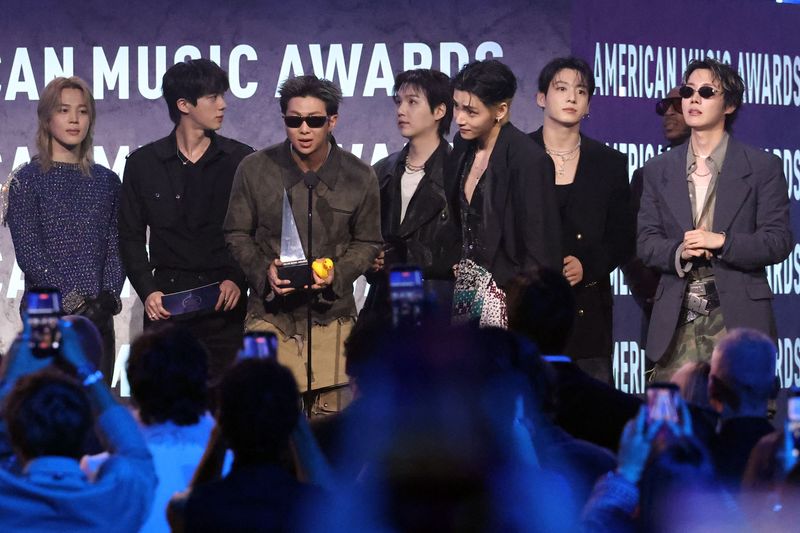
As the K-pop industry grapples with internal tensions, the Recording Academy, the organizer, has walked a deft tightrope to maximize the value of its domestic platform. After years of declining ratings and a lack of buzz, the Grammys urgently need traffic from K-pop fandoms, whose online mobilization is among the most organized in the world.
The Grammys’ placement strategy in this year’s nominations reveals that intent plainly. Seemingly mindful of BTS’s boycott, the Recording Academy placed the new Asian Pop category immediately after the general-field awards and ahead of established major genres such as pop, dance, rock, R&B and rap. It also ranked the category ahead of Latin Pop and African Pop, making a gesture of ‘preferential treatment.’ The strategy leaves the conservative authority of the general-field awards to Anglo-American pop stars while drawing K-pop artists and their global fandoms steadily into the awards ecosystem through a genre-specific category.
■ The Economics of the Big Four Awards... Why Are the Grammys Ultimately the Final Hurdle?
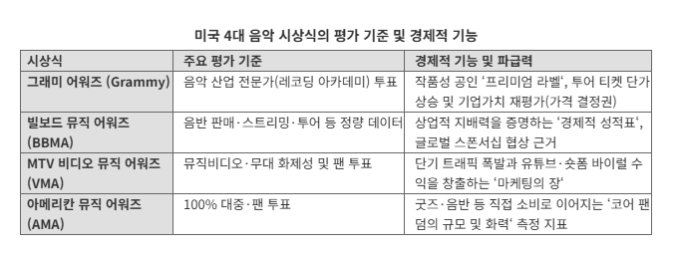
The U.S. mainstream music market has four major awards shows: the Grammys, the Billboard Music Awards (BBMAs), the MTV Video Music Awards (VMAs) and the American Music Awards (AMAs). K-pop has already swept the other three, proving its commercial dominance. The industry’s continued fixation on the conservative Grammys comes down to the different ‘quality’ of the economic impact each awards show generates.
The BBMAs are akin to an ‘economic report card,’ showing how much revenue and how many sales an artist has generated over the year. The VMAs are a ‘marketing arena’ that generates short-term video views and viral revenue through buzz around performances. The AMAs, decided entirely by public vote, measure the spending power of core fandoms. These three awards shows primarily recognize commercial success that has already been achieved.
The Grammys, on the other hand, are awarded by a group of music industry professionals and serve as a premium label that certifies an artist’s ‘artistic merit.’ A Grammy title can sharply raise ticket prices for live tours—the industry’s key source of revenue—and demand for VIP packages. It can also increase the fees paid to participating producers and creative teams for their songs, boosting the asset value of the industry ecosystem as a whole. This unique ‘pricing power’ is precisely why K-pop must break through at the Grammys despite the controversy over the Asian Pop category.
■ From Higher Tour Prices to Market-Cap Re-Ratings... The Multi-Trillion-Won ‘Grammy Bounce’
The ‘Grammy bounce’—the added value generated immediately after a nomination or win—goes beyond prestige, directly translating into the expansion of financial assets. According to an analysis by Forbes, a U.S. business magazine, Grammy-winning artists see their concert-tour revenue surge by an average of at least 55% the following year. Bruno Mars generated more than $300 million (about 400 billion won) in revenue with the world tour that followed his sweep of major categories in 2018. Adele and Taylor Swift are also prime examples of artists whose market value was reassessed as album sales surged immediately after their wins.

This has already been borne out in South Korea’s music industry. When BTS’s ‘Dynamite’ became the first song in Korean popular music history to receive a Grammy nomination in November 2020, HYBE’s stock—then trading under the name Big Hit Entertainment and struggling after the release of lock-up shares following its KOSPI listing—found an immediate catalyst for a rebound. It marked a decisive turning point, as the market re-rated the company’s value, or market capitalization, from that of an ‘Asian agency’ to a ‘global top-tier IP (intellectual property) company.’ The Ministry of Culture, Sports and Tourism estimated that the macroeconomic impact generated by ‘Dynamite’ topping Billboard’s Hot 100 had reached 1.7 trillion won. The Grammy nomination became a crucial catalyst, extending the song’s commercial momentum to the awards stage. Later, after BTS performed solo at the Grammys, its stadium tours in Los Angeles and Las Vegas each generated a record-breaking roughly 40 billion won in concert revenue from just four shows, equivalent at the time to $33.3 million–$35.9 million.

At the 68th ceremony, ‘Golden,’ a song from the soundtrack of Netflix’s animated film KPop Demon Hunters, brought home K-pop’s first Grammy trophy, but the award went to the creative team, including the songwriters and producers. If even one of Jennie, IVE or KiiiKiii takes home a trophy at the 69th ceremony, which will be held next February, it will make history as the first Grammy win by a K-pop artist as a performer. With the major agencies’ boycott, mid-sized agencies’ pragmatism and the direct route to the general field intersecting, K-pop’s capitalist contest of strategy to overcome invisible barriers and secure the premium of true global mainstream status is unfolding more fiercely than ever.
[email protected] Park Ji-hyun Reporter