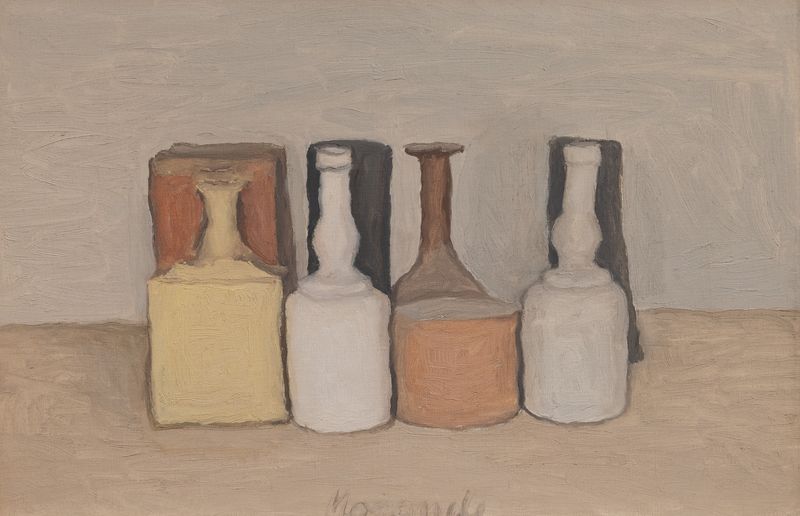
Giorgio Morandi’s Still Life (1956). Oil on canvas, 30 × 45 cm. Courtesy of Haji. © Museo Morandi | Settore Musei Civici | Comune di Bologna Pencil marks tracing the bases of bottles remain on a sheet of yellowed paper. It is a sheet on which the Italian painter Giorgio Morandi (1890–1964) marked the positions of bottles and boxes in his Bologna studio. In his 1956 Still Life, a reddish-brown bottle sits between two white bottles. A box behind them is obscured by the bottles, with only its upper part visible. Morandi repeatedly painted the same objects, varying their positions and the light.The ‘Giorgio Morandi’ exhibition opens on the 21st on the sixth floor of ALT.1 at The Hyundai Seoul in Yeongdeungpo District, Seoul. Jointly organized by the Morandi Museum in Bologna and exhibition company Haji, it is the largest Morandi solo exhibition in Korea. Through March 1 next year, it will present 82 original works, including 49 oil paintings, 15 etchings, 12 drawings and six watercolors. It comes 12 years after a 2014 exhibition at MMCA Deoksugung, which featured around 40 of Morandi’s works.
■ Objects on the Worktable and a Courtyard Beyond the WindowThe first section, ‘A Room Embracing the World,’ features bottles containing pigment powder, a box of oil paints, a palette and brushes. These tools came from 36 Via Fondazza in Bologna, where Morandi lived and worked from 1933 to 1964. Lorenzo Balbi, director of Verona Civic Museums and former director of the Bologna Museum of Modern Art, who curated the exhibition, explained at a press preview on the 20th: “Morandi spread paper over two worktables and moved objects around until he found the composition he wanted.”
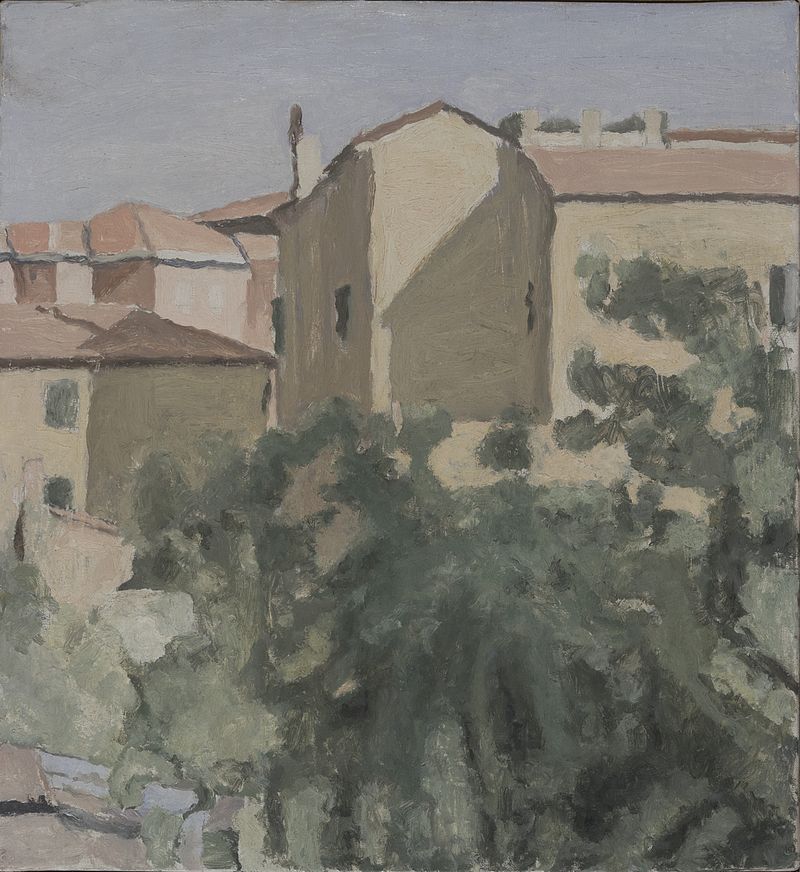
Giorgio Morandi’s Courtyard on Via Fondazza (1956). Oil on canvas, 47 × 43.2 cm. Photo: Sergio Buono, courtesy of Haji. Museo Morandi | Settore Musei Civici | Comune di Bologna There was only one window in the studio. In Courtyard on Via Fondazza (1956), which depicts the view beyond it, red-tiled roofs overlap and a leafy tree obscures the lower part of a building. Morandi depicted the courtyard from the same vantage point several times in oil paintings and drawings.
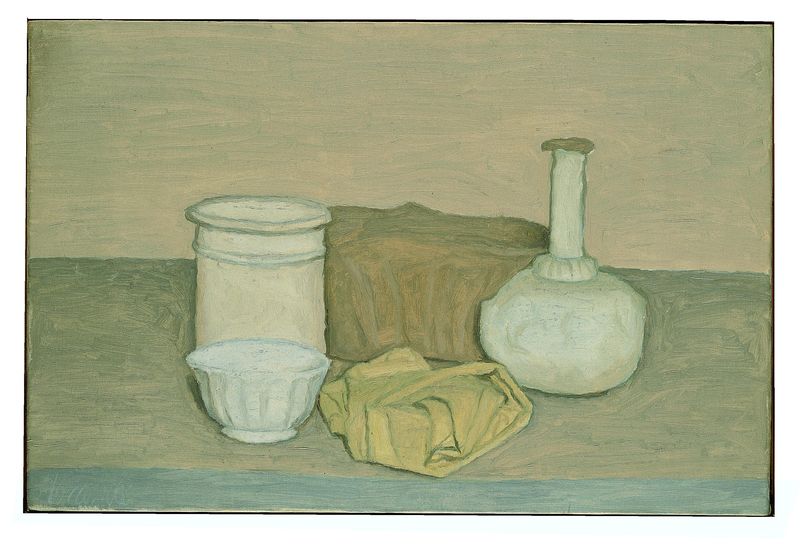
‘The Theater of Objects’ pairs the oil painting Still Life (1952) with a drawing depicting the same objects. Director Balbi said that five objects used as models for the painting had also been rearranged in the exhibition. In the oil painting, the round opening of a bowl seen from above and the folds of a folded cloth are visible. In the drawing, the viewpoint drops to the objects’ level. That year, Morandi painted ten still lifes with a cloth arranged in the composition.
‘The Language of Flowers’ brings together flower paintings that Morandi often gave as gifts to friends and collectors. To study the forms of flowers over long periods, he used dried flowers and silk flowers as models. In ‘The Silence of Shells,’ visitors can see three of the 18 oil paintings of seashells that he painted in 1942–1943, during World War II.
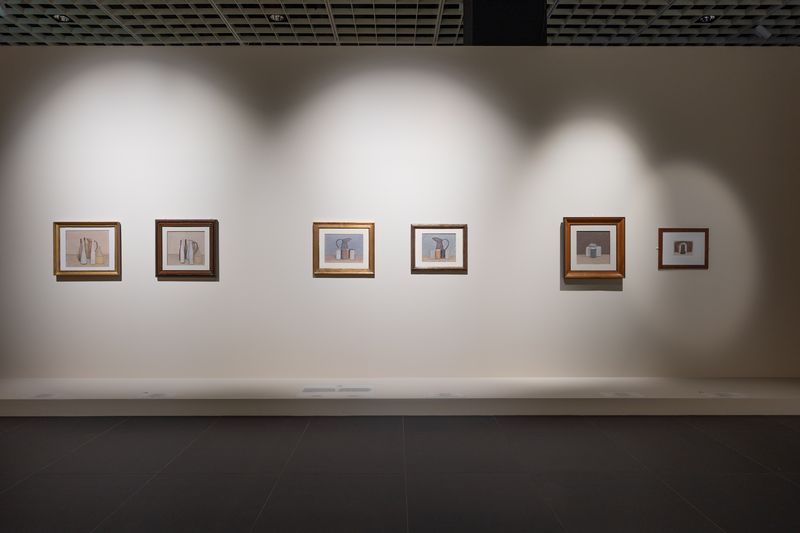
Giorgio Morandi’s Still Life (1952). Oil on canvas, 32 × 48 cm. Courtesy of Haji. © Museo Morandi | Settore Musei Civici | Comune di Bologna A view of the ‘Variations of Time’ section in the ‘Giorgio Morandi’ exhibition on the sixth floor of ALT.1 at The Hyundai Seoul in Yeongdeungpo District, Seoul. The two works in the center are Still Life (1960) and Still Life (1961), from left. Courtesy of Haji ■ Still Lifes Painted by Rearranging ObjectsThe final of the exhibition’s eight sections, ‘Variations of Time,’ displays side by side two still lifes painted in 1960 and 1961. Both paintings show a teapot and four cylindrical vessels against a blue-gray background. The teapot handle, which is on the left in the 1960 painting, is on the right in the following year’s work. Seen together, the teapots’ spouts point toward each other. An orange vessel has also moved from the right to the left of the front row.
Director Balbi explained that Morandi shifted objects by 1–2 cm at a time or adjusted the amount of light. In front of another still life, in which one bottle is missing, he said, “Take away one bottle and see what small difference it makes.”
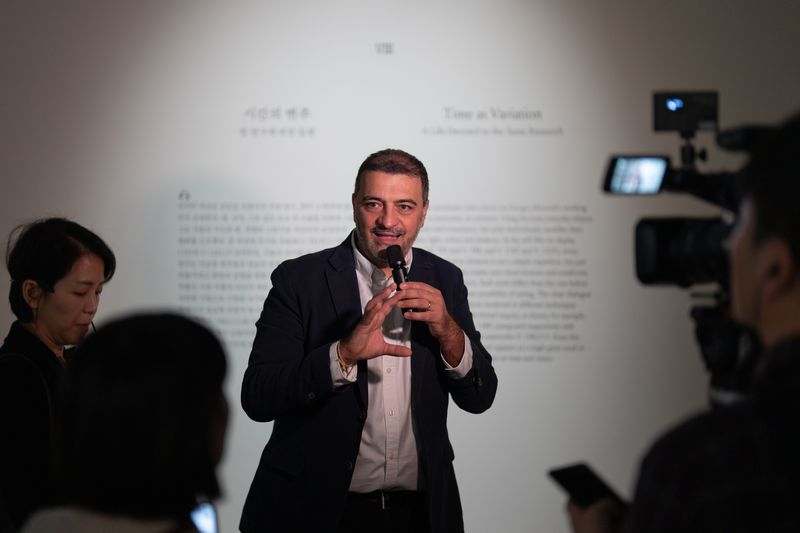
Lorenzo Balbi, director of Verona Civic Museums, explains the ‘Variations of Time’ section at a press preview of the ‘Giorgio Morandi’ exhibition on the sixth floor of ALT.1 at The Hyundai Seoul in Yeongdeungpo District, Seoul, on the 20th. Courtesy of Haji ■ Landscapes Rendered as Prints and a 1924 Self-Portrait‘Seventy Shades of Green’ features landscapes of Grizzana, near Bologna, where Morandi spent his summers. The village also appears in the etchings Alberi fra due case a Grizzana (1933) and Il Poggio di sera (1928). In ‘Forms of Silence,’ visitors can see both prints alongside the copper and zinc plates used to make them.
Morandi, who taught himself etching, taught printmaking at the Bologna Academy of Fine Arts from 1930 to 1956. Areas where lines were densely overlapped printed as deep shadows, while spaces left between the lines came out as bright areas.
Self-Portrait (Autoritratto) (1924), in the collection of the Uffizi Gallery in Florence, will be shown in Korea for the first time in ‘Faceless Self-Portraits.’ Morandi, wearing a white shirt and blue vest, rests a palette on his lap and looks straight ahead. Director Balbi said the palette in the self-portrait is the actual one displayed in the first section.
At the end of the exhibition, 30 photographs taken in 1993 by photographer Gianni Berengo Gardin of Morandi’s home in Bologna and his villa in Grizzana are on display. The photographs preserve the worktable, shelves lined with bottles and the window overlooking the courtyard. Admission is 24,000 won for adults, 19,000 won for teenagers and 15,000 won for children.
[email protected] Jang In-seo Reporter