ECEC Integration Gains Momentum, With Teachers’ Pension Joining In... “Reviewing Staff Welfare”
- Input
- 2026-11-20 20:09:28
- Updated
- 2026-11-20 20:09:28
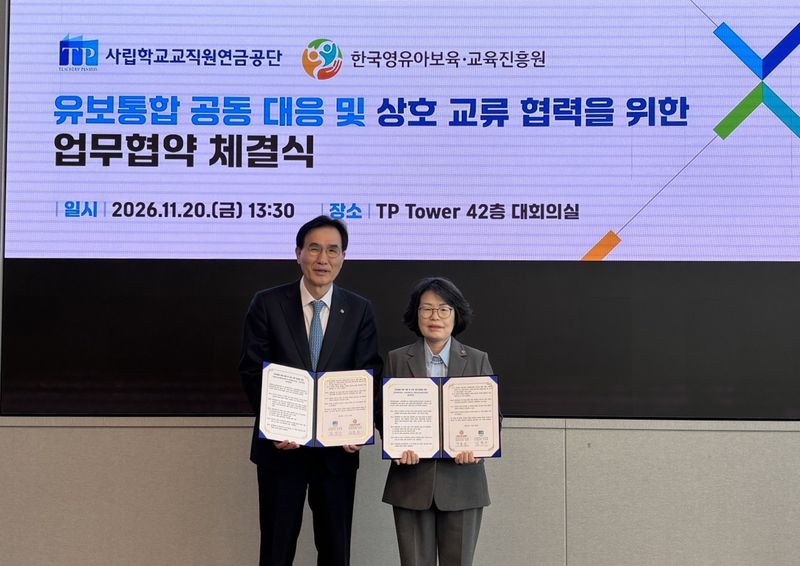
[Financial News] As the government pushes to integrate education and childcare (ECEC integration), the Teachers’ Pension has begun building a cooperative framework to respond to policy changes. With staff working conditions and welfare likely to emerge as major issues in the reform of the education and childcare systems, the plan is to establish a basis for a joint response with relevant organizations.
According to the Teachers’ Pension on the 20th, the fund signed an agreement that day at TP Tower in Yeouido, Seoul, with the Korea Institute for the Promotion of Early Childhood Care and Education to jointly respond to ECEC integration and cooperate through mutual exchanges. The agreement is intended to address the ECEC integration policy, which the government is pursuing as a national agenda. The two organizations agreed to share developments in policy implementation by relevant ministries, including the Ministry of Education, and establish a cooperative framework with key stakeholders.
Specifically, they will pursue the exchange and promotion of information related to ECEC integration and identify collaborative projects in response to policy changes. The focus is on establishing a basis for cooperation to address changes on the ground that may arise as the management systems for education and childcare are integrated.
Particular attention is focused on follow-up collaborative projects, given that ECEC integration is linked not only to improvements in the quality of education and childcare services but also to issues involving staff working conditions and welfare. However, the agreement does not include an expansion of pension coverage or specific plans for institutional reform.
Kim Chang-soo, chairman of the Teachers’ Pension, said, “ECEC integration is an important turning point that goes beyond simply integrating systems and requires stable support for the working conditions and welfare of staff on the ground.” He added, “We will share the resources and experience of both organizations and turn them into practical cooperation.”
In the education and pension sectors, there is a view that reconciling differences in staff working conditions and welfare systems could emerge as a major challenge in the ECEC integration process. There are calls for the effort to lead to changes that people can feel on the ground, rather than stopping at the integration of administrative systems.
An industry official said, “The key to ECEC integration lies not only in bringing the education and childcare systems together as one, but also in how gaps in staff working conditions and welfare are addressed,” adding, “The key question is whether cooperation between institutions will lead to actual improvements to the system and support on the ground.”
[email protected] Kim Gyeong-a Reporter