“45 Trillion Won Is Scarier Than Samsung Electronics’ 7% Plunge”...Why Are Foreign Investors Abandoning Korean Stocks? [Money Signal]
- Input
- 2026-11-20 20:00:00
- Updated
- 2026-11-20 20:00:04
[Financial News] Imagine investing the 30 million won you saved by carefully setting aside part of your salary in Samsung Electronics. If the share price plunged 7% in a single day, the loss on paper would be 2.1 million won. That is money an employee saving 500,000 won a month would have to tighten their belt for more than four full months to accumulate—yet it would vanish into thin air overnight.
On the 20th, this harsh hypothetical became reality in the domestic stock market. Samsung Electronics plunged 7.01%, and SK hynix fell 5.92%. The KOSPI sank 5.21% (267.93 points) from the previous trading day to 4,869.96, giving up even the 4,900 mark. Trading screens were awash in fear, with sell-sidecars triggered in both the KOSPI and KOSDAQ markets.
But there is another figure that is making investors even more fearful than that day’s plunge.
'45.094 trillion won'. That is the net amount foreign investors dumped in the Korean stock market in September and October—over just two months.
According to the Financial Supervisory Service, foreign investors net-sold 19.116 trillion won in domestic stocks in September and 25.978 trillion won in October.
In October, US investors alone led the selling, dumping 13.854 trillion won. The outflow continued into November. From the 2nd to the 6th of this month, foreign investors sold about 7.6 trillion won worth of Samsung Electronics and SK hynix shares alone. During the same period, the two semiconductor leaders accounted for 73% of total foreign net selling on the KOSPI.
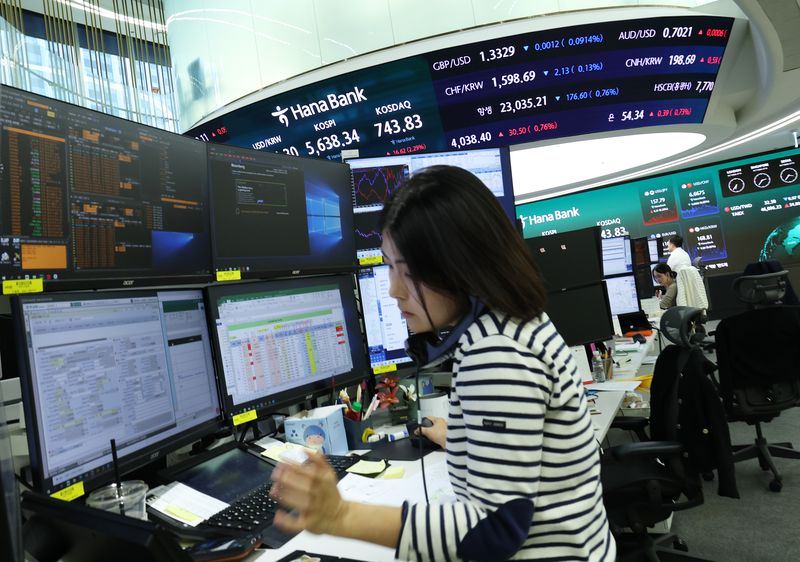
From the perspective of individual investors, the situation is frustrating and feels unfair. Samsung Electronics and SK hynix are not companies whose earnings have turned down. Buoyed by the spread of AI data centers, they are posting profits at record levels. Even so, there are three main reasons foreign investors are hitting the “Sell Korea” button without hesitation.
The first is fundamental skepticism about the profitability of the AI industry. Global big tech companies are pouring astronomical sums into data centers and semiconductors, but the market has grown increasingly skeptical about whether those investments will generate returns to match. The stock market reacts more to what companies will earn tomorrow than what they earned today. The selling reflects fears that semiconductor earnings could falter at any time if big tech investment slows even slightly.
The second is geopolitical uncertainty over US restrictions on semiconductor exports to China. The tighter the restrictions on China, a key source of demand, the cloudier the outlook for global supply chains and orders becomes.
The most devastating third reason is a “vacuum in supply and demand.” According to Reuters, the KOSPI has fallen 44% since its June peak, wiping out about 3.3 quadrillion won in market capitalization. Meanwhile, companies’ share buybacks, which had firmly supported stock prices, are nearing completion. Foreign investors are unloading shares, but the “big players” who would buy them up have disappeared.
On the 20th, foreign and individual investors made sharply contrasting choices. While foreign investors dumped 1.2682 trillion won and institutions sold 349.9 billion won, individual investors were the only ones to step in, net-buying 1.6182 trillion won and absorbing the shares.
An interesting detail lies beneath the Financial Supervisory Service’s statistics. Although foreign investors dumped nearly 26 trillion won in domestic stocks in October alone, they actually made net investments of 7.375 trillion won in domestically listed bonds. This suggests they were not abandoning the Korean economy as a whole, but rather making a clear-eyed portfolio adjustment—reducing their exposure to highly volatile stocks and shifting their focus to safe assets.
When stock prices plunge, it is natural to see it as an opportunity to buy quality stocks at a discount. But a sharp price drop alone is not enough to conclude that a stock is undervalued. Conversely, large-scale selling by foreign investors does not mean a company’s long-term competitiveness disappears overnight.
With foreign investors having pulled 45 trillion won out of the Korean stock market, what individual investors need now is neither panic-driven selling nor reckless averaging down out of defiance. They need to calmly assess whether companies can continue to make money—and, before that, check whether their own accounts have the staying power to last until a recovery.
The market bottom is in God’s domain. No one can predict it accurately. But we can prevent, with our own hands and right now, the tragedy of reckless bets shaking the precious everyday lives of our families.
[email protected] Jeon Sang-il Reporter