Next Year's Officially Assessed Price Realization Rate Frozen at 69%... “Property Tax Burden Remains in Areas Where Home Prices Have Risen”
- Input
- 2026-11-20 17:24:13
- Updated
- 2026-11-20 17:24:13
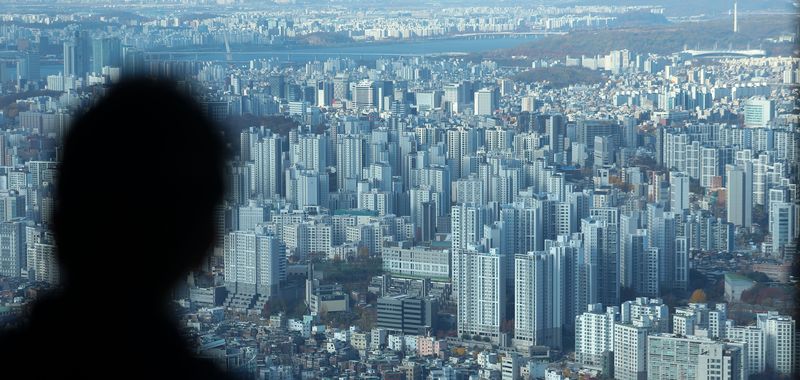
[Financial News] The government has kept at this year's level the target market-price reflection rate (realization rate) to be applied when calculating officially assessed prices in 2027.
According to the Ministry of Land, Infrastructure and Transport (MOLIT), the ministry convened the Central Real Estate Price Disclosure Committee on the afternoon of the 20th and deliberated and approved the “2027 Real Estate Price Disclosure Plan.” Next year's target realization rates are unchanged from this year: 69.0% for multi-unit housing, 53.6% for standard detached houses and 65.5% for standard land. For multi-unit housing, the rates vary by price bracket: 68.1% for properties valued below 900 million won, 69.2% for those valued from 900 million to 1.5 billion won, and 75.3% for those valued at 1.5 billion won or more. For standard detached houses, the rates for the same brackets are 52.4%, 53.5% and 58.4%, respectively. MOLIT said it made the decision after considering this year's real estate market conditions, the 8·3 tax reform package and public acceptance of officially assessed prices.
The 69% realization rate for multi-unit housing has remained in place since it was restored to the level that preceded the Moon Jae-in government's realization roadmap in 2023. With this decision, the rate will remain unchanged for a fifth consecutive year through 2027.
A freeze does not mean that officially assessed prices or property holding taxes will also be frozen. Officially assessed prices are calculated by multiplying market prices as of January 1 of that year by the market-price reflection rate, so any rise in home prices is fully reflected. In fact, this year, officially assessed prices for multi-unit housing in Seoul rose 18.60% despite the frozen realization rate, reaching about twice the national average increase. The number of homes with officially assessed prices above 1.2 billion won that are subject to the Comprehensive Real Estate Holding Tax for one-home households was 487,362, up 169,364 (53.3%) from a year earlier.
Tax changes are another factor. Under its 8·3 tax reform package, the government plans to raise the fair market value ratio for the housing portion of the Comprehensive Real Estate Holding Tax from the current 60% to 70% next year, and to raise it to 80% in 2028 for owners of three or more homes and owners of homes in designated adjustment areas, excluding one-home-per-household owners. This means the tax base will grow even if officially assessed prices remain the same.
Ham Young-jin, head of Woori Bank Real Estate Research Lab, said, “From a taxation perspective, this means preventing an additional increase in the tax burden from a higher realization rate.” He analyzed that “in areas with concentrations of high-value homes, particularly Seoul's Gangnam area and the neighborhoods along the Han River, recent price increases make rises in officially assessed prices likely, so if the realization rate had also gone up, the property holding tax burden could have compounded.” He noted, however, that “the higher fair market value ratio for the Comprehensive Real Estate Holding Tax (60%→70%), tax rates and deduction rules also determine the actual tax burden, so it is difficult to conclude that a frozen realization rate alone will stabilize property holding tax burdens.”
The government will also work to improve balance. It will focus on areas where officially assessed prices need to be brought into better balance, gradually adjusting selected properties with low market-price reflection rates. Target areas will be selected using measures of uniformity and equity, among other indicators proposed by the International Association of Assessing Officers (IAAO). Ham said, “A freeze at an average of 69% does not mean that the burden of officially assessed prices will remain the same for all multi-unit housing.” He added, “We can expect it to ease some of the pressure on homeowners who have to sell in a hurry because of taxes, while avoiding a sharp increase in property holding tax burdens.”
The government will also strengthen measures to improve the accuracy of assessments. It will expand city and provincial official-price verification support centers to increase local government participation, and open a permanent communications channel on the Real Estate Officially Announced Price Notification Service to gather feedback from the field. AI-generated price assessments will be provided for reference, while geographic information systems (GIS) will be used to extract property characteristics such as area and road conditions. Dedicated teams will conduct focused investigations of high-priced and ultra-high-priced homes, as well as high-priced land and land owned by major corporations.
Next year's officially assessed prices will be announced in stages during the first half of the year. Standard detached houses and standard land are scheduled to be determined and announced on January 22, and multi-unit housing, individual detached houses and individual land on April 30.
Hong Ji-seon, minister of MOLIT, said, “Officially assessed prices are an important benchmark closely connected to people's daily lives, so it is important to manage them stably by taking comprehensive account of real estate market conditions and public acceptance.” Hong added, “We will gradually address imbalances by property type, region and price bracket, and strengthen the assessment and verification system to build an officially assessed price system that the public can trust.”
[email protected] Jeong Gyeong-su Reporter