Even Outside the Game, 'Quest Complete'... Gamers Changing the World [G-STAR 2026]
- Input
- 2026-11-20 17:04:16
- Updated
- 2026-11-20 17:04:16
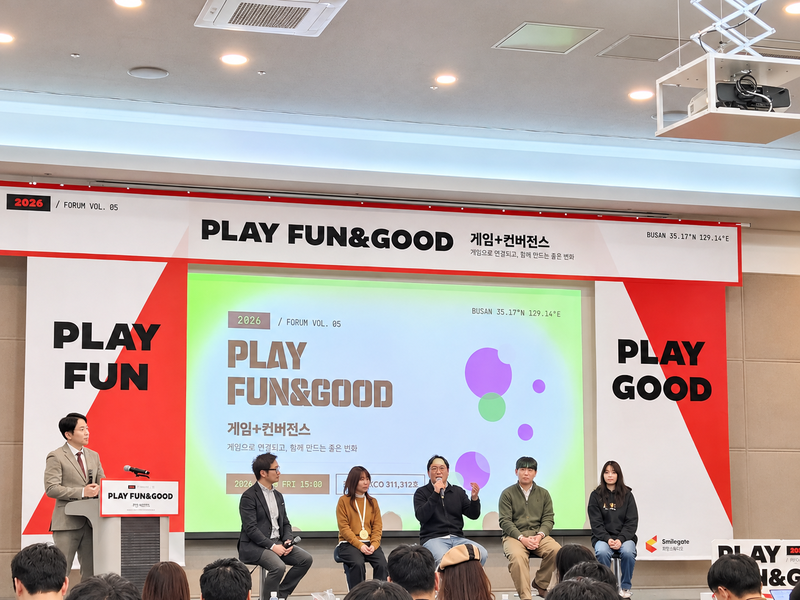
【Busan = Jang Min-kwon】Games are expanding their role beyond mere entertainment, becoming a vehicle for collaboration to solve social problems. Drawing on the worlds of games and users’ shared empathy, game companies, platforms, startups and other players are pooling their efforts to expand the scope of giving, from environmental protection to support for vulnerable groups. A new model of corporate social responsibility is attracting attention: one that moves beyond one-off, company-led donations to create social value through users’ voluntary participation and sustained collaboration.
At the 2026 Play Fun & Good Forum, held by Smilegate Hope Studio on the 20th at BEXCO in Busan during G-STAR 2026, the country’s largest gaming exhibition, participants discussed ways to create social value through empathy and collaboration under the theme of games and convergence.
Yoo Young-man, a professor at Hanyang University, stressed the importance of human empathy amid technological advances in a talk titled “Creating Social Value Through Empathy and Collaboration in the AI Era.” “The most powerful virtue we need in the AI era is empathy,” Yoo said. “People who are hurting open the way to social innovation based on empathy.”
He highlighted the need for collaboration that connects expertise across different fields. “For empathy and collaboration to take place in our society, we need to humble ourselves, meet and learn from experts in other fields, and combine our knowledge to continually create a third kind of knowledge,” Yoo said. He emphasized that “coming up with ideas to heal others’ pain is imagination; social innovation happens when those ideas are put into practice on the ground, and games are no exception.”
Jung Ju-hee, a manager at HoYoverse Korea, introduced the “Genshin Forest Project,” which connects the world of the game to real-world environmental protection activities, in a talk titled “Building a Forest Together with Game Intellectual Property (IP).” “Technology, including AI, is boosting individuals’ capabilities, but large-scale social problems such as the climate crisis are difficult to solve at the individual level,” Jung said. “The fuel that can move the public to help solve social problems is empathy itself.”

HoYoverse worked with Karrot and Smilegate Hope Studio to bring to life in the real world Sumeru, the forest city featured in the game Genshin Impact. In August, about 530,000 people took part in Karrot’s “Neighborhood Walk” campaign, logging a total of 6.3 billion steps. According to HoYoverse, this was equivalent to reducing carbon emissions by about 616 tons. In addition, a total of 4,010 trees were planted last September at Yanghwa Hangang Park in Seoul, supported by charity sales of merchandise via Hope Studio and users’ volunteer tree-planting activities. It is the first Genshin forest created by a game company at a Hangang Park. Jung said it was “a prime example of something that a game company could not have imagined achieving on its own, but that games, platforms and users accomplished together,” adding that “games have taken root as a cultural foundation where people share the same worlds and characters.”
Gyeong Min-gyu, Smilegate’s content marketing team leader, shared the company’s experience making one-off donations a regular part of game operations in a talk titled “Business Value Built Through Consistency.” Over seven years, from 2020 through this year, Smilegate ran 13 donation campaigns through the IPs of three games: Epic Seven, Lord Nine and Chaos Zero Nightmare. Cumulative donations totaled about 900 million won, about 43,000 people benefited, and users made 2,385 direct donations. The campaigns initially focused on selling donation packages in games, but later expanded to connect giving with activities users already enjoy, such as gifting items and attending esports tournaments. “The focus has shifted from companies matching large sums to users taking part directly,” Gyeong said. “Rather than donating a large amount all at once, we’ll work to build users’ trust through a small-scale structure that recurs every year, and to make that trust part of the brand’s value.”
Kang Seong-eun, a Lost Ark player, shared an experience of providing volunteer services and donating talents to help children from vulnerable backgrounds, including by wearing a costume of the game character Mokoko. Kang described turning love of the game into giving, promoting a donation campaign directly in the game community and drawing participation from 244 users and raising 3 million won.
Han Ga-on, CEO of Moseutek, a social tech startup that helps people with ALS communicate, introduced assistive technology that enables communication and control of electronic devices using only the physical movements patients retain, such as blinking. Moseutek worked with Smilegate Hope Studio and the Seungil Hope Foundation on fundraising for ALS patients’ care costs and a program providing communication assistive devices. Recently, it has also developed games controlled by blinking and online yutnori that patients can enjoy together. “Working with Hope Studio showed us that even serious social problems can be approached through the idea of enjoyment,” Han said.
[email protected] Jang Min-kwon Reporter