Investor in Their 50s: “Stocks Valued at 5.5 Billion Won ... How to Avoid Capital Gains Tax as a Major Shareholder” [Tax and Investment Q&A]
- Input
- 2026-11-21 08:00:00
- Updated
- 2026-11-21 08:00:01

Q. A, an individual investor in their 50s, has invested in shares of B, a KOSDAQ-listed company, for several years. The stock price rose sharply this year, increasing the value of the holdings to 5.5 billion won. The gains are welcome, but A heard that holding more than 5 billion won in a single stock would make them a major shareholder who has to pay capital gains tax. Wondering what to prepare before year-end, A sought tax advice.
A. According to KB Securities, no capital gains tax is imposed when a small shareholder sells domestic listed shares on the exchange. However, transfers by major shareholders are taxable whether made on or off the exchange. Small shareholders are also subject to tax when they sell shares off the exchange.
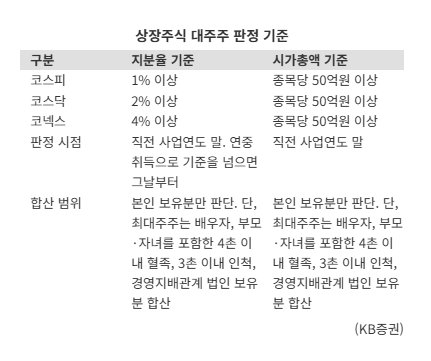
A shareholder is considered a major shareholder if their stake in a single stock is at least 1% on the KOSPI, 2% on the KOSDAQ, or 4% on KONEX, or if the market value of their holdings is at least 5 billion won. For companies whose fiscal year ends in December, whether their shares will be taxable the following year is determined by their holdings at the end of this year.
Once someone becomes a major shareholder, they must pay capital gains tax on any transfer of shares in that company the following year, regardless of the number of shares sold. The rates are 20% on the first 300 million won of taxable income and 25% on the excess, with local income tax charged separately. A 30% rate applies to shares in corporations other than small and medium-sized enterprises if held for less than one year.
The market capitalization test is based on holdings on just one day, the final day of the preceding business year. Shareholdings are measured by settlement date, so shares must be sold by December 28 this year, and their value is calculated using the Korea Exchange closing price on December 30. A must sell at least 10% of the holdings, but should reduce the number of shares by a comfortable margin to account for price fluctuations.
The ownership-stake test works differently. Even if the stake is below the threshold at year-end, acquiring additional shares during the year and exceeding the threshold makes the investor a major shareholder from that day onward.
Kang Su-in, a tax specialist at KB Securities, said, “Market capitalization can be managed by focusing on year-end, but ownership stakes need to be monitored throughout the year,” and explained, “For a KOSDAQ stock with 10 million shares issued and a share price of 10,000 won, holding just 200,000 shares, worth 2 billion won, makes you a major shareholder with a 2% stake.”
Those who are not yet major shareholders can sell some shares before year-end to bring their holdings below 5 billion won, or gift shares to family members to divide up the holdings. A spouse can claim a gift-tax deduction of up to 600 million won over 10 years, while an adult child can claim up to 50 million won. An additional 100 million won is deductible if the child is within two years before or after registering a marriage, or within two years after childbirth.
Those planning to continue holding their shares even if they become major shareholders next year can also sell them this year and repurchase them to raise their cost basis. Those who are already major shareholders can sell overseas stocks or off-exchange shares at a loss in the same year to offset gains and losses.
When distributing shares among family members, investors should check whether they are the largest shareholder. If they are not, major shareholder status is determined based only on their own holdings. If they are the largest shareholder, holdings by related parties are aggregated, including those of their spouse, blood relatives up to the fourth degree—including parents and children—relatives by marriage up to the third degree, and corporations in a management-control relationship.
The largest shareholder is not necessarily the company owner. The Enforcement Decree of the Income Tax Act stipulates that corporate shareholders are excluded when determining who the largest shareholder is. If the largest shareholder listed in the business report is a corporation, the individual shareholder with the largest combined family stake may be considered the largest shareholder. Even if an individual’s stake is below 2%, all family members may be considered major shareholders if their combined stake exceeds 2%.
It is not easy for investors to check this in advance. Disclosures provide information only on the largest shareholder and shareholders with stakes of 5% or more, making it difficult to identify other shareholders’ relatives and special relationships. The National Tax Service, by contrast, later verifies tax filings by combining securities firms’ transaction records with shareholder holdings.
At year-end, investors should therefore check the valuation and ownership stake for each stock and see in the business report whether the largest shareholder is a corporation. If it is, they should aggregate the holdings of family members and other related parties to check whether the major shareholder threshold is met. If they are close to the threshold, they should adjust the number of shares before December 28.
Kang, the tax specialist, advised, “It is easy to view the determination of major shareholder status as a matter of a single day at year-end, but you also need to consider ownership stakes and family holdings,” adding, “When it is difficult to make a determination, taking a conservative approach is a way to avoid unexpected taxes.”
The Tax and Investment Q&A, based on consultations with KB Securities tax experts, is published in the fourth week of every month.
[email protected] Lee Jeong-hwa Reporter