“Half of Apartments Nationwide Are Over 20 Years Old”... Now ‘Apartment Management’ Determines Value
- Input
- 2026-11-20 15:07:58
- Updated
- 2026-11-20 15:07:58
[Financial News] More than half of apartment complexes nationwide are over 20 years old, increasing the importance of maintaining and managing aging multi-unit housing. As accumulated reserves for long-term repairs have exceeded 11 trillion won, the housing management industry is also moving to establish professional management systems.
Real Estate R114 said on the 20th that 52.89% of apartment complexes nationwide this year were more than 20 years past completion. Apartments more than 30 years past completion accounted for 25.75% of the total.
The share of transactions involving older complexes has also grown in Seoul’s apartment sales market. Of the 35,745 apartment transactions in Seoul in the first half of this year, 23,718 involved complexes more than 20 years past completion, accounting for 66.3%. That was 8.9 percentage points higher than in the same period a year earlier (57.4%).
The share of transactions involving older complexes has also grown in Seoul’s apartment sales market. Of the 35,745 apartment transactions in Seoul in the first half of this year, 23,718 involved complexes more than 20 years past completion, accounting for 66.3%. That was 8.9 percentage points higher than in the same period a year earlier (57.4%).
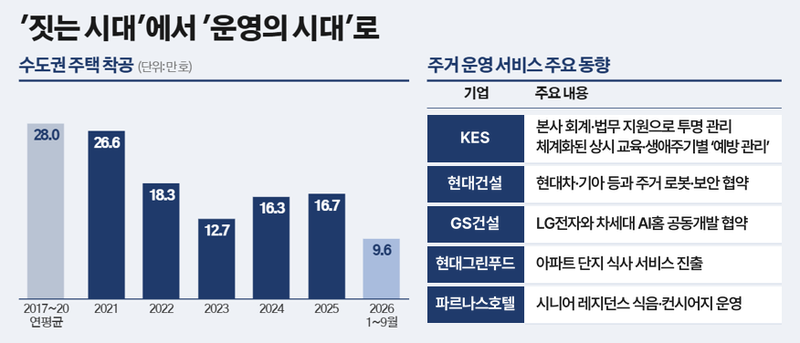
By contrast, housing starts, a leading indicator of future housing supply, are declining. According to the Ministry of Land, Infrastructure and Transport, housing starts in the Seoul metropolitan area totaled 9,308 units in September, down 43.3% from the same month a year earlier. Cumulative housing starts from January through September this year also fell 5.7% year over year to 96,047 units.
Annual housing starts in the Seoul metropolitan area totaled 163,255 units in 2024 and 166,823 in 2025. As the decline in housing starts could also affect future housing move-in supply, the need to maintain existing apartments is expected to grow further.
As the number of aging apartments increases, reserves for long-term repairs used to replace and repair key facilities are growing. Accumulated reserves for long-term repairs in multi-unit housing nationwide rose about 3.5-fold, from 3.1722 trillion won at the end of 2015 to 11.2489 trillion won as of August this year.
Changes in the internal and external environment surrounding apartment complexes are also heightening the need for professional management systems. According to the 2025 Population and Housing Census, the share of the population aged 65 and older exceeded 20% for the first time, while single-person households reached a record 36.6%, making resident populations more diverse. Management and lifestyle technologies being incorporated into apartment complexes, including AI and robots, are also advancing rapidly.
The construction industry is expanding the residential services it provides after residents move in. Hyundai Engineering & Construction has signed agreements with Hyundai Motor Company, Kia Robotics LAB, and Suprema, and plans to introduce robotic technologies in stages for security patrols, luggage transport, and resident guidance. GS E&C is developing an AI home solution specifically for multi-unit housing with LG Electronics.
Food service companies including Hyundai Green Food Co., Ltd. and CJ Freshway have also entered the apartment meal service market. Parnas Hotel plans to provide food and beverage, concierge, wellness, and other services at a senior living residence in Yongsan-gu, Seoul.
As the technologies and services offered by apartment complexes become more complex and legal requirements more extensive, management transparency has emerged as a key issue in the housing management industry, which is responsible for day-to-day operations on site.
KES, launched through the merger of four housing management companies, has begun standardizing its management systems. A professional housing management company overseeing about 1,500 complexes nationwide, KES plans to establish a system in which its headquarters provides support in safety, legal affairs, labor, and accounting.
It provides ongoing staff training through its in-house program, KES University, and plans to integrate the operating standards of the four existing companies
as well. It also plans to establish a management system tailored to the age of each property, covering everything from addressing defects soon after residents move in to inspecting and repairing facilities in older complexes, and to strengthen preventive inspections.
KES CEO Seo Il-seop said, “As the supply of new homes declines and people live in their homes longer, how transparently and efficiently residents’ management fees are spent is directly tied to the quality of their housing. We are working to enhance residents’ housing value through professional support and ongoing training.”
A real estate industry source predicted, “In the past, people chose homes based only on the apartment brand and the quality of the initial construction. Now, transparency in the management of fees after residents move in and the ability to manage key facilities and equipment have become factors that determine even a complex’s market value. The role of management companies that handle fees transparently and efficiently will grow further in the future.”
[email protected] Choi A-young Reporter