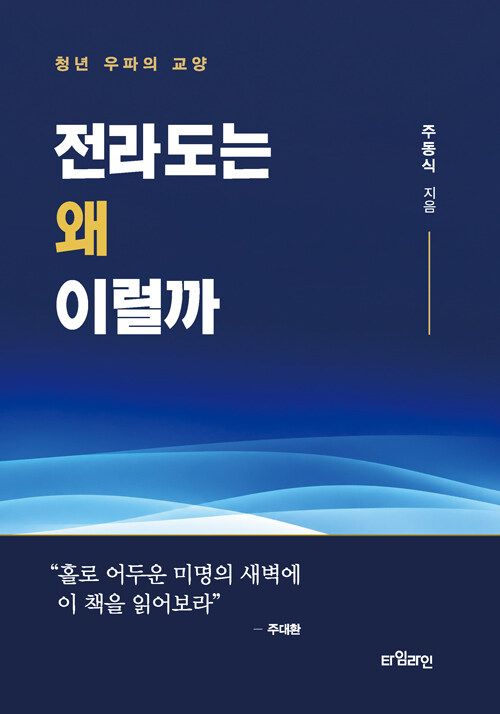
Why Is Jeolla Like This? / Joo Dong-sik / Timeline Author Joo Dong-sik, a native of Gwangju, South Jeolla Province, was a hardline leftist who, in his youth, was active in the Youth Coalition for Democratization Movement (Mincheongnyeon) and the Socialist Workers’ League (Sanomaeng). After democratization on June 29, he became a founding member of the Weekly Workers’ Newspaper. Since publishing ‘Honam and Pro-Roh’ in 2016, however, he has consistently taken the lead in bringing the ‘Jeolla issue’ into public debate. More specifically, he critically assesses the political, economic, and social realities of Jeolla—that is, Honam—explores their historical background and structural causes, and calls for fundamental change in Jeolla.
The author was the driving force behind the initiative to bring a mega-mall to Gwangju, which became a nationwide talking point during the 2022 presidential election, the country’s 20th. He also made blunt remarks such as, “Gwangju is a city of memorial rites for the May 18 Democratic Uprising.” As a result, people from the same region have called him a “turncoat” or a “traitor to his hometown.”
In his recent book, ‘Why Is Jeolla Like This?’, the author raises questions about the issue with even greater seriousness, force, and depth, without yielding an inch on his convictions.
“There is a saying that ‘Honam has an outstanding ability to unite a small number of people, wield its influence to the fullest, and get what it wants. In that respect, I think it is the greatest people in the world.’ But is that really a desirable phenomenon for Honam and South Korea?”“Honam has become mired in the logic that markets and businesses are evil while the public sector is good. Anti-business and anti-market thinking lies at its core. Examples include opposition to a mega-mall moving in, opposition to LG CNS establishing a smart farm in the Saemangeum district, and opposition to the redevelopment of Jeonju Sports Complex.” (p. 26)In the author’s view, the roots of the Jeolla problem are not merely a regional issue. He argues that Jeolla residents, marginalized in the allocation of resources during South Korea’s modernization and industrialization, went through the collapse of rural communities, outmigration, and a shift away from farming before settling on the outskirts of industrial belts. In the process, they internalized hostility toward industrialization and modernization and adopted an anti-South Korea stance.
“Looking beneath the surface, the problem in Honam should be understood as one of premodernity and leftist ideology. In other words, Honam remains trapped in an anti-modern, anti-South Korea straitjacket rooted in its marginalization during modernization, including industrialization.” (p. 83)“An economy in Honam based on political rather than market logic cannot become self-sustaining and must keep invoking political justifications to plunder state budgets and public resources. The moment it loses power, economic benefits also disappear. One consequence is the increasingly widespread anti-Honam sentiment.” (pp. 35–36) Joo Dong-sik, author of ‘Why Is Jeolla Like This.’ On these grounds, author Joo Dong-sik points out, “What I can state with certainty is that unless the Honam problem is resolved, South Korea will not only be unable to move forward even a single step, but the very survival of its system will also be at risk.” He goes on to say:
“The impeachments of Park Geun-hye and Yoon Suk Yeol, and the rise of the Moon Jae-in and Lee Jae Myung administrations, are the result of South Korea’s failure to resolve the Honam problem; to put it more bluntly, they are the result of South Korea’s defeat in its struggle with Honam. That result is likely to lead to South Korea’s collapse. (Omitted) If South Korea collapses, a system embodying premodern or anti-modern values will take its place. North Korea’s Kim dynasty and the People’s Republic of China are examples of such systems.” (p. 68)The author argues that the anti-business and anti-market, anti-American and anti-Japanese, pro-North Korea and pro-China views underlying Honam’s premodernity, along with its ultimately anti-South Korea orientation, have created a conflict structure of “Honam versus South Korea,” which has led to widespread anti-Honam sentiment. He also points to the failure of the 2023 World Jamboree held in Saemangeum, Jeonbuk State, as a consequence of a system unfamiliar with market logic.
“Not being familiar with market logic means not understanding modern systems of order or the mechanisms for carrying out work. In that respect, the Jamboree’s failure was inevitable. The recklessness and incompetence that disregard modern order were laid bare even in the efforts to deal with the failure of the Jamboree.” (p. 56)The author argues that “to resolve the Jeolla problem at its root, Honam must be criticized while the values of modernity are placed front and center.” He stresses the need to believe that Honam, too, can change, just as South Korea broke through the enormous barrier of premodernity to reach where it is today. This work is based on his firm belief that “one’s hometown is an object of affection, while South Korea is the object of one’s loyalty.”
“A more comprehensive ideological war, a battle of ideas with Honam, is needed. The point is not to attack Honam, but to criticize its errors and lack of modern training. This is a genuine expression of affection for Honam. It is the way for Honam and South Korea to move forward together.” (p. 69)In his recommendation, Joo Dae-hwan, an adviser to the Korea Republican Association, said, “I want to tell our country’s educated citizens, especially young people, that they should definitely read this book. I believe there is no writing quite so honest and courageous that lets you feel, above all, the power of profound prayer.” He added, “Let’s read this book alone in the dark hours before dawn. Let’s recognize that only those who truly love can be dispassionate.”
[email protected] Jang In-seo Reporter