The Hidden Trap Behind Lush Volume: A Warning About Hair Extension-Related Hair Loss [Kim Jin-oh's Hair Loss Escape]
- Input
- 2026-11-21 06:00:00
- Updated
- 2026-11-21 06:00:14
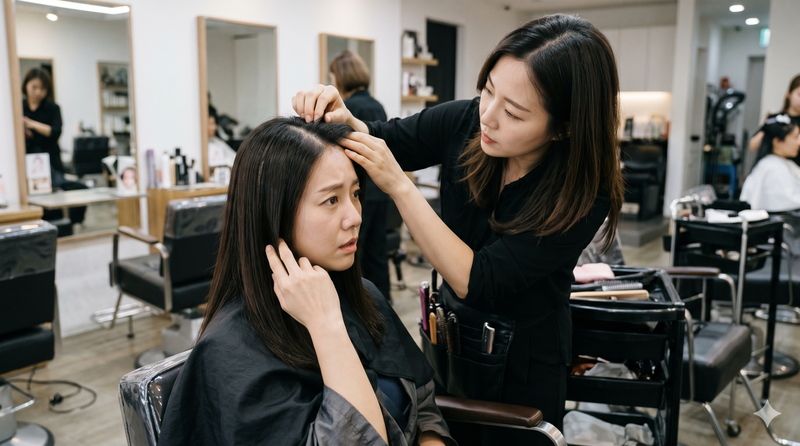
[Financial News] Recently, the story of a female entertainer’s hair extensions has drawn attention. She said she got extensions to add volume because her hair was fine. A hairstylist who examined her scalp said she might be losing hair at the back of her head. In fact, if extensions keep pulling on the hair, hair density can decrease in that area.
If you feel pain or pulling after getting hair extensions, don’t ignore it
It can feel awkward to ask for a redo after spending time getting your hair done. You may think it will feel normal after a few days. But if your scalp hurts while the extensions are being put in, or only the attached areas throb when you brush your hair at home, it’s best to ask for them to be loosened right away. The American Academy of Dermatology also recommends wearing extensions for no more than two to three months at a time and advises loosening the attachments immediately if pain or severe pulling develops.
The weight of each bundle of extensions is borne by the wearer’s own hair that secures it. The longer and heavier the extensions, or the more tightly they are secured from the outset, the more force is placed on that spot. The hair can break under that force. If the same area is pulled repeatedly, the hair follicles beneath the scalp can also be damaged. Hair loss caused by this kind of pulling is called traction alopecia. The same thing can happen even without extensions if you tie your hair tightly every day.
Hair density can decrease without pain... watch for redness or bumps
A British dermatology journal reported on four women who developed hair loss between 7 and 20 days after getting extensions. The women said that when their extensions came out, their own hair came out with them. Examination of their scalps under magnification revealed several small bare patches at the attachment sites, with short, broken hairs remaining in them. Four cases are not enough to gauge how common traction alopecia caused by extensions is, but it is worth noting that the thinning occurred in the same areas where the extensions had been secured.
If you develop pain after getting extensions and noticeable bare patches appear on your scalp, it is best to remove the extensions and seek medical care. If they were secured tightly, having the salon that applied them remove them may help reduce pulling on the hair during removal. Sometimes, however, hair density decreases at the extension sites even without noticeable pain. Close observation is important. The back of your head is easy to overlook even when you check the mirror each morning, so you can take a photo from behind to see whether the scalp is especially visible at the attachment sites. Redness or bumps in those areas are also signs that you should reduce the pulling force.
If you suspect hair loss and visit a clinic, the examination involves magnifying the scalp to inspect broken hairs and follicular openings. In some cases, the patient reports that their part had gradually widened even before getting extensions. In those cases, the clinician also checks for coexisting female-pattern hair loss. Knowing when and where the thinning began can help determine how much the extensions contributed.
Bare patches take three months to fill in... the scalp must recover fully before the next procedure
Removing the extensions or reducing the pulling force eases the strain on the scalp. Hair becomes visible in bare patches after about three months. However, if prolonged pulling has destroyed the follicles and left scar tissue, it is difficult to restore hair density in those areas. If the scalp remains red or painful after the extensions are removed, its condition should be checked before waiting for the hair to grow back.
If you got extensions to add volume to your hairstyle, using shorter, lighter hair only where needed can reduce the pulling force. It is best not to attach extensions to the fine baby hairs at either side of the forehead. If you tie your hair up while wearing extensions, tying it loosely will reduce the pulling.
Areas where hair has thinned may be the very spots you want to cover with extensions again. But putting extensions there again puts more weight on the remaining hair before new hair has even had a chance to grow. Even if you want to add volume again, it is better to leave those areas alone for a while.

/Kim Jin-oh, director of New Hair Plastic Surgery Clinic
[email protected] Kim Hyeon-seon Reporter