Will K-Entertainment Benefit Directly if the Hallyu Ban Is Lifted? ... “China Has 100 Million Hallyu Fans, the Most in the World”
- Input
- 2026-11-20 13:48:51
- Updated
- 2026-11-20 13:48:51
[Financial News] An analysis has found that profits at South Korea’s Big Four entertainment agencies—HYBE, SM Entertainment, JYP Entertainment and YG Entertainment—could rise by around 40% on average if large-scale K-pop concerts resume in mainland China. The forecast was presented on the 19th by Lee Ki-hoon, a researcher at Hana Securities. The analysis says concert ticket revenue would be added to existing album and merchandise sales, and sales of limited-edition products linked to tours could also expand.
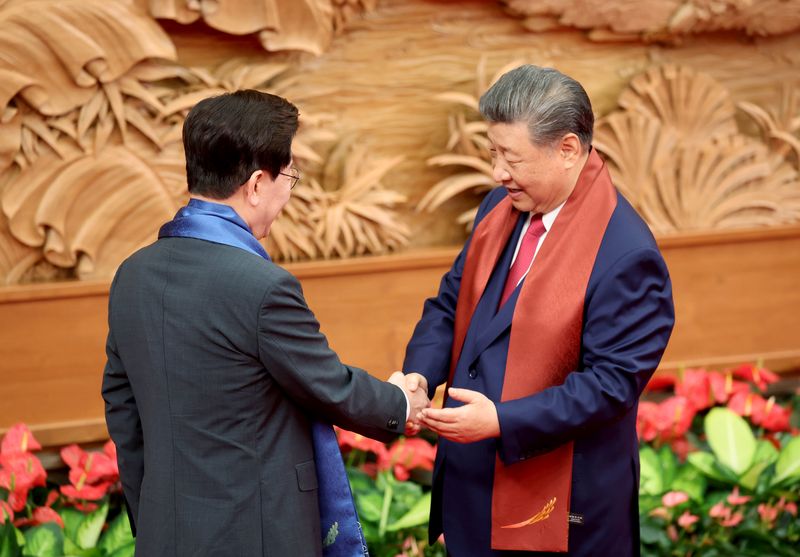
At the South Korea-China summit held in Shenzhen on the 18th, the two countries’ leaders agreed on the need to gradually expand cultural and content exchanges. However, no date was announced for allowing large-scale K-pop concerts in mainland China.
According to the Ministry of Foreign Affairs and the Korea Foundation’s “2023 Global Hallyu Status,” China had about 100.8 million Hallyu fan-club members at the end of 2023, equal to 45% of the approximately 225 million worldwide. That is about 3.6 times the number in second-place Mexico, at 27.8 million. The figure includes Hong Kong and counts fan-club members across Hallyu, including K-pop and dramas.
Among the prominent services Chinese fans already pay to use are Dear U Co., Ltd.’s “bubble” and “Idol Store,” a subsidiary of Cheongdam Global. Dear U partnered with Tencent Music Entertainment Group to launch bubble on the local music app QQ Music in June last year. Fans subscribe to artists’ messages, and Dear U receives a set percentage of sales proceeds as royalties.
Idol Store, a subsidiary of Cheongdam Global, distributes albums and merchandise from artists affiliated with South Korea’s Big Four entertainment agencies—HYBE, SM Entertainment, JYP and YG—primarily across Greater China. It sells products online through cross-border direct sales and has built a network of major local fan clubs in China. A key feature is its distribution network, which connects directly with core consumers.
Knowmerce launched its fan platform fromm on China’s WeChat in January this year and integrated WeChat Pay. According to figures from Shinhan Investment & Securities released by Knowmerce, the number of paid fromm subscribers in Greater China had risen by about 168% year on year as of July 14.
According to a corrected disclosure filed by Cube Entertainment on September 30, the value of its three-year music distribution contract with Tencent Music’s Zhuhai entity was finalized at about 12.2 billion won. The contract runs from October 2023 through September this year.
The effect of concerts driving merchandise sales can also be seen in HYBE’s BTS tour. Around 2 million pieces of official merchandise were sold across 31 shows on the “Arirang” tour, held in 12 North American cities from April to September this year. Sales at concert venues and orders through Weverse Shop for pickup at the venue were both used.
SM Entertainment opened China’s first official merchandise store, “SM Town Store Shanghai,” in April this year. In the third quarter, it sold concert merchandise alongside tours by aespa and NCT 127. On a standalone basis, SM Entertainment reported concert revenue of 34.5 billion won and merchandise and licensing revenue of 62.1 billion won for the third quarter.
JYP Entertainment operated pop-up stores in Japan in connection with Stray Kids’ tour. In China, it signed a contract in July this year with local commerce platform Xiaomang for a merchandise business using artists’ intellectual property and the distribution of official products.
YG Entertainment opened BLACKPINK world-tour pop-up stores in five Chinese cities, including Shanghai and Beijing, in August last year. Some products, including light sticks and character key rings, sold out early, prompting additional orders.
Meanwhile, the investment banking industry expects the benefits of an easing of the Hallyu ban to extend beyond large entertainment agencies. One industry source said, “If the resumption of concerts expands fandom spending, opportunities to generate revenue could spread to album and merchandise distribution and paid subscription platforms.” The source added, “However, the actual scale of the benefits is expected to vary depending on the scope of concert permissions, local distribution networks and revenue-sharing structures.”
[email protected] Kim Gyeong-a Reporter