Knowing Martial Law Was Unconstitutional Is Separate From Taking Part in an Insurrection... The ‘Purpose’ Standard Set by Han Duck-soo Ruling [Seocho Samgeori]
- Input
- 2026-11-22 14:56:06
- Updated
- 2026-11-22 14:56:06
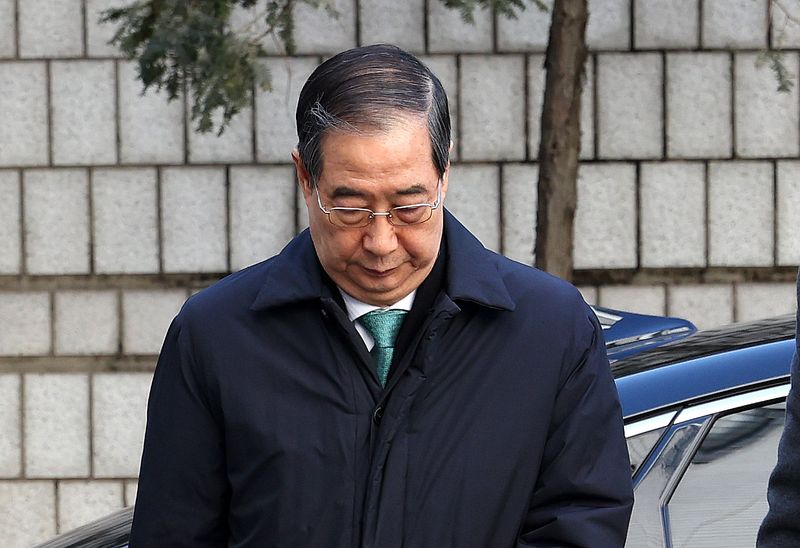
[Financial News] Was knowing that the 2024 South Korean martial law crisis was unconstitutional enough to count as participation in an insurrection? In the case of former Prime Minister Han Duck-soo, the Supreme Court distinguished awareness of unconstitutionality from the purpose of carrying out an insurrection. It said that awareness of the possibility of subverting the constitutional order was not enough; the court must determine whether, at the time of each individual act, the person intended to pursue or accept its realization. The standard for distinguishing official duties from participation in an insurrection is also drawing attention in the trials of other cabinet members.
According to legal circles on the 22nd, the Supreme Court en banc on the 19th reversed and remanded the lower court’s ruling, which had sentenced Han to 15 years in prison in a case involving charges of performing important duties in an insurrection, among others, with a view to partial acquittal. It found that a purpose to subvert the constitutional order had not been proven in connection with Han’s request to convene a cabinet meeting before martial law was declared. By contrast, it considered his post-declaration request for cabinet members’ signatures and discussions on carrying out measures to cut off electricity and water to media outlets to be participation in the insurrection.
Analysts say the ruling’s key point is not simply the timing distinction of whether an act took place before or after martial law was declared. The Supreme Court set out a standard requiring not merely awareness of the possibility of subverting the constitutional order, but an intent to pursue its realization and at least accept it, to establish the purpose required for the crime of performing important duties in an insurrection. The majority and dissent agreed on this legal principle, but differed in their assessments of Han’s specific actions.
Lee Sang-young, a partner attorney at law firm JR, explained, “The key is that awareness of unconstitutionality was separated from purpose.” The request to convene a cabinet meeting before the declaration could be viewed as a legitimate act of official duty aimed at calling for the deliberation required by the Constitution. The Supreme Court majority also found it difficult to rule out the possibility that Han had sought to delay the declaration of martial law or persuade then-President Yoon Suk Yeol to reconsider his decision.
By contrast, the court found that the situation changed after the declaration. Han’s request for cabinet members’ signatures on martial-law-related documents and his discussion with then Interior and Safety Minister Lee Sang-min about carrying out power and water cutoff measures took place in circumstances in which he could have recognized the unconstitutionality of martial law that had already been declared. The explanation, however, was that the fact that he could have recognized its unconstitutionality must be distinguished from a finding that he had the purpose of subverting the constitutional order.
The Special Prosecutor Team for Insurrection and Treason, led by Cho Eun-seok, said it respected the Supreme Court’s conclusion but expressed regret over its finding in favor of partial acquittal. The team argued there was sufficient evidence supporting the view that Han intended to give martial law procedural legitimacy, including circumstances suggesting that he joined in selectively summoning cabinet members to meet the quorum. It also noted that the courts of first and second instance had accepted this, while the Supreme Court reached a different conclusion.
The three Supreme Court justices who dissented also reflected this difference in the assessment of the facts. Justices Oh Kyung-mi, Shin Sook-hee and Kim Seong-su dissented on the grounds that the events should be viewed as a continuous sequence, from the call to convene a cabinet meeting before the declaration through the actions taken afterward.
Attorney Lee said, “If the majority placed weight on the fact that no expression of opposition before the declaration or prior awareness had been established, the dissent considered it difficult, in the context of a self-coup, to treat formal compliance with procedures as grounds for finding the actions lawful.”
This difference of opinion is also tied to how much continuity between actions should be considered when inferring a purpose to subvert the constitutional order from circumstantial evidence. The legal assessment of the same evidence may differ depending on whether the intent at the time is judged by examining each act separately or a single purpose is inferred from actions spanning the period before and after the declaration.
Another issue is whether a prime minister can be held criminally liable for failing to fulfill constitutional duties. The special prosecutor argued that Han, as vice chair of the State Council, abandoned his duty to ensure that substantive deliberation took place. However, the appeals court and the Supreme Court did not find that he had performed important duties in an insurrection by omission.
The constitutional duty to check the president is separate from whether criminal liability for an omission is established. A violation of official duties alone does not constitute the crime of insurrection; the court must examine the specific duty to act, the possibility of preventing the crime, intent and other factors.
The legal principles in this ruling are expected to serve as a reference in cases involving other cabinet members, although they are not directly binding in those cases. In the case of former Minister Lee, the key issue is his alleged involvement, after martial law was declared, in orders to cut off electricity and water to media outlets. For former Justice Minister Park Sung-jae, the issues include measures such as considering the dispatch of prosecutors to the Joint Investigation Headquarters and checking the available capacity at correctional facilities.
Attorney Lee said the ruling’s impact could be limited because Han’s pre-declaration request to convene a cabinet meeting differs in nature from the actions of other cabinet members. He explained that the ruling would be unlikely to work in former Minister Lee’s favor in particular, given that the issue in his case is his conduct related to power and water cutoffs after the declaration.
By contrast, Attorney Lee assessed that former Minister Park could argue that his post-declaration instructions were merely administrative contingency measures and that he did not seek or accept the realization of subversion of the constitutional order. The point is that even when the same legal principles are applied, the outcome may differ depending on prior awareness, the person’s intent at the time of the conduct, and how much the person actually contributed to carrying out the insurrection.
Han’s case will be reheard by the Seoul High Court. Attorney Lee said the sentence could be reduced if the finding that his pre-declaration conduct warranted acquittal is reflected in the retrial. However, the specific sentence will be determined only after the court reassesses the remaining convictions and sentencing factors. The special prosecutor said it would make every effort to maintain the prosecution through the final appeal in related cases as well.
Ultimately, the standard established by this ruling is that participation in an insurrection cannot be presumed solely from holding a particular position or being involved in cabinet procedures. In future trials, the key will be to prove with specific evidence whether each act substantially contributed to carrying out the insurrection and whether the person involved intended, at the time, to bring about the subversion of the constitutional order.
[email protected] Yu Seon-jun Reporter