“After Repeatedly Applying Pressure to Cancer Tissue...”: Metastasis Increased and Anticancer Drug Effectiveness Declined
- Input
- 2026-11-22 12:00:00
- Updated
- 2026-11-22 12:00:02
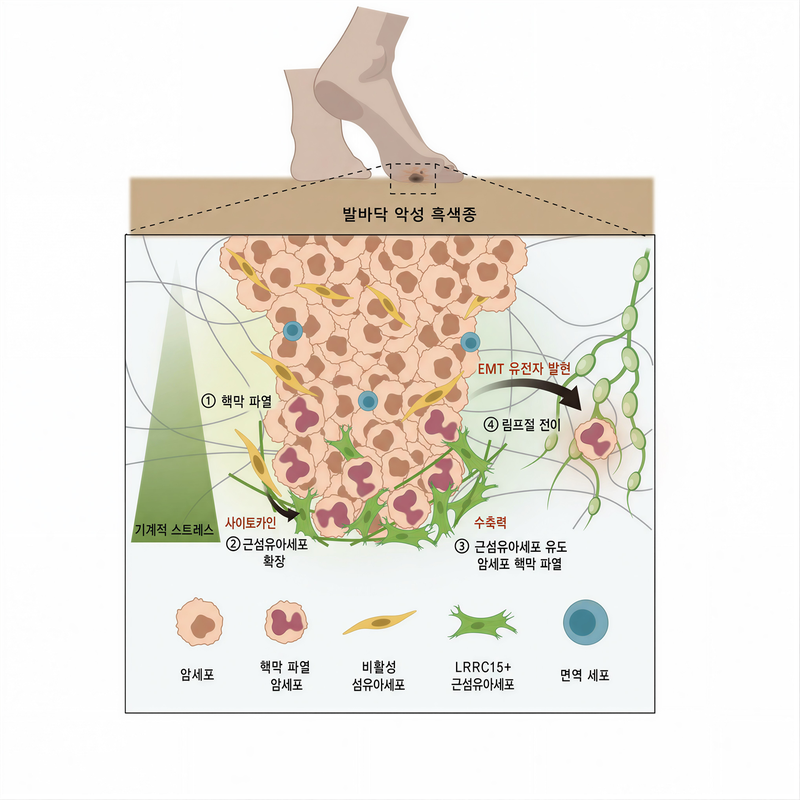
[Financial News] Cancer tissue exposed to repeated stimulation was found to damage even the normal cells surrounding cancer cells. The findings raise hopes that understanding the physical interactions between cancer cells and surrounding tissue could lead to a new treatment strategy to prevent metastasis.
KAIST (Korea Advanced Institute of Science and Technology) said on the 22nd that research teams led by Professors Kim Jun and Park Jong-eun of its Graduate School of Medical Science and Engineering and Professor Park Hyeong-sun of its Department of Mechanical Engineering had worked with a team led by Professor Roh Mi-ryeong of Yonsei University Gangnam Severance Hospital to identify how repeated pressure changes melanoma cells and surrounding tissue, and had found differences in cancer metastasis and the effectiveness of immunotherapy drugs.
Melanoma is a cancer that develops in the cells that produce pigment in the skin, and it can become difficult to treat if it spreads to other organs. It is known to occur relatively often on the soles of the feet, in areas that bear weight and are subject to high pressure.
In an earlier study, the research team found that repeated pressure damages the “nuclear membrane” surrounding the nucleus of cancer cells. The nuclear membrane is a protective layer around the nucleus, which contains genetic information. This time, the team investigated whether damage to this protective layer affects surrounding cells as well as cancer cells.
To investigate, the researchers implanted melanoma cells in the soles of mice and then applied repeated pressure. They found that the nuclear membranes of the cancer cells were damaged while nearby “fibroblasts” also changed. Fibroblasts normally support tissue and help wounds heal. In cancer tissue, however, they can also help cancer cells grow and spread.
An analysis of gene activity in individual cells and their locations within the tissue showed an increase in “myofibroblasts,” which exert a pulling force on surrounding tissue, in cancer tissue exposed to repeated pressure. The researchers identified these cells using a marker called LRRC15. The changes were especially pronounced at the edges of more heavily pressurized cancer tissue.
Damage to cancer cells’ nuclear membranes and changes in surrounding cells were interconnected. Similar changes in surrounding cells occurred when the researchers weakened the cancer cells’ nuclear membranes through genetic means. Conversely, the team also found that myofibroblasts promote damage to cancer cells’ nuclear membranes. When the cancer cells’ protective layer was damaged, surrounding cells changed, and those altered cells in turn exacerbated the damage to the protective layer, creating a “vicious cycle.”
There were also differences in cancer metastasis and treatment effectiveness. In mice exposed to repeated pressure, more cancer cells spread to the lymph nodes, while immunotherapy drugs—which help the body’s immune cells attack cancer—were less effective.
The joint research team also examined tissue from patients with melanoma. Tumors in high-pressure areas showed changes in surrounding tissue, and lymph node metastasis was observed more frequently. However, these changes were not directly linked to patients’ overall survival. Nor can the researchers conclude from the co-occurrence of these findings in patient tissue alone that pressure caused the metastasis.
Professor Kim Jun said, “This study shows that repeated mechanical stimulation can affect cancer metastasis and treatment resistance not only by inducing damage to cancer cells’ nuclear membranes but also by changing the normal cells around them.” He added, “Understanding the physical interactions between cancer cells and surrounding tissue could be an important clue in developing new cancer treatment strategies.”
The findings were published online on October 20 in Cancer Research, an international academic journal published by the American Association for Cancer Research (AACR).
[email protected] Yeon Ji-an Reporter