Let's Bring Back the Warmth of 'Miryang Theater City' With a Sustainable Creative System
- Input
- 2026-11-20 09:53:42
- Updated
- 2026-11-20 10:05:28
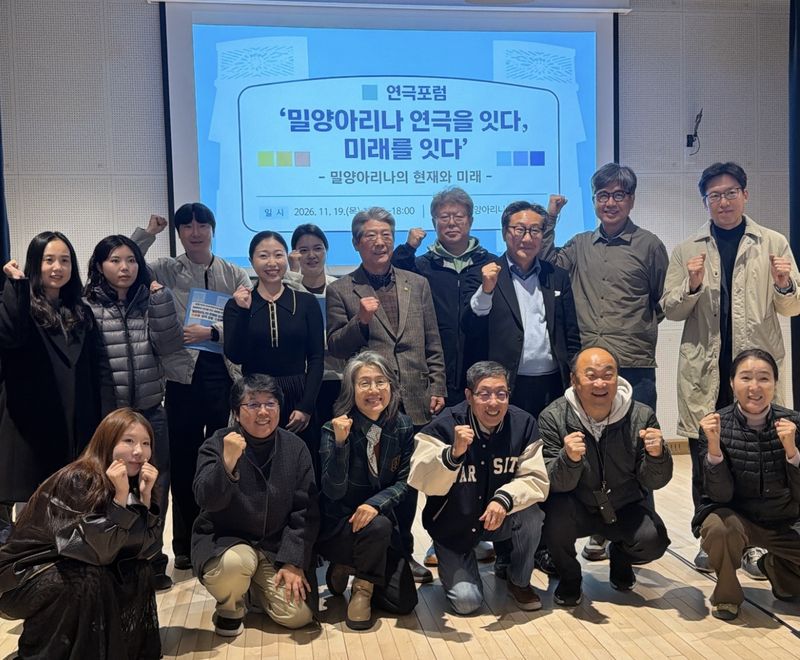
[Financial News] Daekyung University Professor Kun Pyo Kim of the Department of Acting Arts emphasized at a policy forum on development plans for 'Miryang Arina: Present and Future,' held on the 19th during the 16th Gyeongnam Theater Artists Festival, that "to revive Miryang's warmth as a theater city, establishing a sustainable system for creation, production and education, along with a residential creative residency system, must come first."
In a presentation that day titled 'Miryang Arina's Historical Transition and Directions for Sustainable Development,' Professor Kim said that "the future of a theater city depends on who can create and produce what kind of theater, and how consistently, in the unique environment of Miryang Arina."
He went on to explain that, for Miryang Arina to recover the communal creative energy it had during the days of Miryang Theater Village, it must go beyond simply operating a performance venue and holding festivals to build a sustainable creative ecosystem where theater artists live on-site and creation, rehearsals, production and performances take place as part of everyday life.
Miryang Theater Village became a major creative hub for theater artists in Korea when full-fledged theater creation activities got underway there in 1999, centered on Yeonhui-dan Georipae.
The existing management system changed around the 2018 MeToo scandal. After a period of university partnerships and K-STAR activities centered on young artists, the system has now shifted to one centered on theater artists from Gyeongsangnam-do.
Professor Kim divided the historical transition of Miryang Theater Village into three periods and examined the achievements and limitations of each.
The first period (1999–2018) was when the village formed an identity as a collective creative space centered on Yeonhui-dan Georipae, bringing together creative work, education and performances.
The second period (from 2018 onward) was a time when new operational possibilities were explored amid changes to the existing management system, including university partnerships and K-STAR activities centered on young artists. He described the third period (the present) as one in which the management system was reorganized around theater artists from Gyeongsangnam-do, making ties with the local theater ecosystem an important task.
He noted that Miryang Theater Village had once been a space where theater artists' collective creation and experimentation, education and performances were organically integrated.
By contrast, he pointed out that Miryang Arina's systems for creation, production and retraining are relatively underdeveloped compared with its facilities and operations, citing the lack of permanent creative entities, a nationwide creative network and a residential residency system where playwrights, directors and actors can retrain.
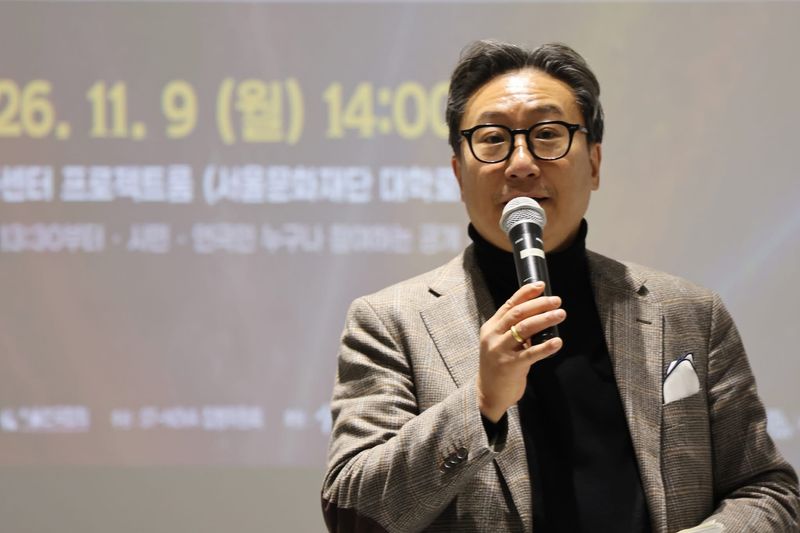
Professor Kim said, "Miryang, the theater city, has become a city that serves as a public asset for theater artists." He emphasized, "Rather than simply putting on enjoyable and entertaining performances, we need to develop works that can be seen only in Miryang. We need a residential creative residency system and an environment for retraining, where creators stay for a set period to develop a work, then proceed through rehearsals and a showcase to a full production and subsequent performances."
To that end, he proposed seven directions for development: operating creative residencies, securing permanent creative entities, fostering young theater artists, co-producing with local theater companies, establishing a performance distribution system, overhauling the professional management system, and drawing up a mid- to long-term development plan.
He also concluded that the way the Miryang Performing Arts Festival is run needs to change.
Professor Kim proposed that "the Miryang Performing Arts Festival also needs to move away from its current foundation-centered management system, reintroduce the artistic director model and make a fresh start as a more flexible theater festival."
He added, "The sustainability of a theater festival depends on works and programs that balance artistic merit, experimentation and popular appeal." He assessed that "in this respect, the recent content of the Miryang Performing Arts Festival leaves a great deal to be desired."
In addition to Professor Kim, writer Lee Mu-yeol of Jeonhwan Studio Wawoldang presented on 'A Strategy for Korea's Performing Arts Hub Cities.' Researcher Cho Ye-na of the Korea Craft & Design Foundation (KCDF) then presented on 'Miryang Arina's Achievements and Challenges.'
Local theater figures attended the policy forum on development directions for Miryang Arina and exchanged views on its present and future and ways to invigorate the local theater ecosystem. They included Kim Eun-min, head of Miryang Medley; director Mun Jong-geun of Gaekseokgwa Mudae Theater Company; Ko Neung-seok, head of Theater Company Hyeonjang; director Son Min-gyu of Haman's Asirang Theater Company; and Kim Su-hyeon, chair of the Gyeongnam Theater Association.
Theater critic and professor Kun Pyo Kim, who has been active in theater since the 1990s, served as chair of the organizing committee and chief artistic director of the Miryang Performing Arts Festival in 2020. The following year, he also served as the festival's artistic director. He was credited with helping Miryang Theater Village and the Miryang Performing Arts Festival, which entered a period of transition after the MeToo scandal, make a fresh start as a citizen-friendly, nationwide festival for theater artists.
His books include 'Mr. Croaker and the Acting World He Peeks Into,' 'Reading Contemporary Theater,' 'The Contenders of Korean Theater' and 'Scene Acting Text,' along with numerous other books on theater and interview collections.
[email protected] Byun Ok-hwan Reporter