AI Assesses Lane Markings, New Materials Delay Icing... KICT Develops Road Safety Technology
- Input
- 2026-11-20 08:39:04
- Updated
- 2026-11-20 08:39:04
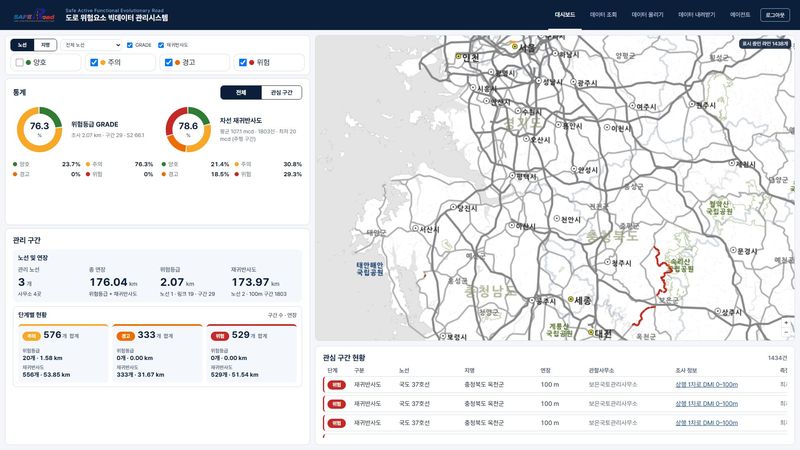
[Financial News] Technology has emerged to detect and reduce road-surface hazards in advance, such as lane markings that become difficult to see at night or in rainy weather and black ice in winter.
According to the Korea Institute of Civil Engineering and Building Technology (KICT) on the 20th, a research team at its Road Transport Research Division, led by Yang Seong-rin, is conducting research spanning the diagnosis of road-surface hazards, ice prevention and field validation. The work is part of the Ministry of Land, Infrastructure and Transport (MOLIT)-funded national R&D project “Development of Technologies to Reduce Road-Surface Hazards That Cause Traffic Accidents (2023–2027).” The goal is to move beyond the conventional approach of making repairs or spreading de-icing agents after problems arise and establish a proactive system that continually monitors road conditions and manages risks in advance.
Survey vehicles and advanced sensors are at the heart of the diagnostic technology. AI analyzes information gathered by the vehicles on lane-marking visibility, pavement damage and road-surface conditions to quickly identify hazardous sections. The team is developing “One-Scan,” a combined survey technology that can assess lane-marking visibility, road-surface defects and icing conditions in a single pass on high-speed, multilane roads without disrupting traffic.
The response to icing focuses not only on prediction and warnings but also on making the pavement itself inhibit ice formation. The team independently developed new construction materials for ice prevention and combined them with paving methods suited to Korean road conditions to develop technology that prevents or delays ice formation. It has established the entire process using domestic technology, from source materials and performance testing to long-term durability verification, field demonstrations and instrumented monitoring. Test methods, evaluation criteria and performance-assessment facilities have also been organized, laying the groundwork for standardization.
Statistics presented by the research team show that road-surface hazards increase the severity of crashes. There are 2.1 fatalities per 100 crashes on wet roads and 2.9 on icy roads, more than the 1.5 on clear days. Lane markings are also inadequately maintained. A comprehensive Seoul city survey found that, as of 2022, at least 90% of road markings fell short of retroreflectivity standards. In one case, fatalities fell by 56% after road markings were properly installed.
The government is also stepping up its response to icing-related crashes. According to the Ministry of the Interior and Safety (MOIS), 3,944 traffic crashes caused by black ice on roads and other factors occurred over the five years from 2019, resulting in 95 deaths. In its measures to prevent icing-related crashes announced last February, MOIS said it would expand the highway road-weather observation network from 366 sites in 2025 to 469 by 2026. The measures also call for ice-related vulnerabilities at tunnel entrances and exits and on bridges to be assessed from the design stage.
KICT plans to further improve the technology's performance and continue field demonstrations. It will work with road management agencies to expand its application on actual roads and establish a foundation for performance assessment and institutionalization. Once put into practical use, the technology is expected not only to reduce crash risks but also to improve the efficiency of road maintenance and reduce the use of de-icing agents.
KICT President Park Sun-kyu said, “A road environment where lane markings are clearly visible and people can drive with confidence even in winter is the aspect of safety the public experiences most directly.” He added, “By integrating AI-based diagnostics with functional pavement technologies, we will reduce traffic crashes and produce research outcomes closely connected to people’s lives.”
[email protected] Jeong Gyeong-su Reporter