“The Full-Scale Crash Hasn’t Started Yet” ... Analyst’s Warning After Setting Targets of 70,000 Won for Samsung and 200,000 Won for SK hynix
- Input
- 2026-11-20 08:35:56
- Updated
- 2026-11-20 08:35:56
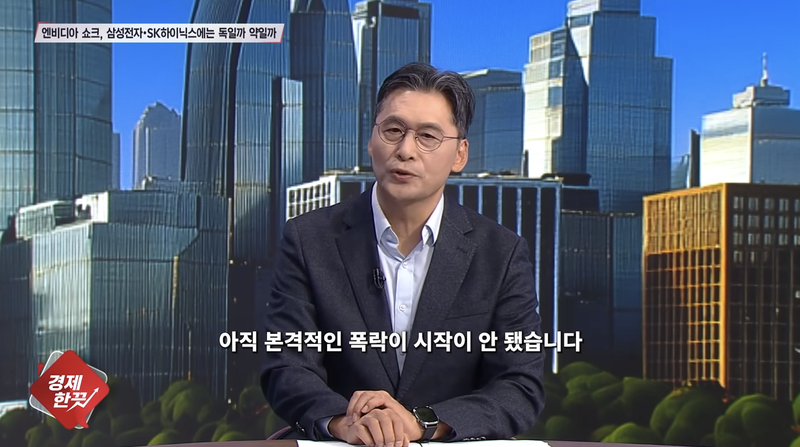
[Financial News] Lee Ju-wan, an industry analyst who set fair price targets of 70,000 won for Samsung Electronics and 200,000 won for SK hynix, forecast that the two companies’ share prices could fall substantially further if memory prices turn downward.
The analyst appeared on the YouTube channel “Jisik Hankkeut” on the 18th and said, “The full-scale crash hasn’t started yet. A full-scale crash in memory companies’ share prices will happen only when prices start falling, and memory prices haven’t started falling yet.”
Asked about his forecast of fair price targets of 70,000 won for Samsung Electronics and 200,000 won for SK hynix, he said, “That hasn’t changed. They’re bound to reach those levels.”
He predicted, “When reports start coming in toward the end of this year or early next year that memory prices have begun to fall in earnest, securities firms will race to sharply cut their earnings forecasts for memory companies for next year and the year after.”
He added, “I believe the memory cycle had already peaked in the third quarter of this year,” and said, “Operating margins at the three memory companies likely peaked in the third quarter.”
He cited past cycles as a basis for the scale of the decline. The analyst said, “Once memory prices start falling, they drop 50% within a year and 90% within two years. The normal price is the price when all three memory companies are in the red, and if they are losing money in two to three years, it’s only natural for share prices to return to the levels they were at then.”
He countered the market’s argument that a backlog of orders would push sales to a peak next year, calling it an illusion created by the appearance of a sellout. He said, “Utilization is currently 70%, and even if we lower it to 70%, we still sell out. If utilization reaches 100%, that means 30% is inventory.”
He added, “Starting next year and the year after, we’ll have no choice but to increase utilization of that 30%. Otherwise, China will take it all.” He said, “That’s why a price decline is inevitable.”
He also pointed out that current earnings improvements depend on higher prices, not increased production. The analyst said, “Production and shipments are the same as they were a year ago. For manufacturers, the fact that production is unchanged means the companies haven’t grown at all. Earnings have improved solely because prices have risen, and those prices were driven not by increased demand but by suppliers cutting production.”
He said, “Even if Samsung Electronics and SK hynix don’t increase production, output keeps rising because of Micron and China,” adding, “I see the shift to oversupply happening at the end of this year.”
He also saw NVIDIA as playing a role in the semiconductor stock bubble. He said, “Companies can’t create demand. But a market in which NVIDIA has been forcefully creating demand for suppliers has continued for three years, which is why there’s a bubble now,” adding, “The current rise in share prices is abnormal and has nothing to do with the cycle.”
He also criticized how the two companies were using their accumulated cash. The analyst said, “I expect them to lose the ongoing class-action lawsuit in the United States, and damages could range from at least tens of trillions of won to as much as 1,000 trillion won. Hundreds of trillions of won in cash should be set aside as provisions, and since oversupply is inevitable from next year anyway, they should actually delay capital investment.”
On the future balance of power in the artificial intelligence (AI) industry, he said, “Ultimately, it will be a competition in software rather than hardware.” He emphasized, “Weak design capabilities are a chronic problem for Korean companies, so they must invest in research and development (R&D) and acquire companies with strong design capabilities through mergers and acquisitions (M&A).”
He told investors, “If you’re a short-term investor, greater volatility could create opportunities to take advantage of, but if you’re investing for a year or longer, you absolutely shouldn’t buy, because prices will fall far below what you paid.”
Earlier, when Samsung Electronics and SK hynix shares had fallen to 210,000 won and 1.26 million won, respectively, in October, the analyst drew attention from retail investors by setting fair price targets of 70,000 won and 200,000 won.
At the time, he said, “Share prices reflect a company’s future value,” adding, “I don’t think it’s at all possible for earnings to be 107 trillion won a year from now.”
According to the Korea Exchange (KRX) on the 20th, Samsung Electronics closed the previous day at 196,900 won, up 1.13% from the previous session, while SK hynix finished at 1,183,000 won, up 3.41%. The KOSPI fell as low as 4,963.61 intraday, dropping below the 5,000 mark, before closing at 5,137.89, up 70.45 points (1.39%) from the previous trading day.
[email protected] Seong Min-seo Reporter