Trump Says Decision on Further Large-Scale Strikes Against Iran Will Be Delayed Until Next Year
- Input
- 2026-11-20 07:42:41
- Updated
- 2026-11-20 07:42:41
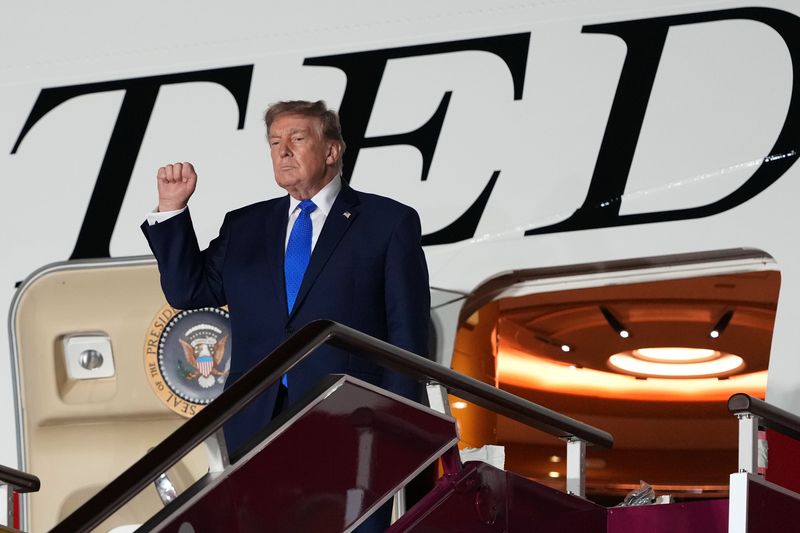
[Financial News] U.S. President Donald Trump has signaled that he intends to delay until next year a decision on additional large-scale airstrikes against Iran. He appears to be pushing back the timeline he had previously outlined, saying he could resolve the Iran issue immediately after this month's U.S. midterm elections, and taking time to regroup.
On the 19th local time, aboard Air Force One as he returned to Washington after his visit to China, Trump was asked by reporters about the possibility of new airstrikes against Iran. He replied, “Let’s talk about it only after the beginning of next year has passed,” adding, “We have time.” In recent weeks, Trump has alternated between threatening to escalate military tensions with Iran and signaling a willingness to ease hostilities, leaving efforts to resolve the conflict at an impasse.
In a Fox News interview that aired that day, Trump also said, “We’ll see what happens after January 1.” He struck a consistent note in separate interviews with the U.S. online outlet Axios and Israel’s Channel 12, saying, “I’m in no rush to make any decision about Iran.”
Before the congressional midterm elections held on the 3rd, Trump had repeatedly claimed that, amid a conflict in its eighth month, Iran would become more active in negotiations once the election was over. But after the ruling Republican Party lost its majority in both the House and Senate in the election, the Trump administration said last week that its blockade of Iran and economic sanctions were proving effective.
Meanwhile, the Republican-led U.S. Senate, which will retain its majority until January 3 next year, again rejected a resolution aimed at limiting the war with Iran that day.
Trump acknowledged that the Iran situation had played some part in the midterm election defeat, but stressed that he would not have changed course on policy. Vice President JD Vance, mentioned as a potential presidential contender in 2028, publicly distanced himself from the administration, citing the war with Iran as a cause of the party’s crushing defeat in this election. Trump later excluded Vance from diplomatic work on Iran and instructed him to focus on domestic issues.
Asked about Vice President Vance’s social media post, Trump replied, “JD was fine. What he said was right,” adding, “He said the whole situation was certainly one of the reasons the election didn’t go our way.” He went on to say, “The important question is, ‘If we went back to that time, would we do the same thing?’ My answer is ‘yes,’ because we can’t let Iran have nuclear weapons.”
Meanwhile, the joint statement issued that day after Trump met with the leaders of China and Russia did not include any mention of the conflict with Iran.
In a Fox News interview, Trump played down the threat in a recent CNN report that Iran was planning to detonate a “dirty bomb”—conventional explosives mixed with radioactive material—in Washington, D.C. Asked whether Washington residents should be on alert, he dismissed the concern, saying, “I don’t think so.”
However, without offering specific evidence, he cited indications that Iran was pursuing chemical and biological weapons. Trump said, “There are signs Iran is looking at gas [chemical weapons] and biological weapons because we blocked its development of nuclear weapons,” adding, “Nuclear weapons are much harder, so they’re looking at gas and biological weapons, and other things.”
Iran’s Foreign Ministry responded on X (formerly Twitter) that U.S. claims Iran was developing chemical and biological weapons were intended to stoke fear and justify military action, and dismissed the earlier CNN report as “baseless claims.” Western countries, including the United States and Israel, have long accused Iran of pursuing nuclear weapons, but Iran has denied this. When Trump carried out airstrikes on Iran alongside Israel last February, he cited the destruction of Iran’s nuclear program as a key justification.
[email protected] Yoon Jae-joon Reporter