European Leaders Reject 'Yalta 2.0'
- Input
- 2026-11-20 06:42:09
- Updated
- 2026-11-20 06:42:09
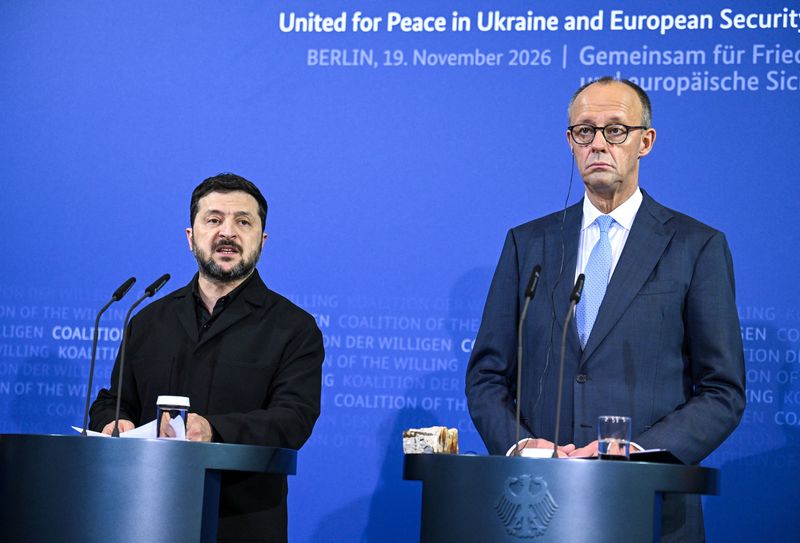
[Financial News] Just hours after U.S. President Donald Trump, Russian President Vladimir Putin and Chinese President Xi Jinping met in Shenzhen, China, on the 19th, European leaders firmly rejected attempts by major powers to divide up spheres of influence as a way to end Russia’s war in Ukraine.
Euronews and other foreign media reported that German Chancellor Friedrich Merz said after a meeting of the “Coalition of the Willing,” made up of Ukraine’s allies, in Berlin, “The Yalta approach will not bring peace.” Merz said, “At Yalta, Europe was divided and carved up. We will not let that happen again,” and presented the roughly 40 delegations attending the meeting with a fragment of the Berlin Wall as “a symbol of what Yalta represents.”
The Berlin meeting took place shortly after President Trump, President Putin and President Xi held their first-ever trilateral meeting in Shenzhen. Some media commentators called the meeting “Yalta 2.0” and raised the possibility of a reshaping of spheres of influence, but Ukraine was not mentioned in the joint statement issued by the three leaders, titled “Declaration Toward Peace.”
French President Emmanuel Macron, seated beside Chancellor Merz, rejected the idea that the four-point statement issued in Shenzhen reproduced the outcome of the 1945 Yalta Conference, which laid the foundation for the 40-year Cold War. “I don’t see it as a reshaping of the world,” Macron said, stressing, “If there is a decisive factor in the reshaping of Europe and its security, it is the meeting being held here in Berlin today.”
Macron said Ukraine, Europe, the United States and Russia must sit at the same table for negotiations to end the war. “Europe is not an item on the menu for discussion, but a group of actors seeking to build their own future,” he said. British Prime Minister Andy Burnham added, “There can be no decisions about Ukraine without Ukraine, and no decisions about European security without Europe represented.” Ukrainian President Volodymyr Zelenskyy also said the Berlin meeting showed that Russia had failed in its attempt to sow divisions among European allies.
The leaders of the four countries agreed that the time had come for Europe to engage directly with Russia in face-to-face negotiations. Europe has appointed a seven-member joint delegation for the next round of talks, drawn from France, the United Kingdom, Germany, Poland, Italy, the European Union (EU) institutions and NATO.
U.S. envoys Steve Witkoff and Jared Kushner, who flew in to attend the Berlin meeting, also urged Russia to allow Europe to participate. At the closing press conference, Kushner said, “I believe it is essential for Europe to be at the table to end the war in a just, long-term and sustainable way,” adding, “The Russian side is also willing to trust us to make that judgment on our behalf.”
Moscow, by contrast, has made no firm commitment to a multilateral negotiating format. In remarks in Shenzhen, President Putin said, “We proposed through diplomatic channels that the Europeans come to Moscow to determine their position, after which the Kremlin will decide whether to continue dialogue with Ukraine.” Referring also to Moscow’s demands for a restructuring of Europe’s security architecture, he said, “It would be strange to discuss European security without Europe.” President Macron criticized this as an extreme demand.
Chancellor Merz said discussions on European security would take place only after peace had taken hold in Ukraine, and that future security guarantees for Ukraine after the war would inevitably have repercussions for the transatlantic alliance. The security guarantee options currently under consideration include a clause modeled on NATO’s Article 5 collective-defense provision in the event that Russia invades Ukraine again, as well as the deployment of a European-led peacekeeping force. President Putin has said that he would not allow peacekeeping forces under any circumstances.
“From the U.S. perspective, providing security guarantees similar to NATO Article 5 is a really big deal,” Kushner said. “I think President Trump is open to it, but of course it must serve the U.S. national interest.”
According to Kushner, during the closed-door discussions in Berlin, President Trump called from the plane he was aboard and addressed the meeting. Some media reported that Trump appeared skeptical of Europe’s military support for Ukraine. But the European leaders stood firm and agreed to continue their support so Ukraine could secure a strong position at the negotiating table.
[email protected] Yoon Jae-joon Reporter