Trump-Kim Jong Un Meeting on Sidelines of Shenzhen APEC Summit Falls Through
- Input
- 2026-11-20 06:09:35
- Updated
- 2026-11-20 06:09:35
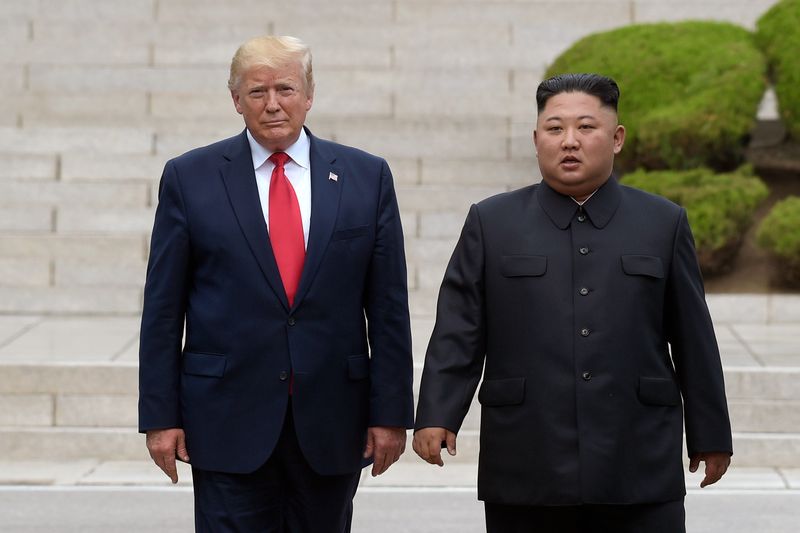
[Financial News] The summit between U.S. President Donald Trump and North Korean leader Kim Jong Un, whose prospects had drawn attention ahead of the Asia-Pacific Economic Cooperation (APEC) summit in Shenzhen, China, ultimately failed to materialize. After the meeting between the U.S. and North Korean leaders also fell through at last October’s APEC summit in Gyeongju, the two leaders have now failed to meet for a second consecutive year, and the stalemate on the Korean Peninsula is expected to continue for the time being.
According to diplomatic sources and major international media outlets, President Trump completed all his scheduled summits with Chinese President Xi Jinping and Russian President Vladimir Putin on the evening of the 19th and set off for home. During his tour of Asia, Trump repeatedly raised the possibility of meeting Kim, publicly signaling his willingness to talk. But North Korea ultimately did not respond, and the leaders did not meet.
Despite Trump’s repeated ‘outreach,’ Kim maintained a focus on domestic affairs, moving between the East Sea coast and areas along the North Korea-China border, and effectively signaled his refusal. North Korea’s Korean Central News Agency reported that Kim conducted on-site guidance on the 17th and 18th at construction sites for regional development policy projects—including fish farms and greenhouse farms in Riwon and Rakwon counties, South Hamgyong Province—and at Kim Jong Suk Naval University in Hamhung. After inspecting the tourist district around Mount Paektu in Samjiyon, Ryanggang Province, on the 15th and 16th, he visited local sites for four consecutive days, appearing to prioritize internal unity over sending messages abroad.
Experts say North Korea appears to have concluded that there is little benefit in holding a summit with the United States at this point, and that the fundamental conditions for dialogue are not yet in place.
Above all, the two sides remain far apart on the nuclear issue. North Korea maintains that it can only enter into talks if the United States recognizes it as a de facto nuclear-weapon state and abandons its hostile policy toward the country. The U.S. State Department, by contrast, reaffirmed its longstanding principles in a fact sheet on the outcomes of the East Asia Summit (EAS), released on the 18th, stating, “The United States remains committed to the complete denuclearization of North Korea and the full implementation of United Nations Security Council (UNSC) resolutions related to North Korea.”
Changes in the external environment are also seen as a factor complicating North Korea’s calculations. Having recently substantially expanded military and economic cooperation with Russia and restored ties with China, North Korea has less need than before to rush into negotiations with the United States. North Korea is therefore expected, for the time being, to strengthen its diplomatic and economic standing through solidarity with China and Russia while continuing to advance its nuclear capabilities and press the United States to change its stance.
However, the prevailing view is that the failure to meet on the sidelines of this APEC summit has not completely closed off the possibility of U.S.-North Korea dialogue during the remainder of Trump’s term. Given Trump’s strong desire to reach a deal with Kim, there is considerable room for him to try to arrange talks again under new circumstances. North Korea, too, ultimately needs a decision by the United States to gain the tangible economic benefit of sanctions relief.
Park Won-gon, a professor at Ewha Womans University, said of the failed meeting, “North Korea, too, will ultimately have in mind reaching a deal with President Trump.” He added, “There is a possibility of a future meeting with the United States for two reasons: sanctions must be genuinely lifted for North Korea to secure the de facto nuclear-weapon-state status it wants and to run its economy properly.”
[email protected] Yoon Jae-joon Reporter