MOLIT: ‘Lease EV Batteries Separately’... Speeds Up Amendment to Motor Vehicle Management Act
- Input
- 2026-11-20 06:30:00
- Updated
- 2026-11-20 06:30:02
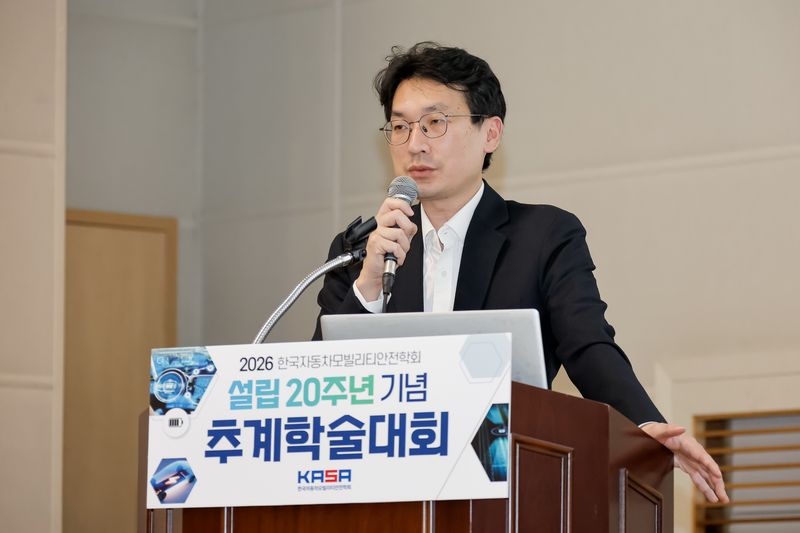
Park Yong-seon, director of the Automobile Policy Division at the Ministry of Land, Infrastructure and Transport, made the remarks in a special lecture titled “Conditions and Directions for Advancing Automotive Policy” at the fall academic conference marking the 20th anniversary of the Korean Auto-vehicle Safety Association’s founding, held on the 19th at the Kim Daejung Convention Center in Seo District, Jeonnam-Gwangju. Citing the spread of artificial intelligence (AI), carbon reduction, safety, a shift toward mobility-centered policies, and the discovery of new industries, Park said, “The conditions for pursuing automotive policy are changing rapidly.” He then outlined four policy priorities: electric-vehicle adoption, autonomous driving, vehicle safety standards, and consumer protection.
■ Battery leasing to ease purchase costs... Building a circular system for used batteries
Park said, “Annual electric-vehicle adoption exceeded 200,000 last year, and the cumulative total surpassed 1 million.” He said that rising oil prices due to wars and other factors also contributed to a sharp increase in adoption this year, but predicted that electric-vehicle adoption would continue to rise steadily.He identified price as an obstacle to wider adoption. A MOLIT survey found that consumers cited price as a factor they considered when purchasing an electric vehicle, and that batteries account for around 40% of an EV’s price.
MOLIT is therefore pursuing a battery leasing system under which buyers purchase only the vehicle body and use the battery through a subscription agreement with a leasing company. Park said, “The idea is that if the battery’s residual value is guaranteed and the subscription fee is set low on that basis, the initial purchase price can be reduced, while the subscription fee might be kept at around the level of maintenance costs for an internal-combustion-engine vehicle.”
There are currently no regulations allowing the vehicle body and battery to be registered to separate owners. MOLIT plans to introduce a system that distinguishes ownership and also clarify who is responsible for recalls, inspections, exchanges, and refunds, which could become confusing if ownership is split. A bill to amend the Motor Vehicle Management Act has been introduced and discussed once by a National Assembly subcommittee. Parts of the business that can be commercialized even before the law is amended have already been approved through the regulatory sandbox.
The used-battery performance assessment system will take effect on July 1 next year. Based on performance and safety assessment results, batteries will be classified as “remanufactured,” meaning they can be installed in electric vehicles again; “reused,” for applications such as energy storage systems (ESS); or “recycled,” by being dismantled to recover valuable metals. MOLIT will oversee remanufacturing, the Ministry of Trade, Industry and Energy will oversee reuse, and the Ministry of Climate, Energy and Environment will oversee recycling. Remanufactured batteries can be installed in vehicles again only after passing the operator’s safety tests and a safety inspection by the Korea Transportation Safety Authority (TS).
Using next year’s budget, MOLIT will phase in performance assessment equipment at 51 TS vehicle inspection centers over the next three years. It will also establish a comprehensive safety management center specializing in used batteries. The government’s budget proposal includes funding for the design. TS is expected to operate the center, and its location will be decided after a regional call for proposals and other steps. MOLIT will also continue the battery certification system and battery information disclosure, which it fully implemented last year. It is also considering incorporating into new-car safety assessments the battery management system (BMS) function that detects risks during parking and charging, as well as underbody collision safety.
■ Autonomous-driving demonstrations to expand to 3,000 vehicles... Accident-liability guidelines planned
In autonomous driving, the priorities are expanding demonstrations and refining the system for commercialization. Park introduced the contents of a presentation made at the second plenary meeting of the Regulatory Rationalization Committee, chaired by the president on the 23rd of last month. He said, “Much of the key regulation has been addressed, and we are now at the stage of considering a commercialization framework that would allow driverless vehicles to be sold or operated after the technology has been developed.”The demonstration-city project underway in Gwangju involves 200 vehicles this year. The government’s draft budget for next year includes a plan to deploy 3,000 vehicles across five to six demonstration cities, including Gwangju. The budget for autonomous driving, including driverless demand-responsive transit (DRT) and the development of a data platform, has also risen sharply, from 73.1 billion won this year to 880.1 billion won next year. Park said, “The budget is currently under review, but I don’t think there will probably be any problem with the 3,000-vehicle demonstration.”
A shift in the legal framework is also being pursued. Because the Road Traffic Act is premised on driver responsibilities, various exemptions have been needed until now; MOLIT will therefore form a working group with the National Police Agency to establish a legal framework suited to driverless operation. For temporary operating permits, it will introduce a “volume-based” approval model in which the safety of a representative vehicle is verified before vehicles are deployed on public roads, rather than conducting separate reviews for each vehicle. The operating framework for service providers, including remote monitoring, appointing safety officers, and deploying on-site personnel, will also be institutionalized. Measures for mutual benefit and equity participation will be developed to reduce conflict with the taxi industry.
On data security, the government is pursuing rules requiring service providers to store their domestic data in South Korea. It will work with the Ministry of National Defense and others to address the issue of connected cars entering key defense facilities, which was raised during a parliamentary audit. Following the adoption last June of international safety standards for driverless autonomous vehicles at the United Nations Economic Commission for Europe’s World Forum for Harmonization of Vehicle Regulations, the government will amend the Motor Vehicle Management Act to introduce safety standards for autonomous vehicles as well. The measure is intended to pave the way for sales of driverless autonomous vehicles directly to consumers (B2C). Guidelines on liability by accident type will also be drawn up, given the difficulty of determining accident causes and apportioning responsibility.
Vehicle safety standards will be upgraded in principle in harmony with international standards. Detailed rules for driver control assistance systems (DCAS) will be established after the law is amended, while the permitted scope of hands-off driving and other matters will be decided in light of industry technology trends. The anti-pedal-misapplication device, which will be mandatory on new passenger cars manufactured or imported from January 2029, will be included in the Korea New Car Assessment Program (KNCAP) to encourage the development of technology that goes beyond the mandatory standards.
On consumer protection, a system under which vehicles that do not undergo recalls within a specified period, including recalls related to fire risks, are deemed to have failed vehicle inspections will take effect next March, Park said. The government is considering introducing a mediation process in addition to arbitration under the vehicle exchange and refund system, and simplifying vehicle modifications closely related to everyday life. MOLIT is also drawing up a five-year basic plan for automotive policy to take effect next year.
[email protected] Kim Dong-chan Reporter