"From 9,000 to 5,000 on KOSPI"...Retail Investors' Losses Estimated at 563 Trillion Won
- Input
- 2026-11-20 04:40:00
- Updated
- 2026-11-20 04:40:00
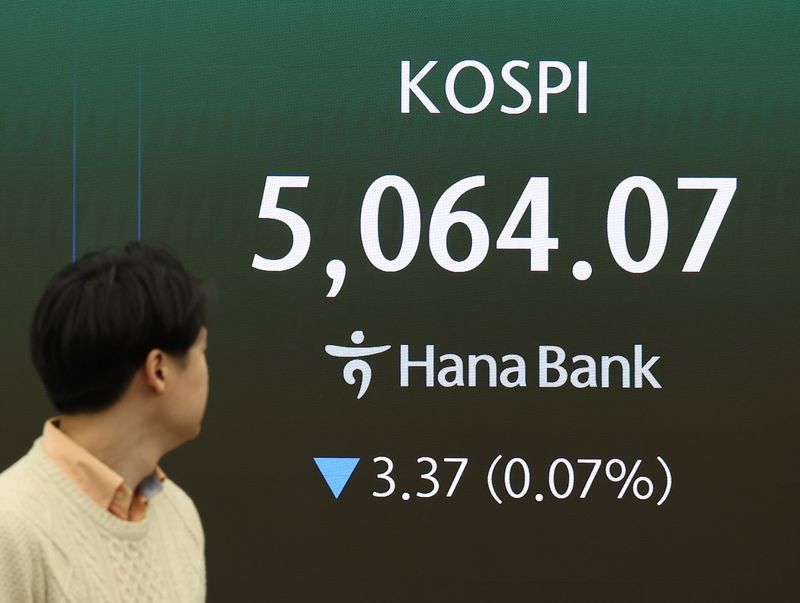
[Financial News] The sharp decline in the KOSPI is expected to result in losses of 563 trillion won on Korean households' stock investments in the second half of this year, according to an analysis. The resulting drag on consumption from the decline in the value of stock assets could be comparable to a 0.50–0.75-percentage-point increase in the benchmark interest rate, according to a forecast.
According to a report by Citigroup economist Kim Jin-uk on the 20th, Korean households' estimated capital losses on stocks in the second half of this year total around 563 trillion won.
Kim said, "We estimate household capital losses on stocks in the second half of 2026 at around 563 trillion won. Taking into account the wealth effect of household stock holdings and the import-induced effects, these losses will cumulatively reduce annual GDP by 0.2 percentage points, private consumption expenditure by 0.5 percentage points, and CPI inflation by 0.1 percentage points over the period from the second half of this year through next year."
This estimate was based on the assumption that returns on domestic and overseas stocks held by Korean households tracked the movements of the KOSPI and Nasdaq, respectively.
Citigroup estimated that households made 579 trillion won in capital gains from stock investments in the first half of this year. The analysis said that although they posted large gains in the first half, they may have lost a substantial portion of them amid the sharp fall in stock prices in the second half.
By year, Citigroup estimated that households recorded capital gains of 429 trillion won in 2025, while incurring capital losses of 61 trillion won in 2024.
The sharp decline in the KOSPI has driven the steep drop in the value of household stock assets. The KOSPI rose 116% from 4,214 at the end of last year through June this year, but then reversed course and began to fall.
The KOSPI, which set a record closing high of 9,114.55 on June 22, ended trading at 4,968.48 on the 17th of this month. It fell 45.5% in about five months, dropping below the 5,000 mark.
The asset losses from the sharp stock market decline are substantial even in comparison with the Korean economy as a whole. The 563 trillion won estimated by Citigroup is equivalent to about 19% of annual nominal GDP and about 37% of private consumption expenditure.
Kim said the recent decline in the KOSPI had likely wiped out almost all of the capital gains Korean households had made from stock investments since the beginning of the year.
The decline in the value of stock assets is expected to reduce consumption of durable goods such as cars and home appliances, and could also negatively affect service output in the financial and insurance industries.
Citigroup assessed that the resulting slowdown in consumption and inflation could be comparable to two or three increases in the benchmark interest rate.
The Bank of Korea has estimated that a 50-basis-point increase in the benchmark rate (1 basis point = 0.01 percentage points) would, over the course of a year, lower real GDP growth by 0.12 percentage points and inflation as measured by the consumer price index by 0.08 percentage points.
Despite concerns that the stock market shock could slow consumption, Citigroup raised its forecast for Korean economic growth, reflecting an improving outlook for the semiconductor industry.
The forecast for real GDP growth in 2027 was raised by 0.8 percentage points, from 3.3% to 4.1%. Citigroup also revised its growth estimate for this year from 3.8% to 3.9%, and its forecast for 2028 from 3.0% to 3.4%.
However, unlike the growth in the semiconductor industry, the recovery in household consumption is expected to remain limited.
Kim said, "Expanded bonus payments by semiconductor companies, increased government transfer payments and a stronger won could support consumption. However, the weakened wealth effect from the stock market decline, household debt burdens, rising housing costs and the cumulative effects of interest rate hikes will constrain the recovery in consumption."
Citigroup maintained its existing forecast that the terminal rate would reach 3.5% during the Bank of Korea's current rate-hiking cycle.
It expects core inflation to slow from the second quarter of 2027 and private consumption to remain weak. It said whether there will be further rate hikes, and how large they will be, could depend on the impact of the stock market decline on household consumption.
[email protected] Han Seung-gon Reporter