With Korean Easier, Math to Decide Regular Admissions Outcomes... Focus Shifts in Regular Admissions [2027 CSAT]
- Input
- 2026-11-19 18:45:26
- Updated
- 2026-11-19 18:45:26
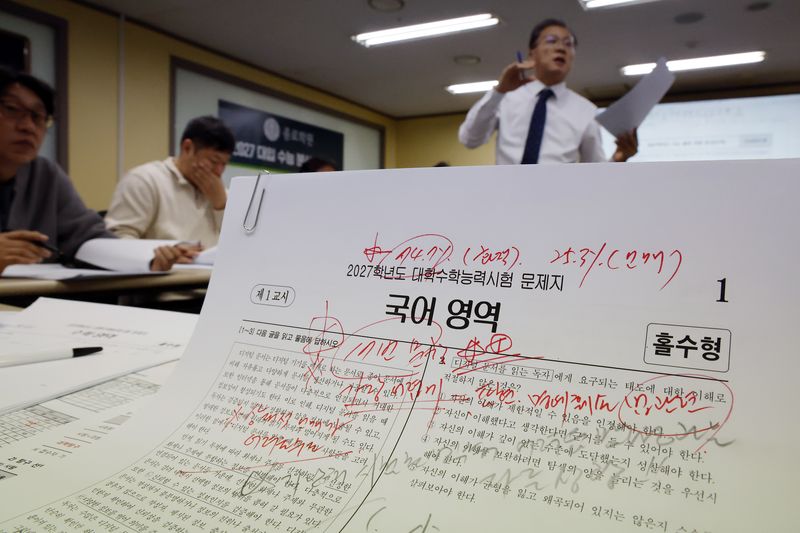
A review of analyses by the Korea Institute for Curriculum and Evaluation, EBS's group of field teachers, and major admissions companies on the 19th found that this year's CSAT was set at a level that students who had fully completed the high school curriculum could handle. There were 551,864 applicants in total, and the exam was held at 1,312 test sites across 85 test districts nationwide.
Korean, the first-session subject, was easier than last year's CSAT and this year's September mock exam. The EBS field teacher group said passages covered digital document reading and familiar topics such as mirrors and family, and that EBS-linked questions accounted for 53.3% (24 of 45 questions), easing test-takers' reading burden. Nam Yungon, head of the Admissions Strategy Research Institute at MegaStudyEdu Co. Ltd., said, “It was somewhat easier than the September mock exam, and test-takers who had studied faithfully with a focus on the basics would have been able to answer the questions comfortably.”
Lee Man-gi, head of the Uway Education Evaluation Research Institute, predicted, “The reduced burden of inference will raise grade cutoffs based on raw scores, and the number of perfect scorers will exceed last year's 261.” Kim Byung-jin, head of the Etoos Education Evaluation Research Institute, assessed the exam as slightly easier than last year's CSAT, but said questions 17 in reading, 30 in literature, and 37 in language and media helped distinguish the very top scorers.
By contrast, math, the second-session subject, was at a similar level to last year's CSAT and maintained its ability to distinguish among top scorers. Nam Chi-yeol, a Baekseok High School teacher and the lead math instructor for the EBS field teacher group, said the overall level was similar to last year's CSAT, while in detail it fell between this year's September mock exam and last year's CSAT. He added that none of the elective subjects offered an advantage or disadvantage. EBS-linked questions accounted for 50% (15 of 30 questions).
The admissions industry likewise assessed math as similar to or somewhat more difficult than last year's CSAT, but opinions differed on whether any elective subject offered an advantage. Nam Yungon said, “The common section and Geometry and Calculus were similar to last year's CSAT, while Probability and Statistics was easier.” Lee Man-gi predicted, “Calculus was somewhat difficult and Probability and Statistics somewhat easier, so there will be differences in the relative advantages of the elective subjects.” Kim Byung-jin said that unfamiliar conditions in the common section and difficult questions in the elective subjects determined how well the exam differentiated among test-takers.
By contrast, Lim Seong Ho, head of Jongro Academy, said, “Calculus and Geometry were at a similar level to last year, but the calculations in Probability and Statistics were complex, so test-takers likely found it relatively difficult.” The questions most commonly cited as the hardest were question 21 in Math II and question 22 in Math I in the common section, and question 30 in each elective subject.
English, the third-session subject, was easier than last year's notoriously difficult CSAT (with a 3.11% top-grade share) and this year's June mock exam (4.13%), but somewhat harder than the easier September mock exam (15.54%). Lee Man-gi said, “Questions 33 and 34 on inference from blanks and question 37 on ordering paragraphs helped distinguish top scorers,” and predicted, “The top-grade share will be in the 7%–10% range, indicating a stable level of difficulty.” Lim Seong Ho also said that, unlike last year, difficult questions did not begin appearing in the early 20s, which likely reduced confusion over time management.
Admissions experts cited the increased weight of math as a key variable in this year's regular admissions. Lim Seong Ho said, “Last year, the highest standard score in Korean (147 points) was higher than in math (139 points), making Korean's ability to distinguish among test-takers decisive. This year, Korean was easier, so math will be key to determining admission outcomes.” He added, “The weight of English will decline, while the record-scale shift to social studies electives, known as the ‘social studies run,’ and differences in difficulty between subjects will make the inquiry section an important variable for both top- and middle-ranking students.”
[email protected] Kim Man-gi, Lee Bomi Reporter