Exports Enter the $1 Trillion Era... 'One of Four Major Powers' Alongside Germany, the United States and China [The $1 Trillion Export Era]
- Input
- 2026-11-19 18:33:49
- Updated
- 2026-11-19 18:33:49
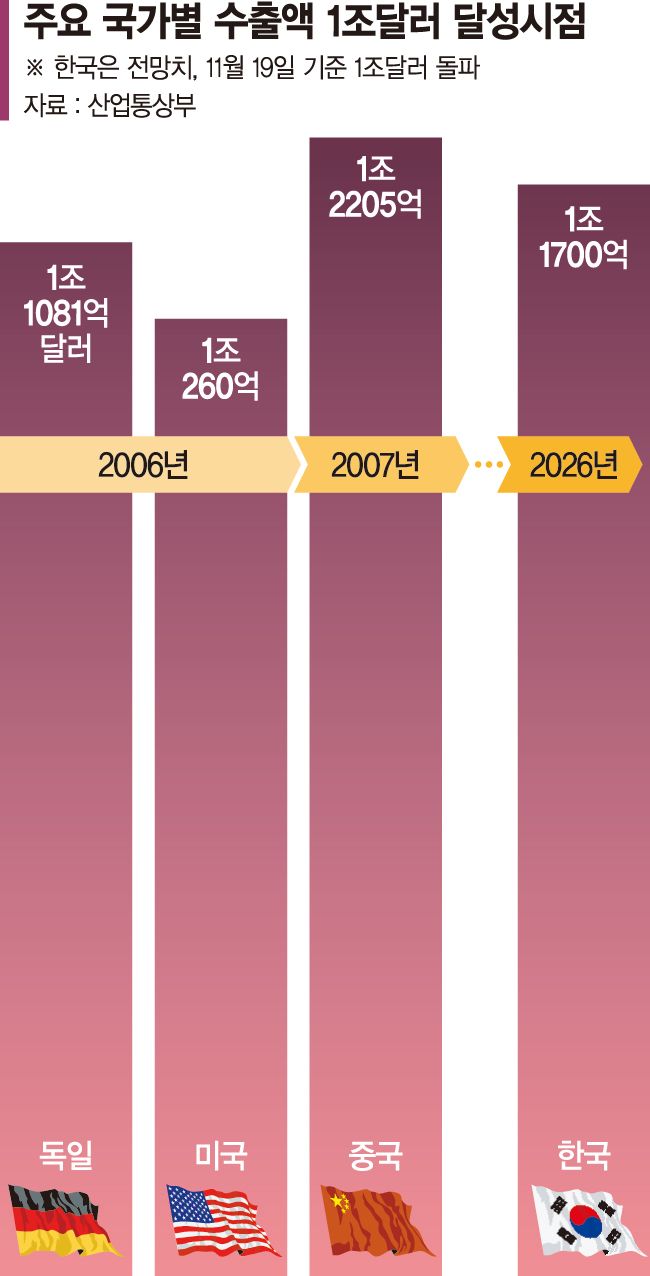
According to the Ministry of Trade, Industry and Energy, cumulative exports for the year had topped $1 trillion as of the 19th. Last year, annual exports surpassed $700 billion for the first time, and in just one year they reached the $1 trillion mark. A new $1 trillion export country has emerged for the first time in 19 years, since China in 2007.
South Korean exports had previously surpassed $100 billion in 1995, then topped $500 billion in 2011 and $600 billion in 2018. After reaching $700 billion last year, they hit $1 trillion this year in a single leap, accelerating their growth. The country is also forecast to rise in the global export rankings from sixth last year to fourth this year. According to the World Trade Organization (WTO), South Korea’s export growth rate from January to August this year was 52.9%, far outpacing those of major exporting countries such as China (19.3%), the United States (14.6%) and Japan (7.7%).
Semiconductors were the biggest contributor to the new export record. Rising demand for memory semiconductors and higher prices, driven by increased AI investment by global tech giants, propelled exports. Semiconductor exports totaled $396.8 billion from January to October this year, accounting for about 43% of total exports. Eight product categories, including computers, petroleum products, electrical equipment, bio products and cosmetics, as well as semiconductors, recorded their highest-ever export figures. Exports of products other than semiconductors also rose 20% over the same period.
Export markets and participants also expanded. Exports increased in seven of the nine major export regions, including the United States, China, ASEAN and the European Union (EU). In particular, small and medium-sized enterprises’ exports from January to October reached a record $107.6 billion, up 9.9% from the same period a year earlier. Exports by mid-sized companies also set a record for the same period, reaching $103.7 billion through the third quarter.
The government forecasts that annual exports will reach $1.17 trillion this year. However, volatility in export prices for semiconductors and petroleum products, stronger protectionism in the United States and the EU, and oversupply originating in China are among the challenges to sustaining export growth. Industry Minister Kim Jung-kwan said, “We have achieved a historic milestone reached by only four countries in the world,” adding, “The government will devote all its capabilities to ensuring that the benefits of strong exports boost regional economies and create jobs for young people, so that everyone can feel the results of our export performance.”
President Lee Jae Myung, who is visiting China to attend the Asia-Pacific Economic Cooperation (APEC) summit, shared the news that exports had topped $1 trillion that day, calling it “the fruit of challenges spanning generations and the efforts of all our people.” He added, “We will strengthen the competitiveness of our leading industries and develop future growth engines such as artificial intelligence (AI) and bio. We will also actively support K-consumer goods, including K-beauty and K-food, in entering global markets.”
President Lee stressed, “The results of our exports should improve people’s lives. We will build ‘growth for all,’ in which large and small businesses, and the capital region and other regions, share growth opportunities and the fruits of that growth.”
[email protected] Ji-young Park, Choi Jong-geun Reporter