First Meeting of Leaders of Three Nuclear Powers... “Backroom Deal” “Agreement Uncertain” [First U.S.-China-Russia Trilateral Talks]
- Input
- 2026-11-19 18:29:20
- Updated
- 2026-11-19 19:06:07
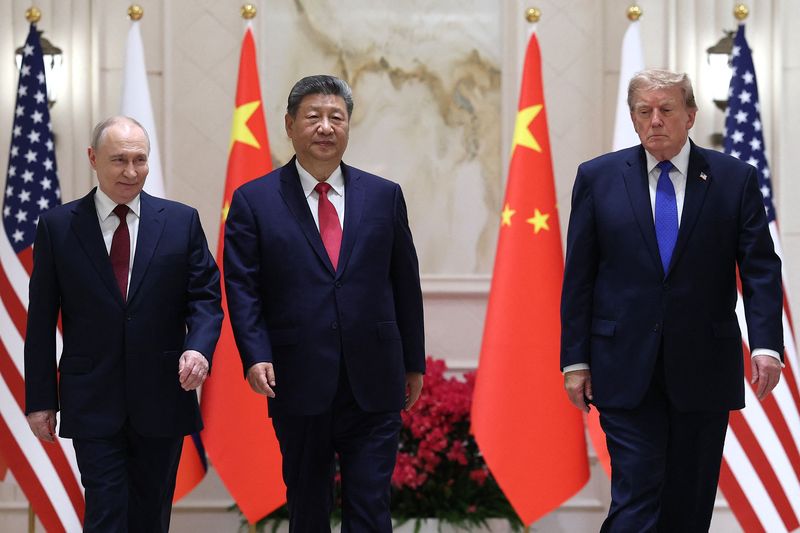
On the morning of the 19th, after attending the APEC summit at the Shenzhen International Exchange Center in China, U.S. President Donald Trump held a brief meeting with Russian President Vladimir Putin. Standing alongside Putin, Trump said, “We are looking forward to the meeting. We have had a very good relationship for many years, and we have known each other for a long time.” He added that “a lot of great things could come out of this meeting,” emphasizing that at least a starting point could be established.
The White House initially announced that “there will be no U.S.-Russia summit during this APEC summit,” but the face-to-face meeting was ultimately arranged amid Russia’s active efforts, according to reports. At the brief U.S.-Russia meeting that day, Putin—who is notorious for keeping others waiting—was spotted arriving first and waiting for Trump, attracting attention.
After the brief U.S.-Russia meeting, Trump also held a U.S.-China summit. Trump said that he and Chinese President Xi Jinping shared views on issues including ensuring the transport of oil through the Strait of Hormuz and preventing Iran from acquiring nuclear weapons. On the war in Ukraine, he also said, “The United States and China both want to help Russia and Ukraine. We hope the war will end.”
He also said that U.S.-China economic relations had improved considerably over the past year and a half. Trump said, “When I visited Beijing last May, we established a trade commission, which brought greater balance to a relationship that had been very unbalanced,” adding, “We have made it a fair relationship, and that is all we want.”
Conflicting predictions had emerged ahead of the U.S.-China-Russia trilateral talks, which followed the U.S.-Russia and U.S.-China summits. One was the concern that the great powers might redraw their spheres of influence while excluding parties such as Ukraine; another was the prediction that the three countries’ competing interests would make it difficult to reach a concrete agreement.
Last month, Ukrainian President Volodymyr Zelensky said, in connection with efforts to arrange the trilateral talks, “I really don’t want this to become a ‘second, third or fourth Yalta’ that redistributes influence.” The Yalta Conference was a meeting in February 1945 where the leaders of the United States, Britain and the Soviet Union gathered to discuss the postwar order in Europe and plans for settling matters after World War II. It symbolizes the power politics by which the fate of smaller countries is often decided through negotiations among great powers without the participation of the countries concerned. Because of these fears of a “second Yalta Conference,” European leaders had in fact planned to meet separately in Berlin, Germany, that day.
On the other hand, some had argued that such concerns were misplaced, since the three leaders had major differences on issues including China’s nuclear weapons. For example, Trump had hoped to discuss nuclear arms control, but Xi, whose country has fewer nuclear warheads, was reportedly reluctant to assume arms-control obligations on a par with the United States and Russia.
It was also noteworthy that while the Yalta Conference lasted eight days, the trilateral talks were scheduled to run for just over an hour. Given the difference in duration, some predicted that the meeting would amount to little more than a “grand photo op” capturing the “strongmen” of the three countries gathered in one place.
A senior Cheong Wa Dae official said that day, “First of all, China, the host of APEC, is itself a country that considers itself a victim of the Yalta Conference,” adding, “The United States, China and Russia do not all think alike, so those three countries are not, for example, in the same position as the great powers that gathered at Yalta in the past.” He added, “The United States, Britain and the Soviet Union may have had different views on the world order after World War II, but they shared the fact that they fought against Germany. Today, there is no such degree of common ground.”
[email protected] Hong Chae-wan Reporter