With Semiconductors Making Up 43% of Exports, What if AI Falters?... Next Year Is the Real Test [The $1 Trillion Export Era]
- Input
- 2026-11-19 18:27:52
- Updated
- 2026-11-19 18:27:52
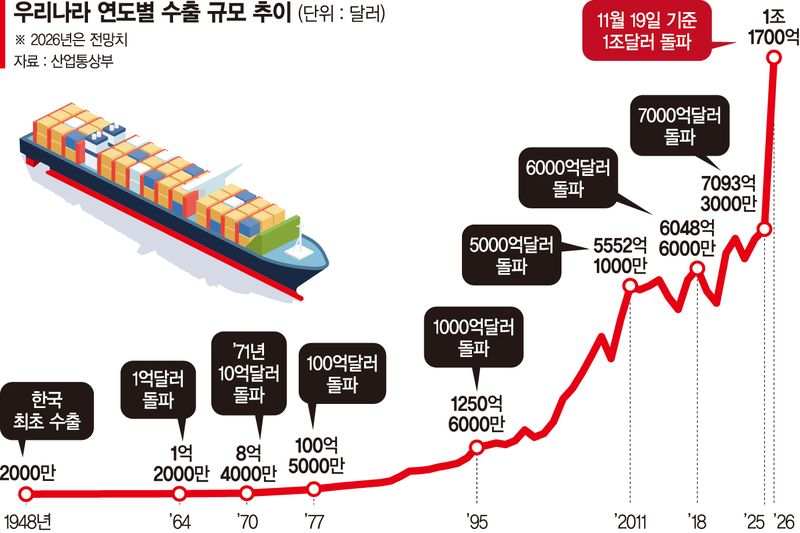
In addition to the heavy reliance on semiconductors and international oil prices, the spread of protectionism and trade pressure stemming from the trade surplus are also concerns. Analysts say that sustaining the $1 trillion export era will require developing new AI-related industries into fresh export engines and shifting the trade structure to balance overseas investment with domestic production capacity.
■ Semiconductor and petroleum product price increases drive growth
According to the Ministry of Trade, Industry and Energy on the 19th, the biggest driver behind this year’s exports reaching $1 trillion was increased global investment in AI. Growing investment in AI data centers boosted both demand for and prices of memory semiconductors, bringing semiconductor exports to $396.8 billion from January to October this year. Semiconductors accounted for about 43% of total exports.
The impact of rising AI demand extended beyond semiconductors. Exports also increased for computer storage devices (SSDs) needed to build data centers, power equipment such as transformers and cables, and nonferrous metals such as copper and aluminum. In effect, South Korea has established itself as a key supplier in the expansion of the global AI industry.
Higher international oil prices also had a significant price effect. Supply disruptions in the Middle East and Russian export controls, among other factors, pushed the export price of petroleum products up 62%, from $681 per ton last year to $1,105 per ton from January to October this year. This helped export revenues rise despite restrictions on exports of gasoline and diesel. Higher prices for certain products, including semiconductors and petroleum products, substantially boosted the overall value of exports.
■ The $1 trillion mark faces a test next year
The challenge lies ahead next year. The possibility that the United States may slow investment in AI data centers has raised the prospect of a correction in semiconductor prices. During previous semiconductor downturns, exports of semiconductors fell 26% in 2019 and 24% in 2023. Petroleum product exports could also decline if international oil prices stabilize at lower levels.
The spread of protectionism is another concern. The United States is continuing investigations into overcapacity under Section 301 of the Trade Act of 1974 and tariff pressure on specific products, while the European Union (EU) is strengthening trade barriers such as the Carbon Border Adjustment Mechanism (CBAM). Competition in third-country markets is also intensifying due to China’s excess supply.
The $1 trillion export era also calls for a shift in the trade structure. As a growing trade surplus resulting from expanded exports could lead to trade pressure from partner countries, analysts say South Korea should move beyond reliance on goods exports and develop trade through industrial cooperation based on overseas investment and local production.
Kang Gam-chan, head of the Trade and Investment Office at the Ministry of Trade, Industry and Energy, said, “As the economy grows to the scale of an advanced economy and costs rise, we cannot keep expanding the domestic production base alone,” adding, “We should gradually shift from an export-centered structure toward investment and strengthen industrial cooperation that benefits both sides with our trading partners.” Kang also stressed the need to keep key production facilities and research and development functions in South Korea so that increased overseas investment does not hollow out domestic industry.
Securing new engines of export growth is also urgent, as promising next-generation export products have yet to grow into leading industries that can follow semiconductors. From January to October this year, organic light-emitting diodes (OLEDs) accounted for just 1.2% of total exports, semiconductor equipment for 1.0%, and cathode materials for 0.5%. The government plans to foster new industries such as biotechnology and robotics, while developing AI-related products—including semiconductor equipment and power equipment, whose demand is rising with the expansion of AI data centers—into new mainstay export industries.
Another challenge is to spread the benefits of export growth across industries. This year, products dominated by large companies, including semiconductors and petroleum products, led export growth, but their spillover effects on suppliers and employment were relatively limited. Analysts say the investment capacity generated by the semiconductor boom should be channeled into strengthening the competitiveness of South Korea’s materials, parts and equipment industries and creating new jobs.
Kang said, “I’m happy, but at the same time, I’m also very worried. AI is what worries me. I’m concerned that the blessing of semiconductors could become a curse,” adding, “Rather than being swept up in the current export boom, we need to prepare for changes in the AI industry and the possibility of an economic downturn.”
[email protected] Ji-young Park Reporter