President Lee Meets Putin for the First Time ... Talks on Korea-Russia Relations and North Korea's Nuclear Issue
- Input
- 2026-11-19 19:00:00
- Updated
- 2026-11-19 19:00:12
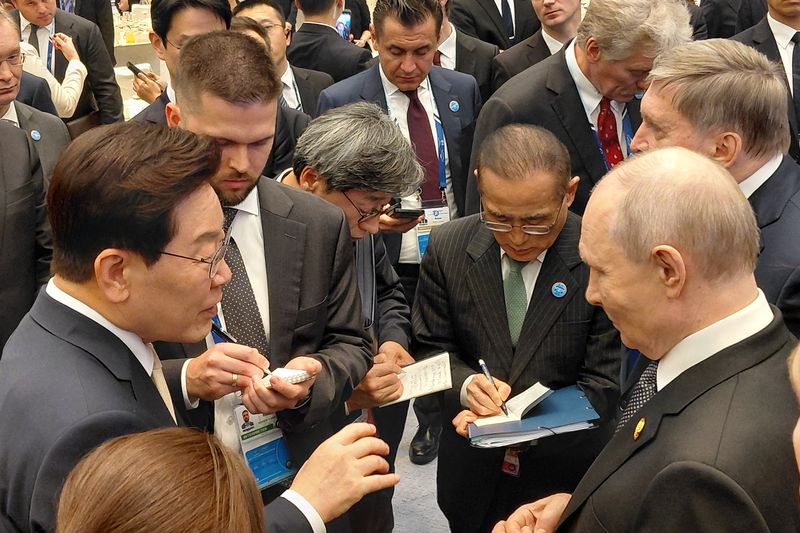
After the APEC Summit that day, President Lee wrapped up his three-night, four-day trip to ASEAN and APEC and set off for home.
According to Cheong Wa Dae, President Lee naturally met Putin as they were leaving after the APEC welcome dinner in Shenzhen the previous day, and the two spoke for about 10 minutes.
A senior Cheong Wa Dae official said, “There was general agreement that, although Korea-Russia relations are difficult given various circumstances, the two sides should seek opportunities to cooperate in areas where there are no issues and manage the relationship well.” The official also said, “There was agreement on the need to prevent the situation on the Korean Peninsula from deteriorating and to ease tensions.” The two also discussed bilateral issues concerning North Korea’s nuclear program and people’s livelihoods.
In the economic sphere, follow-up negotiations on services and investment under the Korea-China FTA, which began in 2018, reached a substantive conclusion after eight years and eight months. The two countries agreed to introduce a most-favored-nation treatment obligation, guaranteeing treatment no less favorable than that given to companies from third countries, and to strengthen investment protection and regulatory transparency.
Once the agreement takes effect, Korean travel agencies will be able to provide overseas travel services to customers across China from 23 regions of the country. Conditions for Korean law firms to form business partnerships in China will also improve. An institutional framework has also been established allowing distribution companies to enter China with 100% Korean ownership.
In the content sector, the two sides affirmed the principle that Korean content would not be treated less favorably than content from other countries. A senior official assessed that “there has been some progress” regarding restrictions on Korean cultural content in China. However, the agreement does not include an obligation to approve performances by singers from the other country, so K-pop concerts are not yet at the stage of being liberalized immediately, the official explained. Signing the agreement could take several more months, leaving its actual entry into force and implementation as tasks for the future.
Currently, trade in goods between South Korea and China stands at $272.9 billion, while trade in services totals $38.8 billion. Cheong Wa Dae made a simple estimate that if China’s share of overall services trade were to rise from 12.4% to around 21%—its share of goods trade—bilateral services trade with China could increase by $10 billion to $20 billion.
Lee also discussed future diplomatic engagements, including the G20, and South Korea-U.S. cooperation agendas with U.S. President Donald Trump. President Lee also agreed to stay in communication with Vietnamese Party General Secretary To Lam to deliver concrete project outcomes in infrastructure sectors such as nuclear power. He agreed to flesh out cooperation with ASEAN on tackling transnational crime and AI, and to continue shuttle diplomacy with Japan while seeking progress on historical issues.
At the APEC Summit that day, President Lee stressed the need to uphold the multilateral trading order and strengthen cooperation to stabilize supply chains. He also proposed institutionalizing joint energy stockpiling, establishing joint response mechanisms, and cooperating to stabilize supply and demand in emergencies.
[email protected] Reporter