EBS: "English Section Set Easier Than Last Year's CSAT and Harder Than September Mock Exam" [2027 CSAT]
- Input
- 2026-11-19 17:23:18
- Updated
- 2026-11-19 17:28:14
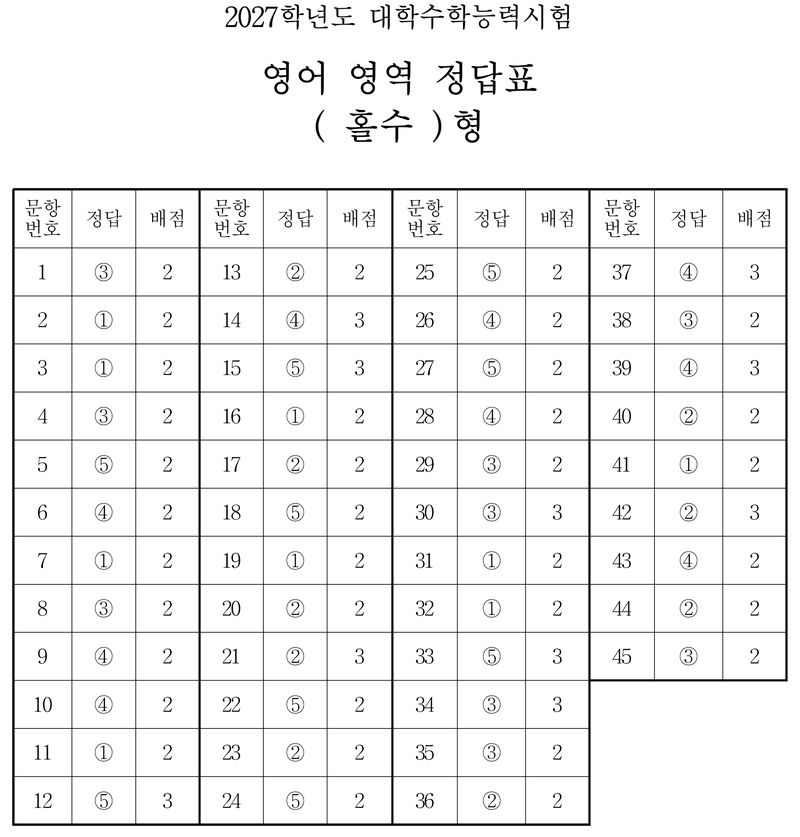
[Financial News] An analysis found that the English section, administered in the CSAT's third exam period, was set easier than last year's CSAT and harder than this year's September mock exam. Last year's Grade 1 rate was just 3.11%, sparking controversy over whether the CSAT was a “killer exam.” The questions were assessed as having differentiated top scorers by using familiar topics to lower their difficulty while still requiring accurate reading comprehension and reasoning.
Kim Ye-ryeong, a teacher at Daewon Foreign Language High School and the EBS field teacher group's lead English instructor, said at a briefing on trends in the English section held that day at the Government Complex Sejong, “We excluded overly abstract passages that would be difficult to understand even when translated into Korean, and used many topics familiar to test takers.” She assessed the exam accordingly.
Examples included the environmental impact of fireworks, respect for celebrities' privacy, sugar-free drinks, and the number of heat-wave days in different cities. Teacher Kim assessed that these questions likely eased the burden on lower- and middle-performing test takers.
The Grade 1 rate for the English section of the 2026 CSAT, held last year, was 3.11%, the lowest since absolute grading was introduced in the 2018 academic year. In English, all students who score 90 or higher on the raw score receive Grade 1, regardless of other test takers' scores. But last year, only about three out of every 100 test takers received Grade 1. The rate was even below the 4% share assigned to Grade 1 under relative grading. The Grade 1 rate was also just 4.13% in this year's June mock exam, making difficulty calibration a major concern.
Differentiation among top scorers was considered to have been achieved through questions that required an accurate understanding of the passages and the ability to identify logical relationships.
Questions EBS identified as highly discriminating included No. 21, on inferring implied meaning; Nos. 33 and 34, on fill-in-the-blank inference; and No. 39, on sentence insertion.
Question 33 featured a passage explaining why different cultures have different norms. The incorrect answer choices used words that appeared in the passage, while the correct answer used vocabulary that did not. This made it difficult to answer simply by matching words; test takers had to understand the passage as a whole to choose the correct answer.
Question 34 asked test takers to apply the concept of rhythm in music to the composition of works of art. Question 39, based on a passage about corporate competition and innovation strategies, required test takers to identify logical relationships between sentences.
The EBS-CSAT linkage rate was 55.6%, with 25 of the 45 questions linked to EBS. This included 15 of 17 questions in listening and indirect speaking, and 10 of 28 in reading and indirect writing.
Teacher Kim said, “Students who consistently practiced using a variety of vocabulary and identifying the main points of passages in their school classes would have been able to understand most of the passages and find the correct answers.” She added, “Highly discriminating questions, such as fill-in-the-blank inference and sentence insertion, also required the ability to accurately identify logical relationships between sentences and the overall flow of a passage.”
[email protected] Lee Bomi Reporter