Supreme Court Reverses and Remands Han Duck-soo's 'Insurrection Case'... "State Council Recommendation Before Martial Law Declaration: Purpose to Disrupt Constitutional Order Not Proven"
- Input
- 2026-11-19 17:33:03
- Updated
- 2026-11-19 18:02:47
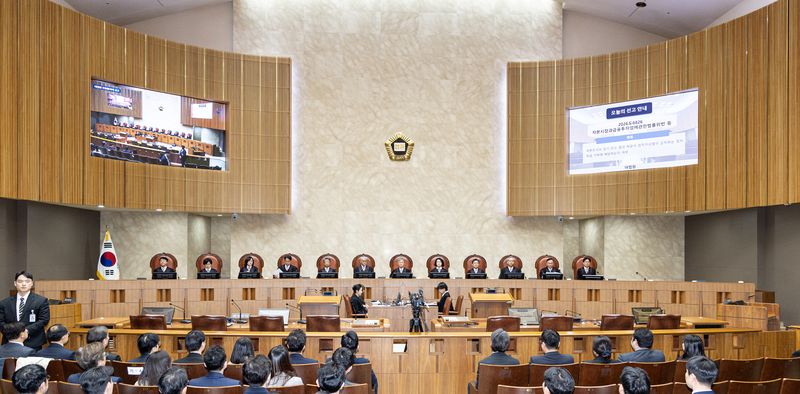
On the afternoon of the 19th, the en banc panel of the Supreme Court of Korea, with Justice Oh Kyung-mi as the justice in charge of the case, overturned all portions of the lower court ruling finding Han guilty in the final appeal of his case involving aiding the leader of an insurrection and related charges, and sent the case back to the Seoul High Court. It dismissed the prosecutor's appeal concerning the use of an official document prepared with false information. The opinions split 9 to 3, with nine justices in the majority and three dissenting. The dissenting justices were Oh Kyung-mi, Shin Sook-hee and Kim Seong-su. The justice in charge of the case was among the dissenters.
The first trial sentenced Han to 23 years in prison on Jan. 21 and ordered him detained in court, while the appeals court reduced the sentence to 15 years on May 7. His detention period, which was set to expire at midnight on the 20th, was extended by two months.
The Supreme Court of Korea categorically stated that the 2024 South Korean martial law crisis of Dec. 3 was "without question unconstitutional and unlawful in itself, as it ran counter to the constitutional order and infringed upon the people's fundamental rights." The court reached that conclusion because no national emergency had occurred when martial law was declared on Dec. 3, nor was the country in a situation where the executive and judicial functions were significantly difficult to carry out.
The disagreement concerned whether Han had the purpose of disrupting the constitutional order. The Supreme Court of Korea set out a new legal principle: to find that purpose, it is not enough for a person merely to be aware, even implicitly, of the possibility of disrupting the constitutional order; the person must have "the intent to seek its realization while being willing to accept such an outcome." This specified the volitional element of an offense requiring a specific purpose, and the dissent also agreed with this principle.
The lower court found Han guilty of engaging in important duties in an insurrection on three grounds: creating the appearance of deliberation by the State Council of South Korea before martial law was declared; urging the State Council members present to sign after the declaration; and discussing with the Minister of the Interior and Safety plans to blockade key institutions and arrangements for carrying out electricity and water cutoffs at certain media outlets. The majority said there was considerable room to find that the two actions after the declaration had been carried out with the purpose of disrupting the constitutional order, but found insufficient evidence regarding Han's recommendation for State Council deliberation before the declaration.
The basis for the ruling was evidence that Han had opposed martial law. In the president's office, he voiced concern to the effect that "the country's credit rating could fall and serious problems could arise for the national economy. We need to be cautious." Former President Yoon Suk Yeol also stated during the investigation, "All I can remember is Han Duck-soo constantly expressing opposition to me."
The court also cited the Criminal Act's function as a norm of conduct. The Supreme Court of Korea said that if the purpose of disrupting the constitutional order were readily inferred from awareness of the unconstitutional and unlawful nature of an act alone, it could "provide the mistaken guidance that, to avoid liability for insurrection in the future, one should instead refrain from recommending deliberation by the State Council."
The dissent characterized the case as a self-coup by the president. It said that because acts aimed at dismantling the constitutional order can take the form of official administrative acts, the fact that someone "followed the procedures prescribed by law" cannot serve as the basis for distinguishing lawful performance of official duties from participation in an insurrection. It said that emphasizing procedural compliance alone and using it as grounds for acquittal meant "using procedural form as a shell and disregarding the substantive contribution to the unconstitutional and unlawful exercise of power inherent in the act."
The court found no error in the lower court's guilty verdicts for preparing false official documents and perjury. Although the sole ground for reversal concerned the events before the martial law declaration, that portion was legally linked to the other guilty counts as either a single offense or concurrent offenses, so all the guilty portions were overturned. The court hearing the case after remand must determine a single sentence anew and is bound by this en banc ruling.
[email protected] Kim Dong-gyu Reporter