Savings Bank Special Account Operation to Be Extended by One Year; National Policy Committee Vote Delayed... "Opposition Boycott"
- Input
- 2026-11-19 17:02:33
- Updated
- 2026-11-19 17:02:33
The amendment to the Depositor Protection Act would change the special account’s expiration date from December 31 this year to December 31 next year. On the 17th, it was approved as originally drafted after the ruling and opposition parties reached an agreement at the National Policy Committee’s Subcommittee on Bill Review No. 1.
The special account was established in response to the savings bank crisis in 2011. Support of 15 trillion won was projected when it was set up, but 27.2 trillion won was actually provided. Debt of about 1.6 trillion won is expected to remain even after the account’s operation ends at the end of this year.
A National Policy Committee official said, “Since the ruling and opposition parties agreed on the bill in the subcommittee, we decided not to approve it with only the ruling party present and to take it up next week when the opposition attends.” The official added, “The schedule change has not hindered the bill’s passage; only the timing of the vote has been delayed.”
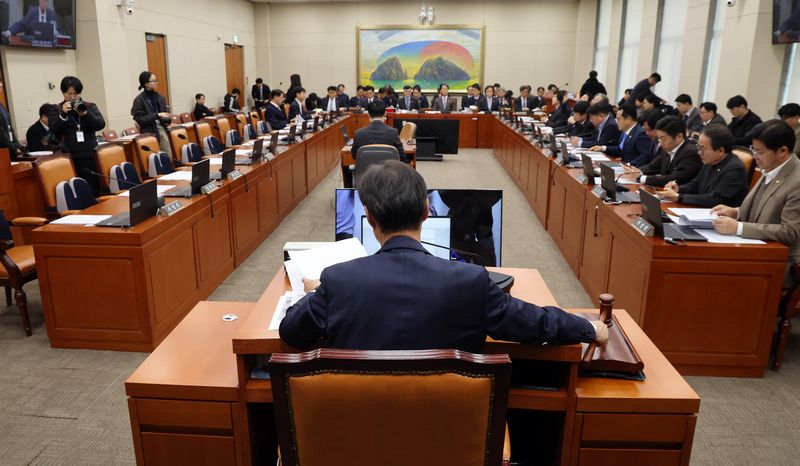
The plenary meeting that morning proceeded with only ruling party lawmakers present. The National Policy Committee referred 131 bills and petitions, including the Middle-Aged and Older Adults Basic Act, to subcommittees and adjourned nine minutes after opening the meeting.
Park Sang-hyuk, the Democratic Party of Korea (DPK)’s secretary on the National Policy Committee, referred to the agreement between the ruling and opposition parties on the schedule for subcommittee review and a plenary vote, saying, “Agreement on today’s agenda is an agreement with the people.” He added, “It is deeply regrettable to see the People Power Party breaking its agreement with the people.”
An amendment to the Corporate Restructuring Promotion Act (CRPA) was also on the plenary meeting’s agenda. The bill would keep the CRPA, which is set to expire next month, in force for three more years, through 2029. With the risk of financial distress among marginal companies rising amid high interest rates and an economic slowdown, failure to extend the deadline could halt corporate workouts starting next year and create a gap in corporate restructuring. The amendment was not included among the bills reviewed by the subcommittee the previous day, so it is expected to proceed to a plenary vote after subcommittee discussion next week.
The Subcommittee on Bill Review No. 1 is also expected to take up an amendment to the Electronic Financial Transactions Act next week. It would impose administrative fines of up to 3% of revenue on financial companies affected by hacking incidents. The committee could not discuss the amendment on the 17th because it was reviewing other bills. The National Policy Committee plans to hold subcommittee and plenary meetings in succession next week to push for passage of year-end sunset legislation, including amendments to the Depositor Protection Act and the CRPA.
[email protected] Park Mun-su Reporter