U.S.-China Summit After Two Months Opts for Stable Management Rather Than Concrete Agreements ... Extension of Trade Talks Agreed in Principle
- Input
- 2026-11-19 16:53:09
- Updated
- 2026-11-19 16:53:09
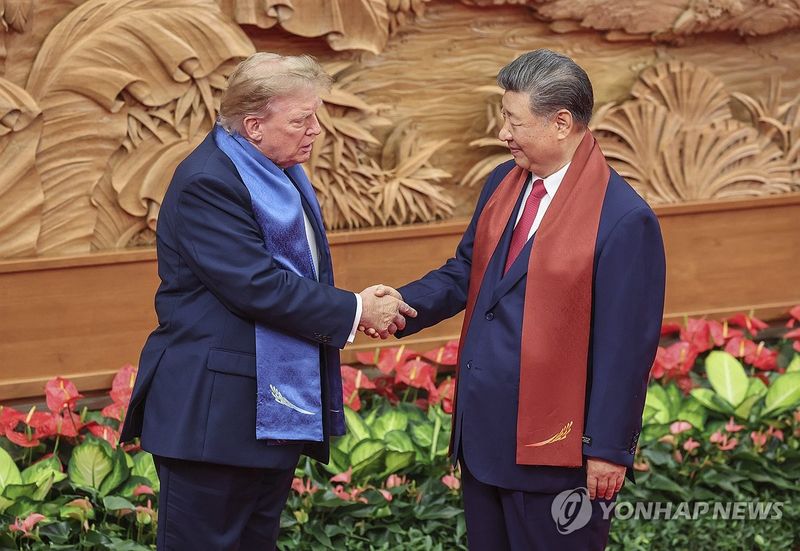
[Financial News] U.S. President Donald Trump and Chinese President Xi Jinping held a bilateral summit in Shenzhen, China, on the 19th (local time). It was their first face-to-face meeting in two months, following their meeting at the White House in Washington in September.
The two leaders discussed the extension of the trade truce, scheduled for January next year, as well as the United States’ tighter restrictions on China regarding advanced AI semiconductors, China’s export controls on rare earths and other key issues. The two sides were reported to have agreed in principle to extend the trade truce.
Trump said he and Xi Jinping shared the goal of ensuring oil shipments through the Strait of Hormuz and preventing Iran from obtaining nuclear weapons. Trump said the two countries had lowered tariffs “in a very fair way.” Xi said China-US relations “have improved while maintaining overall stability.”
Xi also said he intended to work with Trump to steer bilateral relations in the right direction. Xi said the two countries had established a new constructive relationship grounded in strategic stability and given it concrete form on the basis of mutual respect, fairness and reciprocity. AFP reported that Xi stressed that improvements in bilateral relations “have brought tangible benefits to the people of both countries and added stability and certainty to the world.”
At the meeting, Trump pressed China to honor its commitments, agreed at last October’s summit in Busan, to buy 25 million tonnes of U.S. soybeans and $17 billion worth of agricultural products annually for three years. Xi, meanwhile, was reported to have opposed the United States’ tighter AI restrictions on China, while advocating free and fair trade.
The two leaders plan to work toward resolving specific points of contention at a separate bilateral meeting during the G20 summit in Florida this December. As a result, this summit concluded with the two sides affirming their commitment to stable management of bilateral relations. The meeting is seen as having served as a “practical forum for exploration and coordination,” where the two sides narrowed their differences to pursue substantive agreements on bilateral issues and manage disagreements.
Trump also said he wanted to work with China to end the war in Ukraine. “We want to work together to help with the war between Russia and Ukraine,” he said, adding, “I think we can say that both of us very much want the war to end.”
In his opening remarks at the summit, Trump criticized past U.S. administrations’ policies toward China, saying, “The relationship with China was heavily tilted to one side.” He went on to say that the U.S.-China trade committee, whose establishment he and Xi agreed on at their summit in Beijing last May, had helped ease the imbalance in bilateral relations. Officials from the two countries held the committee’s first formal meeting on the 13th to discuss outstanding issues.
The two leaders met at Qilin Villa in Shenzhen, Guangdong Province, on the sidelines of the APEC summit. It was their third bilateral meeting this year, following meetings in Beijing in May and Washington, D.C., in September.
[email protected] Lee Seok-woo, International Affairs Correspondent Reporter