Japan Wary of U.S.-China-Russia 'New Yalta,' Fears Diplomatic Isolation Amid 'Victors' Solidarity'
- Input
- 2026-11-19 16:23:05
- Updated
- 2026-11-19 16:24:51
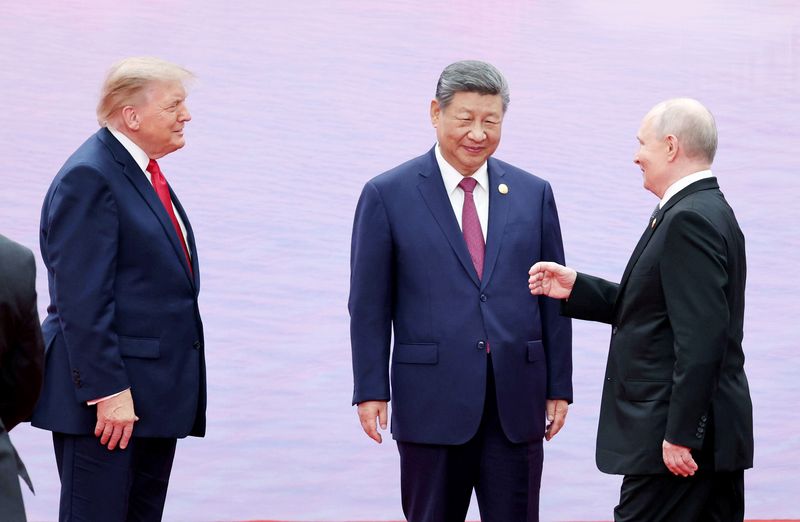
【Financial News, Tokyo—Correspondent Seo Hye-jin】As the leaders of the United States, China and Russia began their first trilateral meeting on the 19th, Japan was closely watching for diplomatic and security repercussions. Tokyo is concerned that China and Russia could invoke the 'solidarity of the victors' of World War II to draw even the United States into efforts to counter Japan. Japanese media noted that Japan's presence is waning in negotiations among major powers, while China's nuclear buildup is also increasing pressure on the U.S.-Japan alliance.
China-Russia 'victors' solidarity' ... Japan wary of a widening 'history war'
U.S. President Donald Trump, Chinese President Xi Jinping and Russian President Vladimir Putin began talks in Shenzhen, China, at 3:30 p.m. that day (Korea/Japan time), on the sidelines of the Asia-Pacific Economic Cooperation (APEC) summit. Nuclear arms reduction and Ukraine were among the issues on the agenda.
Because the meeting brings together three major military powers to discuss international security, it has been dubbed a 'New Yalta,' by analogy with the 1945 Yalta Conference, where the leaders of the United States, Britain and the Soviet Union discussed the postwar order.
According to the Nihon Keizai Shimbun (Nikkei), the Japanese government is monitoring the meeting but remains wary of the three countries coordinating in a 'history war.' Russian presidential aide Yuri Ushakov said the meeting was “based on the alliance among the three countries during World War II.” Trump also told Xi last September that the United States and China had been allies at the time.
China and Russia have criticized the defense policy and historical views of Sanae Takaichi's cabinet as “a new form of militarism.” The Nikkei said that “if the two countries draw in the United States and broaden criticism of Japan, it could become an obstacle to Japanese diplomacy.”
At their meeting the previous day, the Chinese and Russian leaders also flaunted their unity, saying their bilateral ties were “as solid as a mountain” and that they should “cooperate back-to-back.” The Yomiuri Shimbun said the two leaders had “coordinated their positions ahead of their meeting with Trump.”
Japan's diplomatic profile wanes ... China's nuclear buildup adds to the alliance burden
Japanese media also said the country's diplomatic room for maneuver was narrowing. The Nikkei noted that “at the 2014 APEC summit in Beijing, Prime Minister Shinzo Abe held formal talks with Xi despite strained China-Japan relations and continued his own dialogue with President Putin while coordinating on sanctions against Russia.”
By contrast, Prime Minister Takaichi had held bilateral meetings with only three countries in connection with this year's APEC and ASEAN events as of the time of the report, and her interaction with the United States was limited to a brief exchange.
Although she shook hands with Xi for the second day in a row that day, he only nodded and did not speak as Takaichi spoke to him for about 10 seconds. A formal China-Japan meeting is also unlikely to take place. The Nikkei said Japan “seems to be becoming more isolated amid upheaval in the international order.”
China's nuclear buildup is also a burden for Japan's security.
The Nikkei reported that “China has already amassed at least 600 nuclear warheads and is also greatly expanding its silos for intercontinental ballistic missiles (ICBMs) that can reach the U.S. mainland.” The U.S. Department of Defense estimates that China's nuclear warhead stockpile will grow to at least 1,000 by 2030.
As China's ability to retaliate with nuclear weapons grows, the United States must also consider the risk of its own territory being attacked when it intervenes to defend an ally. The Nikkei noted that “Japan, which relies on the U.S. nuclear umbrella, must do more than emphasize the strength of the alliance; it must spell out the specific role it will play.”
The United States, China and Russia nevertheless have diverging interests. Trump wants a political legacy of nuclear arms reduction, while Putin seeks favorable peace negotiations on Ukraine. China is looking to underscore its status as a major power on an equal footing with the United States and Russia.
The New Strategic Arms Reduction Treaty (New START) between the United States and Russia expired in February this year. China opposes taking part in arms-reduction talks, saying its nuclear arsenal is smaller than those of the United States and Russia, while Russia is calling for Britain and France to participate.
The Nikkei said that “unlike the Yalta Conference, which had the shared goal of designing the postwar order, the United States, China and Russia are competing in security and trade, making it unlikely that this meeting will lead to an agreement to shape a new international order.”
[email protected] Seo Hye-jin Reporter