Cosmetics ODM Firms That Grew K-Beauty Go Head-to-Head in Southeast Asia
- Input
- 2026-11-22 13:00:38
- Updated
- 2026-11-22 13:00:38
[Financial News] Major domestic cosmetics original design manufacturing (ODM) companies are knocking on the door of the Southeast Asian market. They plan to expand K-beauty’s global reach by securing local clients in this fast-growing market.
According to industry sources on the 22nd, Kolmar Korea established an Indonesian subsidiary last July and is conducting sales activities focused on local online and indie brands.
Kolmar Korea plans to focus primarily on Indonesia’s halal cosmetics market, which targets Muslim consumers. As of the end of last year, 87% of Indonesia’s population of 280 million was Muslim, making it the largest halal market on a single-country basis. A Kolmar Korea official explained, “Requests and inquiries related to halal have increased over the past 1–2 years, and requests for halal certification have risen significantly, to the point that 80% are for entering Indonesia.”
Kolmar Korea has been preparing in advance to enter the halal market. It obtained halal certification for the basic production line at its Sejong plant in 2017, followed by the color cosmetics line at its Bucheon plant in 2020. In 2022, it signed a supply contract for private-label (PB) cosmetics with a UAE export-import business consulting organization (BPC), and began exporting halal cosmetics in earnest. The Indonesian subsidiary plans to propose formulations tailored to local consumers across all categories, with a focus on skincare and sun care, which are in high demand for K-beauty.
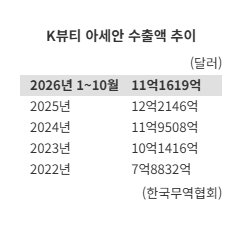
The beauty market in Southeast Asia, including Indonesia, is also growing rapidly. Global market research firm Euromonitor forecast average annual growth of 4.4% through 2030, about three times the projected rate for East Asia. K-beauty exports to ASEAN totaled $1.11619 billion year-to-date through last month, up 13% from the same period a year earlier.
Cosmax laid the groundwork for entering the Southeast Asian market early on. After establishing an Indonesian subsidiary in 2012, it obtained halal certification for its local plant in 2016, and launched a Thai subsidiary in 2018, where it now operates a factory. Last year, revenue at its Indonesian and Thai subsidiaries was 97.7 billion won and 73.2 billion won, respectively, accounting for 7% of its total revenue.
Cosmax is also expanding its original brand manufacturing (OBM) business, which spans brand planning and marketing, focusing on Southeast Asia. It launched OBM services in 2015 and established a dedicated team in 2022 to help brands gain a foothold in the market. It recently confirmed a deal to supply private-label (PB) products to Looks, a beauty specialty store being opened by Tops (TOPS), a distributor affiliated with Thailand’s major retailer Central Group. Building on the performance of its Thai subsidiary, Cosmax established a Vietnamese subsidiary early this year to expand its business. Last month, it set up GrowX as a separate company under its holding company, Cosmax BTI, to specialize in marketing consulting for cosmetics and health functional foods.
An industry official said, “Southeast Asia’s beauty market is growing rapidly, and local brands’ demand for product development and manufacturing is also expanding. Domestic ODM companies will draw on their accumulated technological expertise and product development capabilities to secure local clients and create new growth engines.”
[email protected] Kang Myung-yeon Reporter