HD Hyundai Heavy Industries' Shin Sang-beom: 'Automation's Goal Is a Safer, More Efficient Shipyard'
- Input
- 2026-11-19 15:42:28
- Updated
- 2026-11-19 16:06:17
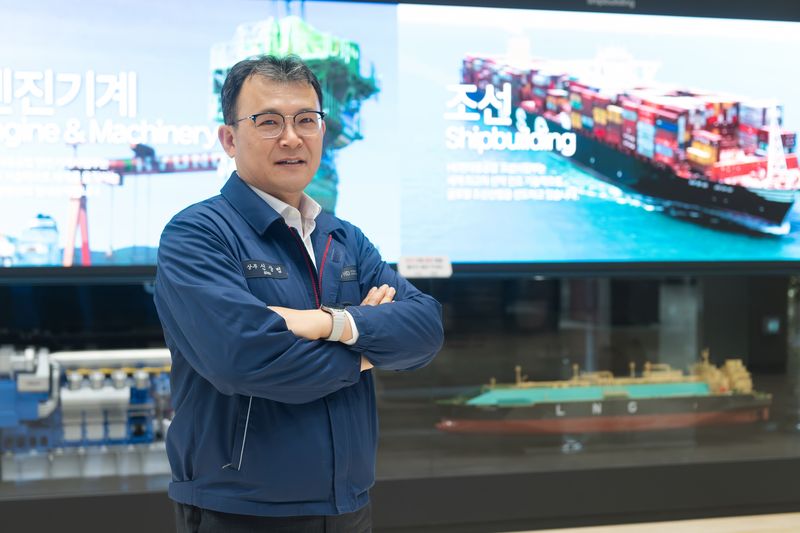
"The purpose of the automation HD Hyundai Heavy Industries is pursuing is not, in itself, to replace people."
That was the point emphasized by Executive Director Shin Sang-beom, who leads the Automation Innovation Division at the forefront of realizing HD HHI's so-called "future advanced shipyard," when he met with Financial News on the 19th. Automation is intended to improve safety and efficiency and is ultimately for workers, not a threat to them. Shin explained that automation is essential to ensure workers can work safely and achieve at least a certain level of work quality, even as skilled workers become increasingly scarce.Executive Director Shin Sang-beom is responsible for identifying automation technologies and applying them to production processes at the Ulsan Shipyard, HD HHI's flagship facility. In other words, he is directly expanding the scope of automation on the ground. Shin said HD Hyundai plans to deploy at least 3,000 robots across its shipyards by 2030, adding, "Alongside increasing the use of robots, it is important to secure automation technologies that can operate reliably even in the complex working environments of shipyards."
Shin said the goal of the shipyard automation and artificial intelligence transformation (AX) efforts he is pursuing on the ground is to "improve the work environment." He said, "We are focused on creating an environment where people can work more safely and efficiently," adding, "Ultimately, the goal is to build a production environment where people can work more safely and efficiently."
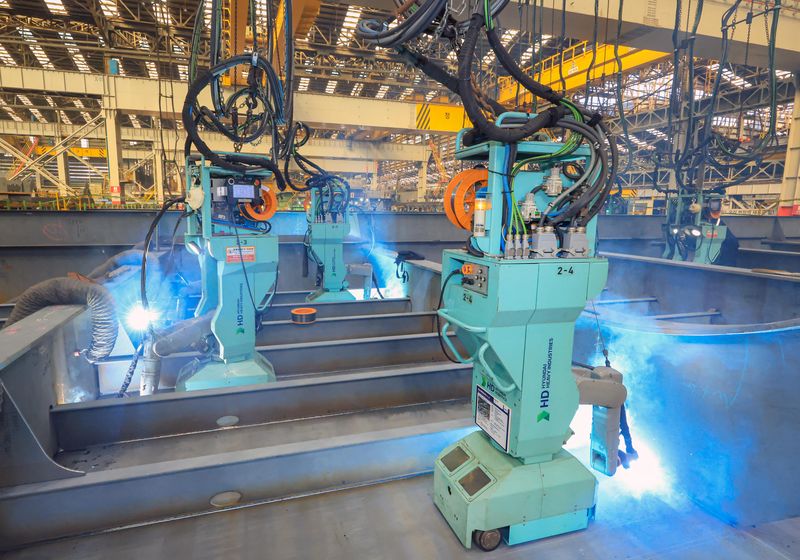
He cited welding during the small-assembly stage as an example. One worker is performing several tasks at once with collaborative robots that either descend from the ceiling or are moved into place and operated by workers. Shin highlighted how "workers' roles are changing: instead of doing repetitive welding themselves, they set and manage the robots' operating conditions or focus on high-skill welding and quality control."
Shin expects that, by advancing automation and AX and accumulating as data the tacit knowledge—the know-how embodied by skilled workers—even as the workforce continues to shrink, work quality can still be assured. He said, "If we accumulate skilled workers' experience and expertise as data and incorporate it into automated systems, even workers with relatively little experience can achieve at least a certain level of work quality," adding, "This will help address the shortage of skilled workers."
There are already visible gains in production efficiency. Shin said that productivity in welding has risen 40% compared with conventional manual work, while the panel-slit welding robot that descends from the ceiling has tripled productivity. The plan is to apply physical AI that adjusts welding conditions on its own in the first half of next year to increase productivity further, and to use block-deformation prediction technology in 2028 to raise the outdoor-work automation rate, currently around 15%.
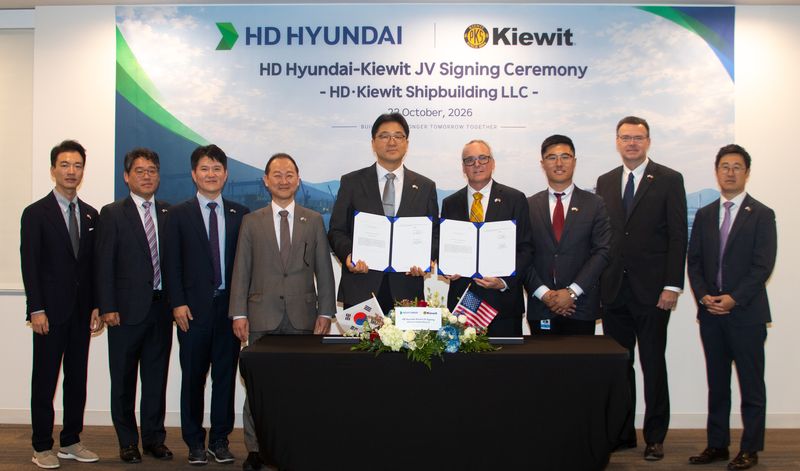
HD HHI aims to increase shipbuilding productivity by at least 30% by 2030 through advances in automation and AX. That target, however, applies to existing shipyards. The shipyard to be built in partnership with Kiewit, the largest construction, engineering and infrastructure company in the United States, will be designed with automation systems in mind and is expected to achieve a level of autonomous manufacturing far beyond that of existing yards.
Shin predicted, "HD Kiewit Shipbuilding can build a production system optimized for automated equipment and robot operations from the design stage," adding, "This shipyard, which will begin operations in 2029, will apply technologies developed to date, including digital twins, robotic welding and automated production systems, to boost productivity and quality and address the shortage of skilled workers in the United States."
Shin predicted that future shipyards, led by HD Kiewit Shipbuilding, will move beyond basic automation to a stage where AI recognizes conditions on the ground and coordinates production processes. He said, "Automation in shipbuilding will go beyond having machines simply take over tasks that people used to do. AI will independently recognize and assess conditions on the ground and carry out the optimal tasks," adding, "Because shipbuilding has more complex working environments and non-routine processes than other manufacturing industries, securing technologies that can automate these areas will determine future competitiveness."
[email protected] Kim Yun-ho Reporter