HIRA President Hong Seung-gwon: “AI Is a Tool... It Counts as Success Only If Public Healthcare Improves”
- Input
- 2026-11-19 16:00:00
- Updated
- 2026-11-19 16:00:01
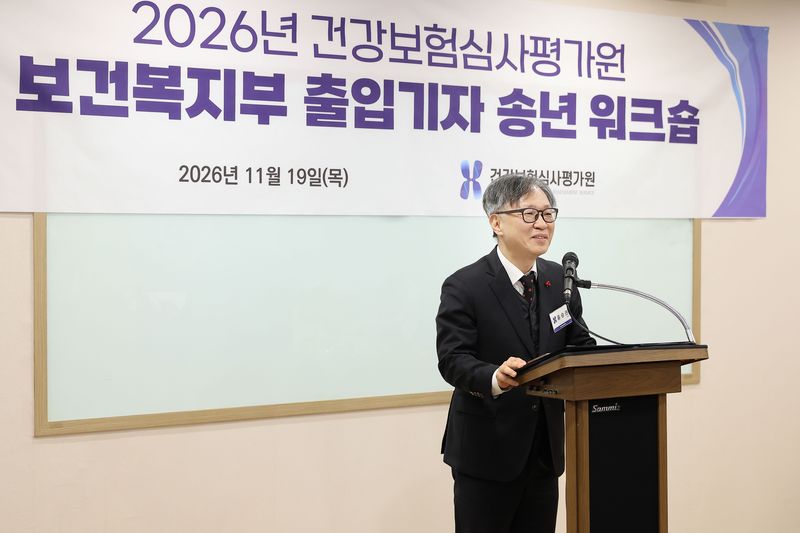
HIRA President Hong Seung-gwon held his first briefing since taking office in Seocho District, Seoul, on the 19th and stressed, “HIRA’s performance should be judged not by how much work we have done, but by how much healthcare for the public has improved through that work.”
In his opening remarks, Hong pointed to changes in the environment, including the low birth rate and aging population, disparities in healthcare between regions, and a shortage of essential healthcare workers, and said HIRA must not rest on its existing ways of working. He said that, after taking office this past April, he had visited regional headquarters and medical facilities across the country and met with medical associations and resident doctors, among others. A common request, he said, was that people receive the care they need on time and that healthcare professionals have the conditions necessary to focus on treating patients.
He said HIRA would turn into tangible results starting next year the three directions he had outlined on the 100th day of his tenure in July: AI- and data-based innovation in review, a shift to a value- and performance-centered review and assessment system, and a compensation system for regional, essential, and public healthcare.
For next year, he set out the following priorities: building a value-based review and assessment system that prevents unnecessary use of medical services rather than relying solely on retrospective reviews; providing fair compensation for essential healthcare, including emergency care, childbirth, and pediatric care; and ensuring the sustainability of national healthcare spending by reducing inefficient expenditure. On AI in particular, he said it was “an essential means of innovation, not a choice,” adding, “What matters is not the technology itself, but creating real change in people’s health and in the medical field through it.”
Kim Mu-seong, head of the AX Innovation Office, then presented a roadmap for AI transformation (AX). In line with the government’s national strategy for an “AI Basic Society,” HIRA developed an implementation strategy centered on AI in everyday life, an AI foundation at the community level, and a sustainable AI ecosystem. Its core principle is “Human-in-the-Loop”: AI supports decision-making, while people make the final decisions and bear responsibility.
One example is the Medical Review and Assessment Committee, made up of more than 1,000 medical experts, focusing on key images selected by AI from among hundreds of medical images. HIRA has established AI ethics principles and operational procedures to manage the process from identifying projects and monitoring errors to removing risky or biased models.
A conversational “Find a Hospital or Pharmacy” chatbot is also under development. For example, comparing three hospitals, which used to require more than ten clicks, can be reduced to two questions, such as, “Please recommend an internal medicine clinic rated Grade 1 in the hypertension and diabetes assessment.”
The AI infrastructure is already in place. HIRA acquired 16 NVIDIA B200 GPUs at the end of October. Two servers, each equipped with eight GPUs (3 billion won), plus ancillary equipment such as memory and storage (3 billion won), bring the total to 6 billion won. This month, HIRA is building an integrated AI platform on this equipment.
HIRA stressed that it would develop better AI so that the insurance premiums paid by the public are put to better use and the quality of care in the medical field is maintained. It plans to link the outcomes of this system—in which AI provides analysis and supporting evidence for each item, and experts make the final decisions—to value-based compensation.
[email protected] Jung Sang-hee Reporter