“Failed to Keep Pace With Rising Bad Loans” ... Big Four Banks’ Loan-Loss Reserve Coverage Ratios Fall 57 Percentage Points in Two Years
- Input
- 2026-11-22 17:14:10
- Updated
- 2026-11-22 17:14:10
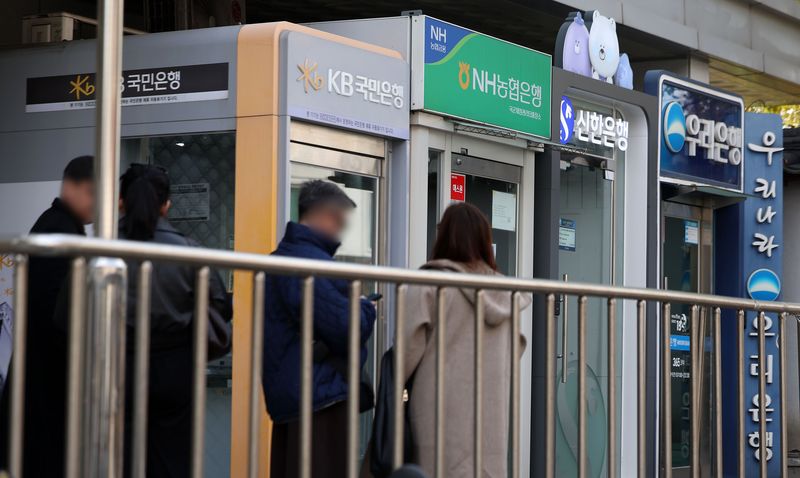
[Financial News] The four major banks’ loan-loss reserve coverage ratios have fallen sharply over the past two years. Nonperforming loans have risen rapidly amid a delayed economic recovery and weakening repayment capacity among vulnerable borrowers, while provisions set aside against those loans have grown relatively slowly.
According to financial industry sources on the 22nd, the average loan-loss reserve coverage ratio at the four major commercial banks—KB Kookmin Bank, Shinhan Bank, Hana Bank and Woori Bank—stood at 146.8% at the end of this year’s third quarter. That was down 25.2 percentage points from 172.0% at the end of last year, and 57.4 percentage points below the 204.2% recorded at the end of 2024.
The loan-loss reserve coverage ratio indicates how much money a bank has set aside to cover potential losses on the nonperforming loans it holds. For example, if a bank has set aside 15 billion won in provisions for every 10 billion won in nonperforming loans, its coverage ratio is 150%. The ratio therefore reflects the bank’s capacity to absorb losses from future loan defaults.
Woori Bank recorded the steepest decline. Its loan-loss reserve coverage ratio fell 45.8 percentage points, from 172.6% at the end of last year to 126.8% at the end of this year’s third quarter. Hana Bank’s ratio also fell over the same period, dropping 29.8 percentage points from 136.3% to 106.5%. Shinhan Bank’s ratio declined 10.6 percentage points, from 173.1% to 162.5%, while KB Kookmin Bank’s fell 14.6 percentage points, from 206.0% to 191.4%.
The coverage ratio declined because provisions did not grow nearly as fast as nonperforming loans. At the end of this year’s third quarter, total loan-loss provisions at the four banks stood at 7.9674 trillion won, up 185.1 billion won (2.4%) from 7.7823 trillion won at the end of last year.
By contrast, the volume of substandard-and-below loans, which are classified as nonperforming, expanded rapidly. At the end of this year’s third quarter, such loans at the four banks totaled 5.5932 trillion won, an increase of 1.0443 trillion won (23.0%) from 4.5489 trillion won at the end of last year. That was about 10 times the growth rate in provisions.
Substandard-and-below loans generally refer to loans deemed difficult to recover through normal means, such as when principal and interest payments are at least three months overdue. The banking industry believes that prolonged high interest rates and a slow economic recovery have contributed to the rise in nonperforming loans. Analysts say the increase reflects mounting debt-repayment burdens, particularly among small and medium-sized enterprises and small business owners whose operating conditions have worsened amid sluggish domestic demand, as well as rehabilitation filings by some large companies.
“The impact of rehabilitation proceedings involving some companies temporarily lowered the loan-loss reserve coverage ratio this year,” a banking industry official said. “However, it remains well above the appropriate level of 100%.”
[email protected] Seo Ji-yoon Reporter