Kim Keon-hee's 'Three Major Allegations': Four-Year Prison Term Finalized; 'Myeong Tae-gyun Polls' Acquittal
- Input
- 2026-11-19 16:49:40
- Updated
- 2026-11-19 16:49:40
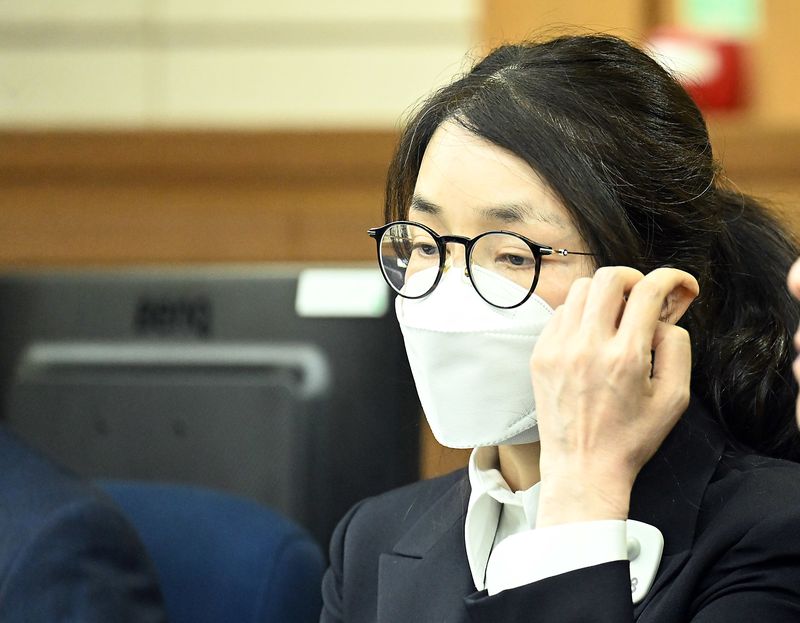
[Financial News] The Supreme Court Grand Bench has finalized an appellate ruling sentencing Kim Keon-hee to four years in prison and a 50 million won fine for the so-called “three major allegations”: stock manipulation involving Deutsche Motors, accepting money and valuables from the Unification Church, and receiving free opinion polls from Myeong Tae-gyun.
On the 19th, the Supreme Court Grand Bench, led by Chief Justice Cho Hee-dae, rejected the appeals filed by both the defendant and the special counsel in the case concerning Kim’s “three major allegations,” upholding the lower court’s ruling. The final decision came one year and three months after she was indicted.
Regarding the alleged violation of the Political Funds Act, Kim was accused of conspiring with former President Yoon Suk Yeol to receive free opinion polls from Myeong Tae-gyun 58 times between June 2021 and March 2022, worth a total of 274.4 million won. The appellate court acquitted her of the charge of receiving the polls free of charge.
The Supreme Court majority, like the lower court, also found her not guilty on this part of the case. The court said, “For conducting opinion polls or providing their results to be punishable as the crime of illegally receiving political funds, there must have been an agreement to bear the costs on someone else’s behalf, or it must have been objectively and clearly foreseeable that the polls would be paid for as expenses for the recipient’s political activities or would replace such expenses.” It added, “In light of the principle of strict interpretation under the rule of law and constitutional fundamental rights, including political freedom, the law must be interpreted narrowly.”
The court further ruled, “It is reasonable to find that Myeong conducted the polls on his own initiative, primarily motivated by the business benefit of promoting the Institute for Future Korea and by his own political convictions and desire to expand his influence, and then gave some of the results to the defendant and her husband.” It added, “It is difficult to regard them as money or other assets replacing expenses for Yoon’s political activities, and it is also difficult to find that the defendant intended to receive political funds as a donation.”
Supreme Court Justices Oh Kyung-mi and Kim Seong-su, who issued dissenting opinions, said the charge concerning 12 of the 58 instances—polls intended for publication and delivered between late July and October 2021—should be found guilty. Justice Oh said, “Opinion polls have inherent property value, and as they were conducted as part of former President Yoon’s political activities ahead of the People Power Party’s internal primary at the time, the defendant’s intent to receive the results free of charge and enjoy a financial benefit is established.” She added, “If opinion polls are received free of charge alongside extensive political assistance, that separately becomes punishable as the crime of illegally receiving political funds.”
The Supreme Court also upheld the lower court’s findings of partial guilt on the charge of participating in Deutsche Motors stock manipulation (violating the Capital Markets Act) and full guilt on the charge of accepting luxury necklaces, bags and other items from the Unification Church (acceptance of money in return for influence under the Act on the Aggravated Punishment, etc. of Specific Crimes). It said, “There was no error of the kind alleged in the grounds of appeal by either the defendant or the special counsel.”
At the first trial, Kim was found guilty of only part of the charge of accepting money and valuables from the Unification Church and was sentenced to one year and eight months in prison. At the second trial, that charge was changed to a full guilty verdict, and she was also found partially guilty of participating in stock manipulation, increasing her sentence to four years in prison and a 50 million won fine.
The Supreme Court Grand Bench ruling is seen as having strictly interpreted the requirements for establishing a violation of the Political Funds Act through the free provision of opinion polls. Oh Se-hoon, the mayor of Seoul, also recently had a first-instance sentence that would have cost him his office overturned on appeal, where he was acquitted in a trial over the payment of polling costs arising from the same “Myeong Tae-gyun gate.” Whether having polling costs paid on his behalf and receiving polls free of charge constitute political funds, as well as the credibility of Myeong’s statements, are key issues in Oh’s trial. The legal principles set out by the Supreme Court are therefore expected to have an impact.
[email protected] Lee Chang-hoon Reporter