Math Exam Focuses on Conceptual Understanding and Comprehensive Reasoning Rather Than Complex Calculations [2027 CSAT]
- Input
- 2026-11-19 14:20:14
- Updated
- 2026-11-19 14:32:12
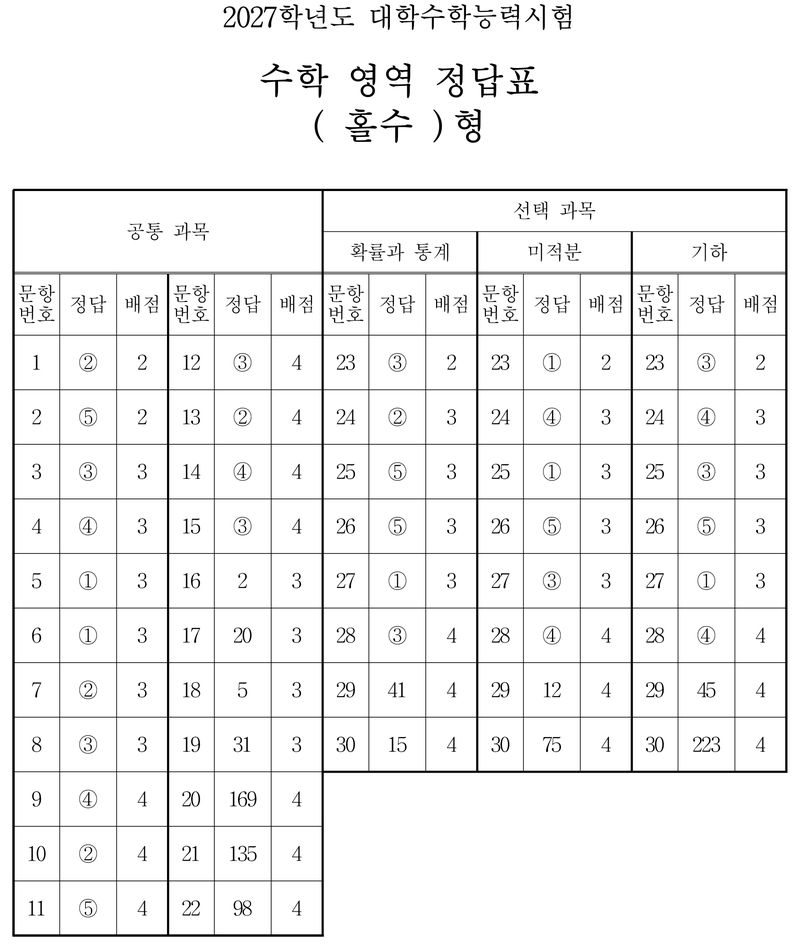
[Financial News] On the 19th, the math section of the 2027 CSAT focused on assessing the ability to understand basic concepts and apply them to solving problems rather than on complex calculations.
The CSAT question-setting committee said of the math section’s exam design, “The questions were designed to enable problem-solving by synthesizing various pieces of information based on mathematical concepts and principles learned in the high school curriculum.” The focus was on assessing the ability to use two or more mathematical concepts together and make logical judgments, rather than on questions that could be solved simply by applying formulas or through repetitive practice.
There were 11 questions each in Math I and Math II, the common subjects. The questions included ones on understanding and using graphs of functions, patterns in sequences, and the relationship between speed and distance.
There were eight questions each in the elective subjects of Probability and Statistics, Calculus and Geometry. Questions drew on major concepts such as conditional probability in Probability and Statistics, differentiation and integration in Calculus, and ellipses and vectors in Geometry.
Questions were assigned 2, 3 or 4 points, taking into account the time needed to solve them and the level of the content. The common subjects included two 2-point questions, ten 3-point questions and ten 4-point questions. Each elective subject—Probability and Statistics, Calculus and Geometry—had one 2-point question, four 3-point questions and three 4-point questions. There were seven short-answer questions requiring examinees to write in the answer directly in the common subjects and two in each elective subject, for a total of six in the electives. All short-answer questions had answers that were natural numbers of three digits or fewer.
Examples of questions linked to EBS included No. 14 in the common subjects, which drew on the properties of logarithmic functions; No. 28 in Probability and Statistics, which asked for the number of possible cases; and No. 27 in Calculus, which involved differentiation.
[email protected] Lee Bomi Reporter