“Up 20.2% Even Excluding Semiconductors”... South Korea Crosses the $1 Trillion Export Threshold
- Input
- 2026-11-19 14:40:50
- Updated
- 2026-11-19 14:40:50
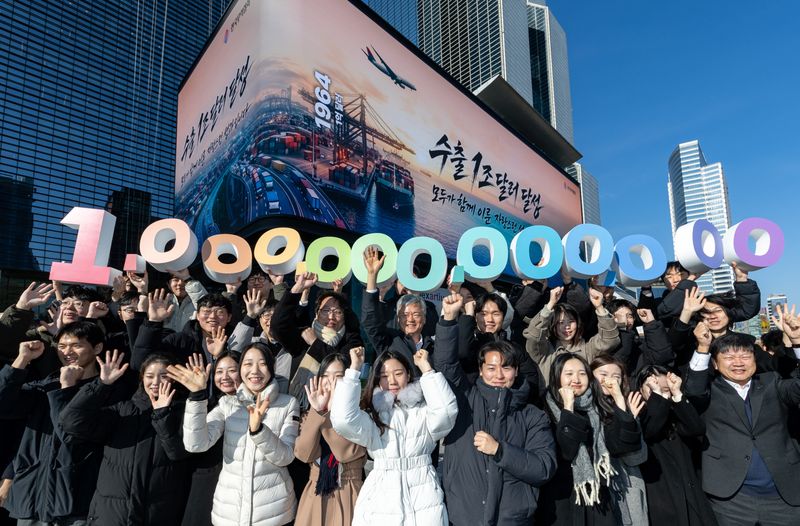
On the 19th, the Korea International Trade Association’s Institute for International Trade (IIT) released a report titled “The Significance and Challenges of Achieving $1 Trillion in Exports.” The countries that had previously surpassed $1 trillion were the United States and Germany in 2006, and China in 2007.
According to the report, South Korea ranked fifth in global exports from January to August this year. It forecast that South Korea was likely to rank fourth for the full year, as its exports were expected to pull well ahead of the Netherlands from September. South Korea’s share of the global export market reached an all-time high of 3.4% in the first half of this year.
South Korea has a population of 51.61 million and relies on imports for 93.9% of its energy. At the time it reached $1 trillion in exports, its per capita exports stood at $19,376, the highest among countries to reach the $1 trillion mark. Among countries with populations of at least 50 million, it ranked second, after Germany.
The timing of the achievement also differed. The United States, Germany and China surpassed $1 trillion in exports between 2000 and 2010, when global trade grew by an average of 8.9% annually. South Korea reached the milestone during the slowdown from 2011 to 2025, when global trade grew by an average of just 2.6% a year. High-tech products, as classified by the World Bank, accounted for 36.3% of manufacturing exports in 2024, the highest share among the top five exporters in the WTO rankings for the first half of this year, excluding Hong Kong.
Semiconductors led this year’s export growth, but other products also contributed. A breakdown of export growth from January to September shows that unit prices contributed 34.0 percentage points and volumes 26.1 percentage points. The report said that volume contributions were generally larger from 1989 to 2011. Export unit prices for non-IT products also rose 12.6% year on year, in addition to those for IT products such as semiconductors and computers. The report said that, excluding the sharp rebound immediately after the economic crisis, growth in exports excluding semiconductors was at its highest level in the past 20 years.
Exports of AI-enabled products ranked sixth globally in 2025. From January to October this year, they rose 169.7% to $478.4 billion, and their share of total exports grew from 31.8% in 2025 to 51.4%.
South Korea strengthened its position in both the U.S. and Chinese markets. From January to September this year, South Korea was the top source of imports for China and the sixth-largest source for the United States. Its ranking in the U.S. market rose three places from ninth in 2025, while in China it overtook Taiwan to take first place, up from second in 2025. Exports to the Association of Southeast Asian Nations (ASEAN) rose from 14.2% of South Korea’s total exports in 2015 to 18.1% from January to October this year. From January to October, consumer goods exports excluding automobiles increased 67.8% year on year.
The report estimated that $1 trillion in exports generated $1.7083 trillion in domestic output, up 30.6% from 2025. The real value added generated was $453.8 billion, equivalent to 27.8% of gross domestic product (GDP). It estimated that exports this year generated employment for 4.95 million people, up 950,000 from the previous year. The value added generated in the service sector by $1 trillion in goods exports was estimated at about $179.3 billion. By sector, the estimates included $44.2 billion in wholesale and retail trade and $22.2 billion in professional, scientific and technical services.
Exports by small and medium-sized enterprises reached a record $120 billion in 2025, up 8.1% from the previous year. From January to September this year, they set another record at $96.5 billion, up 9.5%.
The report framed the tasks for sustainable exports as “broader, farther and deeper.” “Broader” means expanding competitiveness beyond memory chips to system semiconductors, advanced packaging, and materials, parts and equipment, while diversifying core industries into areas such as nuclear power, biotechnology and consumer goods. It also includes cooperation between manufacturers and companies pursuing AI transformation (AX).
“Farther” means diversifying export markets, responding to trade rules and strengthening economic security capabilities. “Deeper” refers to increasing domestic value added and links with the service sector, extending the benefits to SMEs and regional economies, and investing in R&D and infrastructure. According to an April survey by the Korea International Trade Association, 65% of respondent companies said that recent changes in the trade environment had increased the need to diversify markets.
[email protected] Kim Dong-chan Reporter