Consensus That Korean Was Easier Than Last Year... Differences in Perceived Difficulty [2027 CSAT]
- Input
- 2026-11-19 12:58:48
- Updated
- 2026-11-19 12:58:48
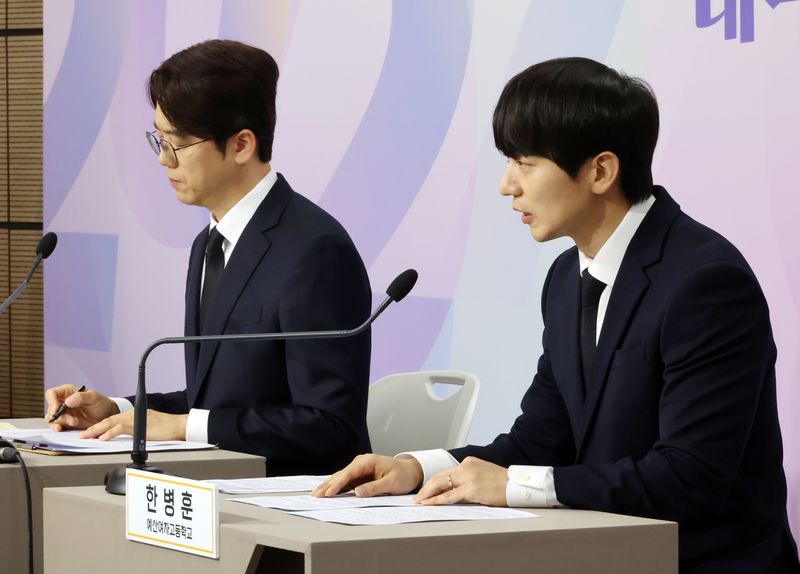
[Financial News] The EBS field teacher panel and test-prep firms agreed that the Korean section of the first session of the 2027 College Scholastic Ability Test (CSAT) was easier than last year’s CSAT and the mock exam held last September. However, the panel and the test-prep industry differed in their views on the difficulty candidates actually experienced and how useful the linked passages were.
Han Byeong-hun, a Korean instructor with the EBS field teacher panel and a teacher at Yesan Girls’ High School, said at a briefing on trends in the Korean section questions, held at Government Complex Sejong on the 19th, that “this year’s CSAT Korean section was designed to ease the reading burden on candidates.” He added, “The passages contained an appropriate amount of information, presented explicitly, so that candidates’ background knowledge would not give them an advantage or disadvantage in reading,” and said, “As a result, we believe the difficulties candidates face due to a lack of time will have been reduced.”
The field teacher panel said all four reading passages drew on subject matter and key concepts from EBS-linked study materials, while three of the eight literary works were linked, and concluded that candidates would likely have felt a high degree of EBS linkage.
Test-prep firms agreed that the overall difficulty of the questions had decreased, but predicted a wide gap in perceived difficulty depending on candidates’ score levels and elective subjects. Lee Man-gi, head of Uway’s Education Evaluation Research Institute, forecast that the number of perfect scores in this year’s Korean section would exceed the 261 recorded in the 2026 CSAT. However, he said, “Top-performing students may have been able to save time on the reading section and clearly identify errors in the literature answer choices, making the questions relatively easy to solve,” adding, “If mid-tier students spent time trying to fully understand the meaning of the mirror-glass composite passage and ‘Bomui Hwan,’ they may have found the test as a whole more difficult than expected.”
Some analyses also pointed to the burden at the start of the test for candidates who chose the elective subject Language and Media. Lim Seong Ho, head of Jongro Academy, said, “Although the overall perceived difficulty will have been lower than that of last year’s CSAT, which was difficult, Language and Media was relatively harder than Oration and Composition, so candidates taking Language and Media who tackled the elective section first would have felt pressure from the very start of the test.”
Assessments also differed on the virtual memory passage, a science-and-technology text in the reading section. One teacher said the use of the ‘virtual memory’ material from EBS-linked study materials likely helped candidates identify the causes of problems related to program execution. By contrast, Nam Yungon, head of the entrance exam strategy research institute at MegaStudyEdu Co. Ltd., said, “The material in the latter part of the passage was not covered in EBS CSAT Special Lecture and was presented in a somewhat complex way, so candidates may have had difficulty solving the questions.” Kim Byung-jin, head of Etoos’ Education Evaluation Research Institute, said, “The questions were slightly easier than last year’s CSAT, and the number of questions and scoring system for the common and elective subjects, as well as the approach of linking questions to EBS materials, remained the same as before.”
Questions commonly identified as key to distinguishing candidates included question 17 in the social studies reading passage and question 37 in Language and Media. One teacher said, “For question 17 in the social studies passage, candidates had to connect the distinction between criminal defamation and insult with differing positions in a civil-law situation, then apply it to a specific case, which likely required several stages of reasoning.” Other questions cited as distinguishing top-performing candidates included questions 6 and 8 in humanities, 23 and 30 in literature, 40 and 45 in Oration and Composition, and 35, 36 and 39 in Language and Media.
The CSAT question-setting committee said it had prepared questions in the Korean section to measure the Korean-language skills needed for university studies, based on the 2015 revised Korean language curriculum. It said 53.3% of the questions were linked to EBS CSAT study materials, with 24 of the 45 questions linked.
[email protected] Kim Man-gi Reporter