“Definitive Treatment Within the Golden Window Is Key” ... 14 Regional Cardiovascular and Cerebrovascular Centers Re-designated, 3 on a Conditional Basis
- Input
- 2026-11-19 12:50:53
- Updated
- 2026-11-19 12:50:53
[Financial News] Fourteen regional cardiovascular and cerebrovascular disease centers nationwide have been redesignated. However, three hospitals—Kangwon National University Hospital, Jeju National University Hospital and Andong Hospital—have performed too few complex cardiovascular surgeries and will have their performance reviewed separately each year going forward.
The Ministry of Health and Welfare said it had held the second 2026 meeting of the Cardiovascular and Cerebrovascular Disease Management Committee on the 19th, where the results of the evaluation for redesignating regional cardiovascular and cerebrovascular disease centers were reviewed and approved. The committee was also briefed on the performance evaluation results for the second year (2025) of the pilot care-coordination network project for cardiovascular and cerebrovascular diseases, plans for distributing follow-up support funds, and measures to improve the pilot project.
All 14 regional centers re-designated; 3 to undergo separate performance monitoring
The 14 centers being redesignated are those among the 15 regional centers currently in operation for which three years have passed since designation. They are Kangwon National University Hospital, Gyeongsang National University Hospital, Kyungpook National University Hospital, Dong-A University Hospital, Seoul National University Bundang Hospital, Andong Hospital, Ulsan University Hospital, Wonkwang University Hospital, Inha University Hospital, Soonchunhyang University Cheonan Hospital, Chonnam National University Hospital, Jeju National University Hospital, Chungnam National University Hospital and Chungbuk National University Hospital. St. Carollo Hospital, designated in February this year, was excluded from the evaluation because it had not yet completed a three-year designation period.
The evaluation was based on clinical performance and operational results over the most recent 42 months (July 2022 to December 2025), following the first-cycle redesignation (2023–2026). Four areas were assessed comprehensively: basic requirements, standards for essential facilities and staffing, treatment capacity standards, and operational evaluation indicators for the past three years.
All 14 centers met the designation criteria under the enforcement regulations, and their average rate of meeting operational evaluation indicators was 94.2%, maintaining an adequate level.
However, three centers—Kangwon National University Hospital, Jeju National University Hospital and Andong Hospital—which need to increase their numbers of complex cardiovascular surgeries, such as coronary artery bypass and aortic surgery, will be conditionally redesignated and have their performance reviewed annually through a separate performance management process.
Performance subsidies will be provided to the top three hospitals in the 2025 operational evaluation (Ulsan University Hospital, Soonchunhyang University Cheonan Hospital and Wonkwang University Hospital) and to four hospitals whose rates of meeting operational evaluation indicators rose substantially from the previous year (Chonnam National University Hospital, Seoul National University Bundang Hospital, Chungnam National University Hospital and Dong-A University Hospital).
Shorter Time From 119 Calls to Treatment ... 10.57 Billion Won in Follow-up Support
The pilot care-coordination network project for cardiovascular and cerebrovascular diseases, launched in February 2024 to ensure that patients with severe and emergency cardiovascular and cerebrovascular conditions receive definitive treatment within the golden window, expanded in scale during its second year, while the timeliness of treatment improved significantly.
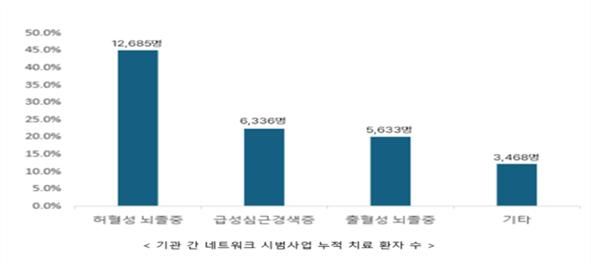
Ten inter-institutional networks (63 institutions) are currently operating, connecting paramedics and medical staff around regional centers to quickly determine which hospital will receive patients and provide definitive treatment. The regional centers, 53 participating hospitals in their areas and 119 ambulance teams are linked by hotlines, and together they had treated a cumulative total of 27,897 patients with severe and emergency conditions by the end of June this year.
The second-year evaluation found that, compared with the first year, the time from a 119 call to the start of definitive treatment fell by 310 minutes and 18 seconds for hemorrhagic stroke and by 20 minutes and 54 seconds for ischemic stroke. The share of patients who received definitive treatment within the appropriate time also rose to 76.5%, up 2.8 percentage points from 73.7% the previous year.
Fifty-six human networks, comprising 1,416 specialists, are operating, enabling specialists at different medical institutions to refer patients to one another and accept referrals in real time through a dedicated platform. In the second year, there were 2,137 patient referrals, up 125% from 949 the previous year; specialists who would provide definitive treatment accepted 95.3% of them (2,037 cases). The average response time for accepting a referral also fell from 4 minutes and 36 seconds to 3 minutes and 12 seconds.
The Ministry of Health and Welfare will distribute a total of 10.57 billion won in follow-up support funds in varying amounts based on the performance evaluation results. It will provide 7.15 billion won to inter-institutional networks and 3.42 billion won to 54 human networks with evaluation scores of 60 or higher.
The ministry also outlined plans to reform and upgrade the pilot project in line with its scheduled conclusion this December and the planned implementation in March 2027 of the Special Act on Support for Strengthening Essential Medical Care and Resolving Regional Healthcare Disparities.
First, the legal and institutional framework will be revised so that the Central Cardiovascular and Cerebrovascular Disease Center oversees the establishment and operation of nationwide networks, while regional centers actively participate in inter-institutional and human networks in their respective service areas and take a central role.
A new evaluation indicator reflecting cooperation between networks will also be introduced in July 2027 to ensure that the ambulance transport stage (inter-institutional networks) and the interhospital transfer stage (human networks) are closely linked. The government will also gradually diversify operating models to suit regional conditions, including in areas with limited healthcare resources, and reform the follow-up compensation system, with implementation targeted for January 2028.
Second Vice Minister Lee Hyeong-hun said, “The redesignation of regional cardiovascular and cerebrovascular disease centers and the upgrading of the network pilot project are key foundations for establishing a fully integrated healthcare system that enables patients with severe and emergency cardiovascular and cerebrovascular conditions in local communities to receive definitive treatment within the golden window.” He added, “We will continue to close healthcare gaps between regions and build an even more robust safety net for essential medical care to protect people’s lives.”
[email protected] Jung Myung-jin, Medical Correspondent Reporter