Ruling Party Angered by Failure to Pass Three Housing Supply Bills: “Bipartisan Decision Needed”
- Input
- 2026-11-19 11:16:09
- Updated
- 2026-11-19 11:16:09
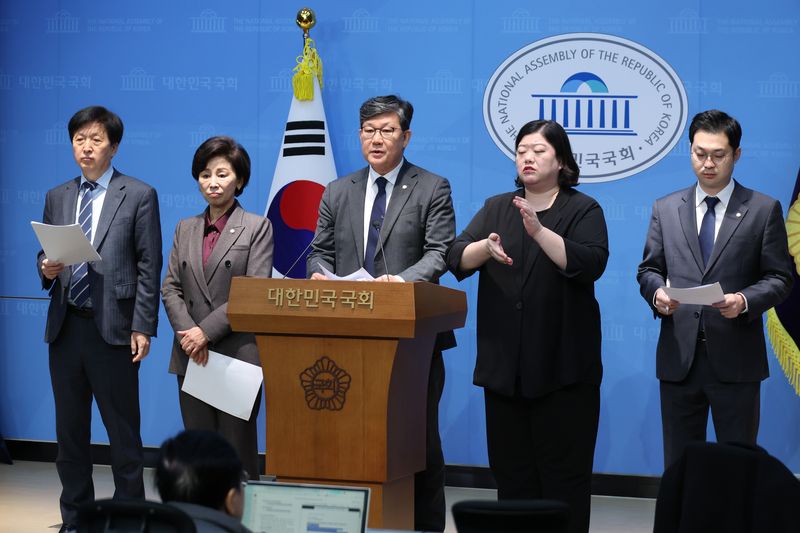
The Democratic Party of Korea’s Seoul chapter Special Committee on Housing Supply Policy held a press conference at the National Assembly that day and stressed the need to pass the Three Housing Supply Bills to ensure housing stability in the Seoul area.
The committee said, “The People Power Party has announced that it will respond with filibusters—unlimited debates legally permitted under the National Assembly Act to obstruct legislative proceedings—on all bills without agreement submitted to the plenary session on the 19th, putting the Three Housing Supply Bills at risk of once again being stopped at the threshold of the plenary session.”
It added, “Even amid political confrontation, the ruling and opposition parties should put their heads together to work out a solution, at least on livelihood legislation to ensure housing stability. The Three Housing Supply Bills are urgent measures that can break the logjam in housing supply.”
The key feature of the amendment to the Urban Improvement Act is that it would allow basic plans and the designation of improvement zones to proceed alongside project implementation and approval of management-and-disposal plans, shortening redevelopment and reconstruction timelines by two to three years. It also includes provisions to bring prices for rental housing acquired by the public sector in line with market rates and to mediate construction-cost disputes.
The core of the amendment to the Urban Renewal Promotion Act is to temporarily ease the floor-area-ratio cap for public redevelopment projects in urban renewal promotion zones, including aging new towns, and simplify procedures. The measure is intended to speed up renewal in aging residential areas.
The amendment to the Yongsan Park Act would adjust green-space requirements for scattered sites around the park, making it possible to supply housing in downtown areas for groups facing housing insecurity, including young people and newlyweds.
The committee said, “We respectfully ask the People Power Party: if you have objections to the Three Housing Supply Bills, please withdraw the blanket threat to launch filibusters and discuss specific alternatives together, both when the bills are brought before the plenary session and at the negotiating table. The Democratic Party of Korea, too, will engage in consultations with an open mind and, after the bills pass, work with the government and the Seoul Metropolitan Government on everything from subordinate legislation to permitting and approval standards. We will take responsibility through the end to ensure the bills lead to actual construction starts and housing supply.”
After the press conference that day, Democratic Party of Korea lawmakers from the Seoul area again called on the People Power Party to cooperate in passing the bills. Oh Gi-hyoung, a lawmaker from the party, said, “We believe the People Power Party or Seoul Mayor Oh Se-hoon would also agree with many aspects of this bill. There is nothing inherently wrong with providing incentives to the public sector, and if there is a desire to discuss the private sector further, that can be done when discussions on the bill begin later.”
Oh stressed, “Holding this bill up because of other politically contentious bills runs counter to what they themselves have said all along about cooperating to increase supply. We are ready to cooperate actively on matters where we can work together. This is not an issue to hold up.”
He went on to urge, “The two sides should cooperate wherever they can, in the interests of people’s livelihoods and citizens, but taking an obstructive stance on this bill is not the right approach. The People Power Party’s floor leadership needs to change its position on this point.”
[email protected] Kim Hyeong-gu Reporter