Warming Seas ... Even Highly Venomous Tropical Marine Life Is Moving North
- Input
- 2026-11-19 09:43:19
- Updated
- 2026-11-19 09:43:19
According to the Korea Institute of Ocean Science and Technology (KIOST) on the 19th, recent observations show that subtropical organisms rarely seen before are being found in the South and East Seas. On Jeju Island, tropical and subtropical species have been recorded more frequently than temperate species for three consecutive years since 2023.
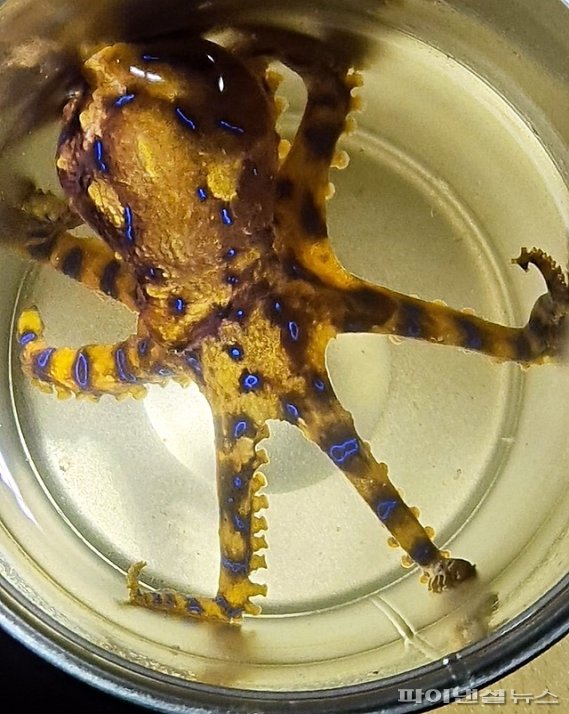
The number of organisms that can harm people, including highly venomous octopuses, toxic jellyfish and sea snakes, is also increasing. A comparison of records of hazardous organisms across the two 10-year periods of 2006–2015 and 2016–2025 shows an increase from 5 species to 16 in the East Sea, and from 10 to 20 in the South Sea.
There were 4,224 jellyfish-sting incidents in 2024, more than five times the previous year’s total. Incidental catches of large sharks in the East Sea surged from 1 in 2022 to 44 in 2024.
The cause is thought to be subtropicalization resulting from rising sea temperatures and the expanding influence of warm currents. The northernmost recorded locations in South Korea for 5 of the 7 representative tropical and subtropical species are shifting farther north by the day. The sharp rise around 2024 in jellyfish-sting incidents and incidental catches of large sharks in the East Sea is also part of this trend.
Go Seong-gil, a research fellow at KIOST’s Tropical and Subtropical Research Center, suggested that “toxic fish, sea snakes and cone snails have been found in particularly large numbers in Jeju. In Jeju, where warm currents arrive first, tropical and subtropical species have been reported more often than temperate species since 2023.” He added, “To understand the nationwide increase in hazardous marine organisms, we also need to examine changes in Jeju, which has the highest proportion of toxic organisms.”
Choi Seon-gyeong, a senior researcher at the Tropical and Subtropical Research Center, also pointed out that “the starting point for responding is to scientifically establish which organisms pose what level of danger. In June 2015, a tourist was bitten by a Paranseon octopus near Hyeopjae Beach on Jeju and received emergency treatment.” She added, “Basic data are still insufficient. We need to expand identification resources as well so that people can easily distinguish hazardous organisms that look similar in the field.”
Kim Tae-hun, a principal researcher at the center, said that “many hazardous organisms spread to the South and East Seas via Jeju. In effect, Jeju is a gateway for these organisms.” He added, “What is ultimately needed is not a collection of individual technologies but a unified system. We need an AI transformation (AX) of integrated marine management that links the entire process, from data collection and classification to unmanned real-time monitoring, early warning and response.”
[email protected] Byun Ok-hwan Reporter