“A Hospital Patients Turn to for Vision Correction When Young and for Retinal Care as They Age” [Weekend Health]
- Input
- 2026-11-19 09:45:15
- Updated
- 2026-11-19 10:16:50
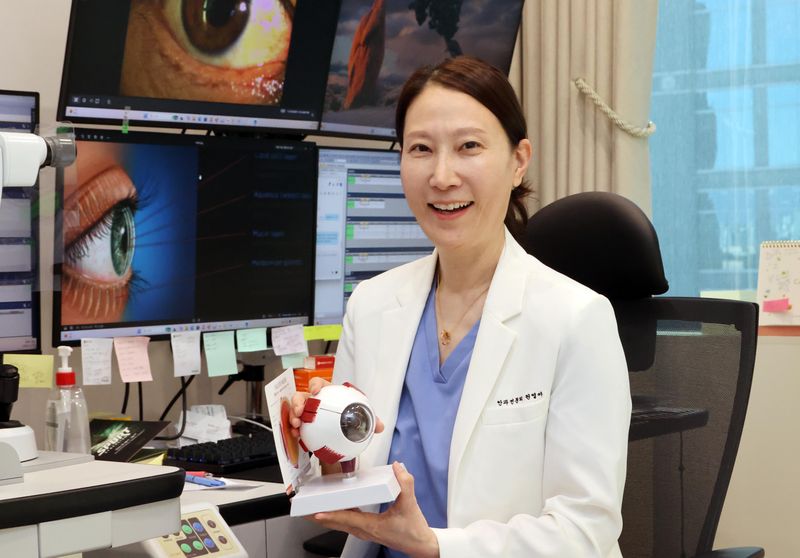
[Financial News] “I want this to be a clinic that patients visit for vision-correction surgery when they are young and can return to as they age for eye care, including cataracts and retinal diseases.”
From vision correction in their 20s, to presbyopia and cataracts in their 50s and 60s, to retinal diseases in old age. On the 19th, Young-a Kwon, director of Gangnam K Eye Clinic, said the clinic aims to care for eye health issues that change with age, all under one roof. That is why Kwon, a corneal and refractive specialist, practices alongside her father, retina specialist Oh-ung Kwon, at Gangnam K Eye Clinic, which opened last October.
Kwon served as head of the LASIK Center and the Cornea Center at Kim’s Eye Hospital. In 2018, while heading the LASIK Center, she introduced SMILE surgery using the VisuMax 500 system. After completing training at the University of California, San Diego (UCSD), in 2019–2020, she established a partial corneal transplantation program. From 2021 to 2025, she gained broad experience in refractive and presbyopia surgery at GS Eye Clinic. Oh-ung Kwon served as head of the Retina Center at Severance Hospital before working as a director at Nune Hospital.
Kwon’s decision to open a clinic with her father was rooted in the belief that the eye should be viewed as a single, integrated organ. Vision is closely linked not only to the health of structures at the front of the eye, such as the cornea and lens, but also to structures at the back, including the retina and optic nerve.
“I have worked in cornea and refractive care, while my father has specialized in treating retinal diseases for more than 40 years,” Kwon said. “We shared the belief that offering patients, in one place, the experience we had built in different fields could create greater synergy. That was the biggest reason we opened the clinic together.”
Retinal exams are also important for patients seeking vision-correction surgery. Severe myopia can increase the risk of retinal disease, so the condition of the retina should be checked before and after surgery. Early detection and treatment of retinal disease at the appropriate time can determine a patient’s visual prognosis. When care in both fields is available in one place, patients can receive broad consultations and treatment for their overall eye health without having to visit multiple hospitals.
Kwon said the clinic aims to be an eye clinic that considers the health of the whole eye, rather than one that addresses only vision problems in a specific area.
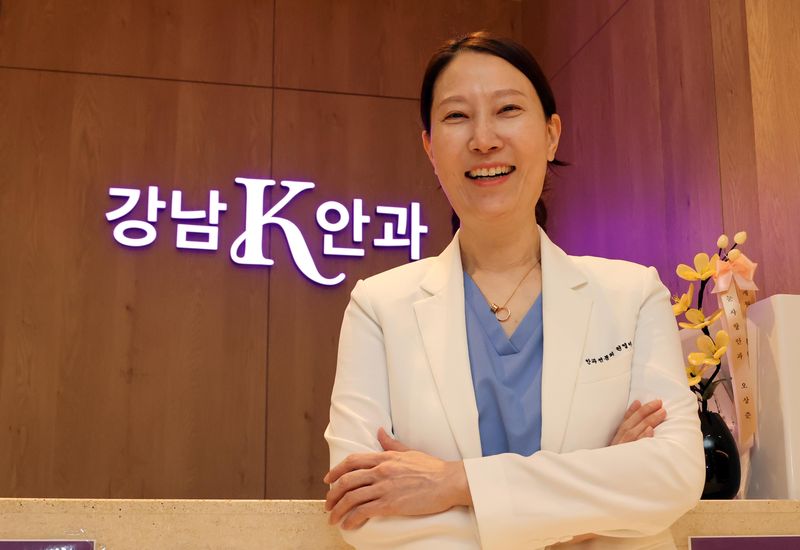
The hospital’s name reflects this idea as well. The “K” stands for Korea, K-culture, K-pop and “Kwon,” the surname shared by the two directors. It also conveys the ambition to grow into an eye clinic representing Korea and a commitment to inspire trust and demonstrate responsibility toward patients.■ “Necessary treatment” matters more than the number of surgeriesAsked about the difference between large specialty hospitals and private practice, Kwon cited “being able to set the principles of care directly.” At Kim’s Eye Hospital, she treated a range of conditions, including keratitis, corneal ulcers, hereditary corneal diseases and keratoconus, and gained experience in not only cataract and refractive surgery but also amniotic membrane and corneal transplantation. As a center director, she was also responsible for managing medical staff and the organization.
“Large hospitals have the strength of having many medical professionals and systems work together in an integrated way. After opening a private practice, I can directly plan and carry out the most appropriate course of treatment for each patient,” Kwon said. “It is also a meaningful change to be able to spend enough time counseling each patient.” She added, “I want to build a clinic that focuses on determining what treatment patients truly need, rather than on surgery numbers or short-term results, and that respects a patient’s choice not to have surgery when it is unnecessary.”
The same principle applies when deciding which vision-correction procedure to use. Rather than choosing a procedure to match what the patient wants, the clinic evaluates the condition of the eye comprehensively and selects the most suitable option. It considers corneal thickness and shape, corneal topography, the degree of myopia and astigmatism, pupil size and whether the patient has dry eye, as well as their occupation, lifestyle, exercise habits and expectations for recovery.
If the cornea is sufficiently thick and its shape is stable, LASIK or SMILE surgery may be considered; if a large amount of corneal tissue would need to be removed, LASEK may be considered. If the cornea is thin or its shape is abnormal, the clinic may look for alternatives such as phakic intraocular lens implantation or advise against surgery.
“A cornea being within the normal range for thickness does not automatically mean surgery is safe,” Kwon explained. “We have to assess the cornea’s shape and biomechanical properties, the expected amount of tissue removal and other factors comprehensively.” Rather than recommending a particular procedure, she considers it more important to explain why one procedure is suitable and why other options are not.
Vision-correction surgery has changed significantly over the past several decades. After an era when LASIK and LASEK were the main procedures, minimally invasive, small-incision surgeries such as SMILE emerged. The goal also shifted from “seeing well without glasses” to improving surgical accuracy and safety, the quality of vision after surgery and the minimization of side effects. Diagnostic and laser equipment have also become more precise, making it possible to tailor surgical plans to each person’s eyes.
Kwon cautioned, however, that “the emergence of a new procedure does not mean it is better for every patient.” Each procedure has advantages and disadvantages, and its suitability varies with the condition of the eye. “Vision-correction surgery will develop toward personalized procedures, preserving the cornea’s structural stability as much as possible, and managing the quality of vision after surgery over the long term,” she said. “Ultimately, just as important as the technology is the experience and judgment of the medical professionals who apply it appropriately to each patient.”■ Retinal detachment cases are also managed through collaborative careRecently, a localized retinal detachment was found during an examination of a patient in their mid-20s who had come in for vision-correction surgery. The patient received laser treatment from Oh-ung Kwon and is being monitored. Young-a Kwon explained, “In cases like this, we need to allow ample time for recovery and make sure the retina has stabilized before proceeding with surgery.”
Kwon also discussed the advantages and limitations of retinal care in private practice. Conditions such as diabetic retinopathy, macular degeneration, retinal tears and retinal detachment can be easy to miss because their early symptoms are not obvious. Seeing a retina specialist at a nearby clinic can help detect disease early and expedite treatment, while chronic conditions can also be monitored regularly. On the other hand, when complex procedures are needed, such as emergency surgery for retinal detachment or a vitrectomy, patients must be referred promptly to a specialty or university hospital with inpatient facilities.
“Good care does not mean handling every treatment at one hospital. It means making an accurate assessment and connecting patients with the care best suited to them,” Kwon said.
Gangnam K Eye Clinic plans to enhance its precision diagnostics and personalized surgery system in vision correction, establishing a process that extends from preoperative assessment through long-term care. In retinal care, it plans to strengthen its diagnostic and treatment capabilities for macular degeneration and diabetic retinopathy, conditions whose importance is growing as the population ages.
“A hospital’s growth depends not on its size or patient numbers, but on how long it remains trusted,” Kwon said. “Our biggest goal is to become a more trusted hospital with every passing year and to support our patients’ eye health throughout their lives.”
[email protected] Myeong-jin Jeong, medical correspondent Reporter